
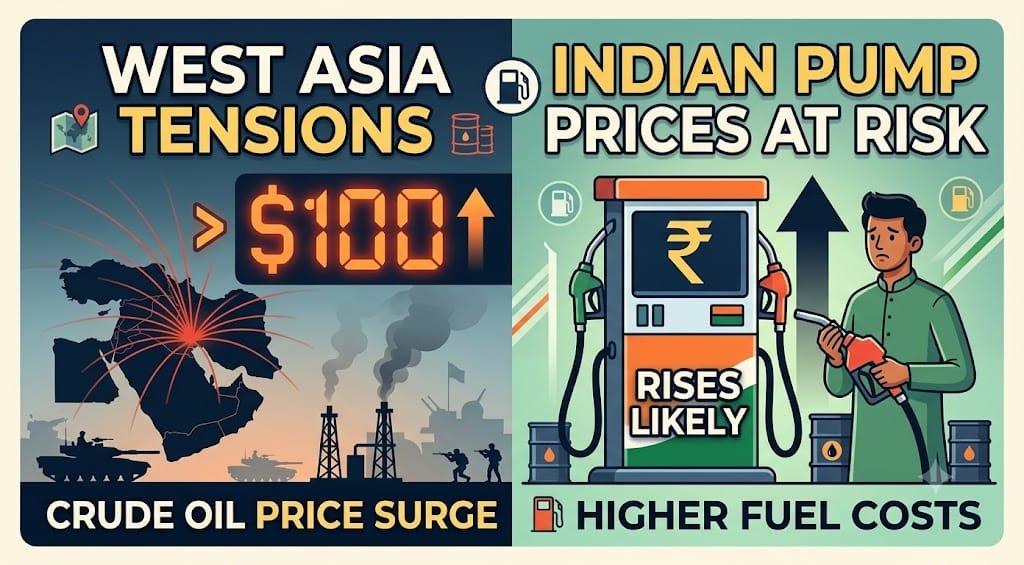
Global oil markets have once again entered a danger zone, with Brent crude crossing the psychologically important level of $100 per barrel. This jump comes after fresh escalation in the long-running West Asia conflict, which has raised fears of supply disruptions from one of the world’s most critical energy regions.
For India, which imports more than 85% of its crude oil needs, such a spike cannot be ignored for long. The immediate impact is already visible in the balance sheets of public sector fuel retailers, who are now selling petrol and diesel at a loss. According to industry analysts, these companies are losing about ₹5 on every litre of petrol and over ₹20 on every litre of diesel sold in the domestic market.
The situation has become particularly stressful because retail fuel prices in India have remained largely frozen for several months, even as international crude and refined product prices have climbed sharply. During this period, state-owned oil marketing companies Indian Oil, Bharat Petroleum, and Hindustan Petroleum absorbed much of the global price increase instead of passing it fully to consumers.
This decision was aimed at shielding households and businesses from sudden cost shocks, especially when inflation was already a concern. However, with crude sustaining levels above $100 and the West Asia crisis showing no signs of quick resolution, the financial strain on these companies has become too heavy to carry indefinitely.
Data from credit rating agency ICRA shows that at the average crude price for September so far, marketing margins on petrol have turned negative by ₹5 per litre, while diesel margins are negative by ₹23 per litre.
On top of this, domestic LPG cylinders are being sold at an under-recovery of around ₹200 per cylinder. These numbers mean that for every unit of fuel sold, the oil companies are effectively paying from their own pockets to keep prices stable.
Such a situation is not sustainable over the long term, and history suggests that once losses cross a certain threshold, price revisions become inevitable. The last time India saw a fuel price hike was in May 2026, when petrol and diesel were each raised by ₹3 per litre after four years of frozen rates.
The broader economic implications are also significant. A higher crude price directly increases India’s oil import bill, which in turn puts pressure on the trade deficit, the current account, and the value of the rupee.
Provisional data from the petroleum ministry shows that India’s net oil and gas import bill already surged by 43% in the April–July period of this financial year compared to the same period last year, largely due to elevated prices and supply tightness caused by the West Asia conflict.
If crude remains near or above $100 for an extended period, this import burden will only grow, potentially feeding into higher inflation across transport, logistics, and essential goods.
For the common person, the risk is that another round of petrol and diesel price hikes could be just around the corner. Even a modest increase of ₹2–3 per litre would be felt immediately at the pump and would also push up fares for buses, autos, and taxis, as well as the cost of vegetables and groceries that travel long distances by road.
The timing is especially sensitive because many households are still adjusting to earlier increases in cooking gas prices and general inflation. While the government and oil companies have tried to delay passing on the full burden, market realities often force a change in stance when global prices stay high for weeks.
At the same time, there is an effort to avoid panic. Oil companies have repeatedly assured the public that additional crude cargoes are being arranged and that supply chains remain functional despite the geopolitical tension. Statements from firms like Hindustan Petroleum have emphasized that there is no need for emergency stocking or panic buying, as arrangements are in place to maintain steady availability.
Still, the underlying message is clear: if global crude continues to trade above $100 and the West Asia situation does not calm down, the cushion that has protected Indian consumers so far will keep shrinking.
In this context, the next few weeks will be critical. Any further escalation in the region, especially around key shipping routes like the Strait of Hormuz, could push crude even higher and leave oil marketers with little choice but to revise pump prices again.
On the other hand, a de-escalation or a diplomatic breakthrough could ease supply fears and bring prices back below the $100 mark, giving some temporary relief. Until then, the Indian economy and its consumers remain exposed to the volatility of global oil markets, with the possibility of another fuel price hike hanging in the background.

