
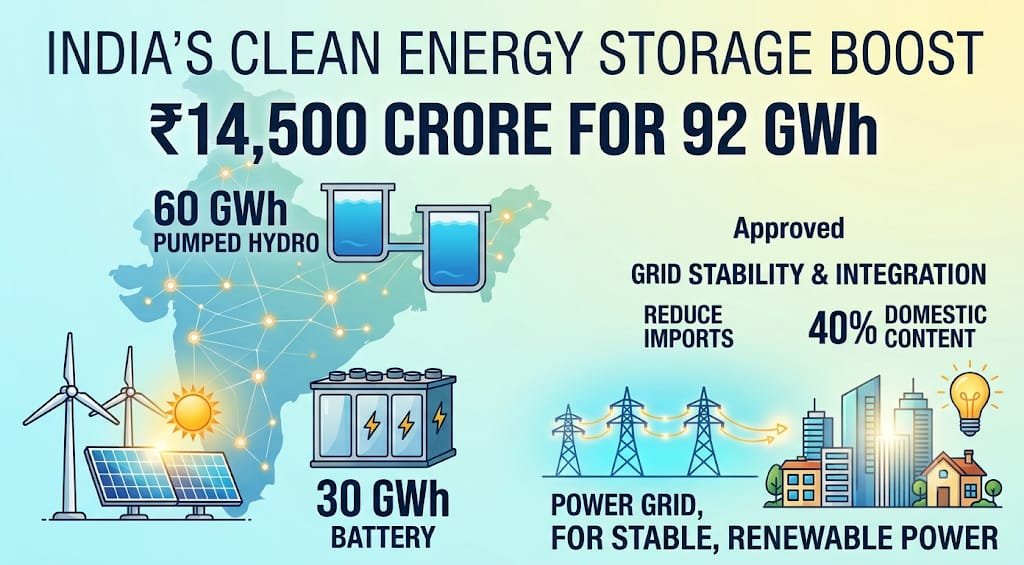
India has taken a major step towards making its electricity supply cleaner, more stable and more dependable. The Union Cabinet, chaired by Prime Minister Narendra Modi, has approved a Viability Gap Funding, or VGF, scheme worth ₹14,500 crore for the development of grid-scale energy storage systems. The support will be available from the financial year 2026-27 to 2030-31 and is expected to help create 92 GWh of new energy storage capacity across the country.
Energy storage is becoming as important as power generation because solar and wind electricity do not flow at the same level throughout the day. Solar power is abundant during daylight, while wind generation depends on weather conditions. Storage systems can save extra renewable electricity when production is high and release it later when demand rises. This helps avoid wastage of clean power and ensures that homes, factories, hospitals and businesses receive electricity even when the sun is not shining or the wind is slow.
Under the approved plan, India will develop 60 GWh of hydro pumped storage capacity, 30 GWh of battery energy storage system capacity and 2 GWh through alternative or emerging storage technologies. The total estimated investment in these projects is ₹97,600 crore. The government’s ₹14,500 crore support will improve the financial feasibility of these projects and encourage faster construction of large storage infrastructure.
Pumped storage projects work like a giant water-based battery. When there is surplus electricity, water is pumped from a lower reservoir to an upper one. When power is needed, the water flows back down and generates electricity. Battery energy storage systems, on the other hand, store electricity directly in large batteries and can respond quickly to changes in demand. The inclusion of alternative storage technologies also gives India room to test newer solutions that may become important in the future.
The new capacity will be allocated through tariff-based competitive bidding. This means companies will compete to offer storage services at the most competitive price, which can help keep costs reasonable for consumers. Public and private electricity distribution companies will be eligible for support for battery storage and pumped storage projects, while alternative technology projects can be developed by both public and private sector entities.
The scheme is also designed to strengthen Indian manufacturing. Battery energy storage projects will have to meet a minimum Domestic Content Requirement of 40 percent. In simple terms, a significant part of the battery storage system will need to be made within India. This condition is expected to encourage local factories, create industrial opportunities and reduce dependence on imported components. It also complements existing incentives for domestic battery manufacturing.
The government says the new 92 GWh capacity will be equivalent to 170 percent of India’s present grid-scale energy storage capacity. It will also help the country move towards the required grid-scale energy storage capacity of 411 GWh by 2031-32. This shows that the scheme is not just a short-term support measure but part of a longer plan to prepare the power system for a renewable-heavy future.
For ordinary consumers, the benefit may come in the form of fewer power disruptions, better evening supply and a more reliable electricity network. For industries, stable power can support manufacturing and reduce losses caused by outages. For the renewable energy sector, storage removes one of the biggest barriers to growth: the uncertainty of solar and wind generation.
The initiative is expected to improve grid stability, support large-scale renewable energy integration, promote domestic manufacturing and enhance India’s long-term energy security. By combining public funding, competitive bidding and local manufacturing requirements, the scheme aims to build a flexible and future-ready electricity system while advancing the goals of Atmanirbhar Bharat and Viksit Bharat.

