
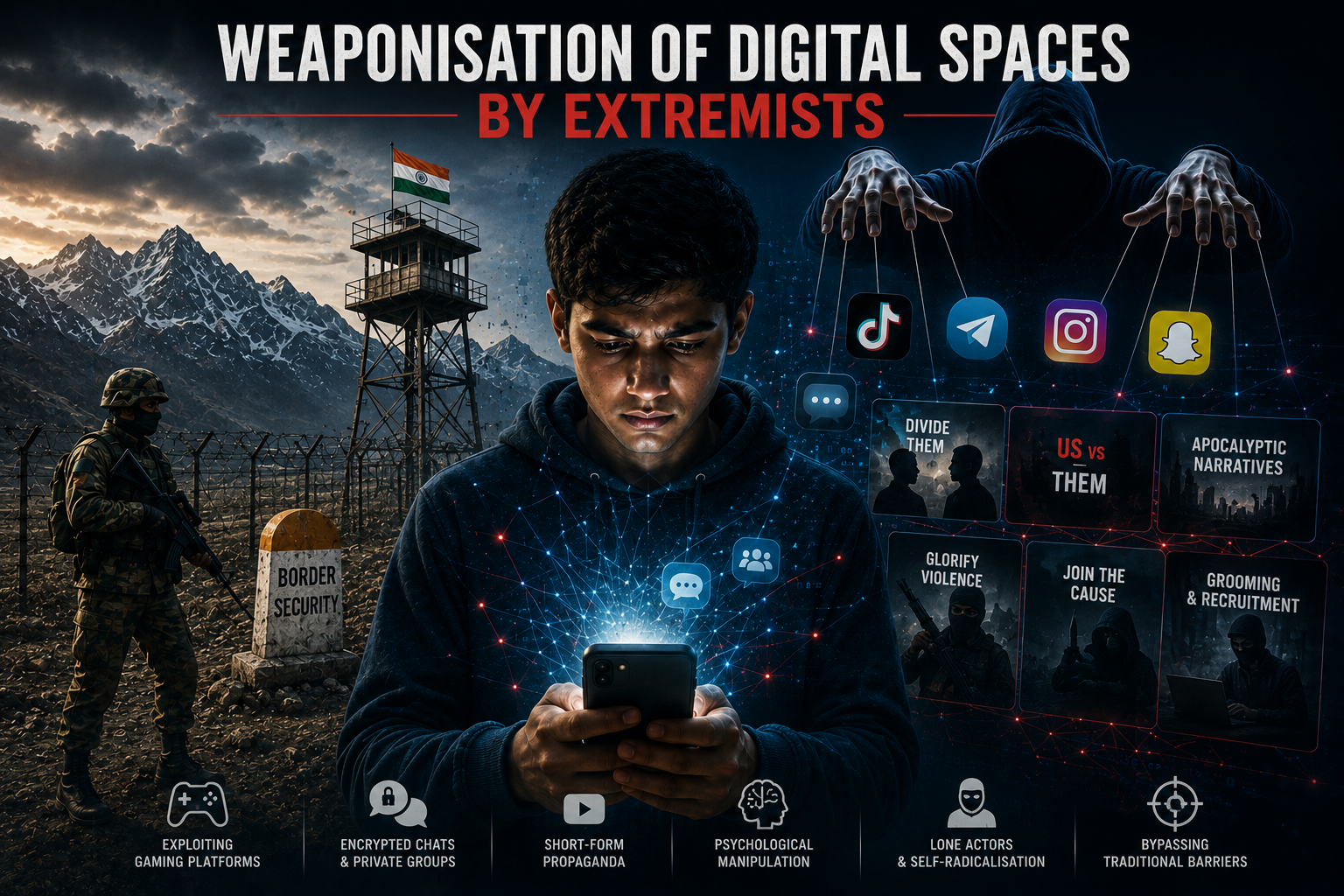
The conventional battlegrounds of national security were once definitively marked by jagged mountain peaks, heavily fortified borders and vast physical frontiers. For decades, the security apparatus concentrated its immense resources on defending territorial integrity against cross border infiltrations and physical militancy. Today, however, the most porous and vulnerable boundary lies within the glowing screens resting in the palms of our hands.
The architecture of terrorism has undergone a profound metamorphosis. It has evolved from a geographically confined militancy into a borderless, psychological contagion widely recognised as the Virtual Caliphate. Extremist organisations realise they no longer need to smuggle physical weapons across international boundaries to destabilise a nation. Instead, they can seamlessly and perpetually stream ideological ammunition directly into the minds of the vulnerable, bypassing conventional barriers with alarming ease.
For India, a nation characterised by its immense demographic dividend and rapid digital penetration, this invisible infiltration is a highly acute reality. This paradigm shift demands a radical recalibration of our internal security strategies from a strictly territorial focus to a comprehensive cognitive defence model.
The weaponisation of digital ecosystems
The transition from territorial extremism to a virtual dominion is deeply rooted in technological opportunism. Following significant territorial defeats globally, extremist networks have pivoted toward dominating the digital spaces where young people naturally congregate.
This strategy is exceptionally insidious because it bypasses traditional security cordons and enforcement radars. Recruiters are actively infiltrating popular online gaming platforms, including virtual worlds like Roblox, Minecraft, etc., using these unregulated spaces to build unmonitored relationships with impressionable adolescents.
Within these closed environments, extremists meticulously groom targets using gamified missions, private chat features and peer validation mechanisms. Furthermore, platforms like TikTok, Telegram and Snapchat are weaponised to disseminate short form propaganda, capitalising on algorithms to push emotionally charged content into the mainstream. They mimic native digital vernacular by employing ironic memes and highly edited music tracks to normalise militant violence.
Consequently, the smartphone ceases to be merely a tool for communication and entertainment. It transforms into an unguarded conduit for ideological indoctrination, delivering radicalisation directly into the sanctity of the family home. The speed of this digital recruitment is currently outpacing government responses, proving that technology drives modern extremist proliferation.
The apocalyptic blueprint
This digital infiltration is powered by a weaponised theology designed to resonate deeply with isolated individuals across the subcontinent. Historically, the Afghan jihad seeded localised militancy, which was largely confined to territorial disputes. Today, the narrative has shifted dramatically to align with global, apocalyptic jihadist frameworks. Central to this ideological warfare is the concept of Ghazwa-e-Hind, a prophesied end of times battle for the conquest of India. This narrative has been aggressively popularised by groups like Jaish-e-Muhammad, transforming regional grievances into a cosmic, existential struggle.
Alarmingly, intelligence agencies observed that Jaish-e-Muhammad and Al-Qaeda in the Indian Subcontinent are increasingly working in tandem. These distinct organisations now collaborate closely to radicalise Indian youth under the shared banner of Ghazwa-e-Hind, orchestrating a unified front that leverages the global branding of Al-Qaeda alongside the localised networks of Jaish-e-Muhammad as seen in the Haryana Al-Falah Module involving Ansar- Ghazwat-ul-Hind (an of shoot of Al-Qaeda) and Jaish-e-Muhammad.
The rise of white collar extremism and lone actors
The seductive power of this digital caliphate has shattered the obsolete assumption that extremism solely attracts the socioeconomically deprived. We are currently witnessing the terrifying rise of white collar terrorism, where educated urban professionals are drawn into the extremist web through digital radicalisation. The deadly November 2025 Red Fort car bombing in Delhi serves as a chilling testament to this evolution.
The subsequent investigation exposed a highly sophisticated terror module operating out of Al-Falah University in Faridabad. The perpetrators of this heinous act were not marginalised foot soldiers but established medical professionals. Doctor Umar-un-Nabi, the suicide bomber who drove the explosive laden vehicle, worked alongside figures like Doctor Muzammil Ganaie and Doctor Shaheen Shahid. Doctor Shahid was allegedly tasked by handlers in Pakistan to establish Jamaat-ul-Muminat, a dedicated women recruitment wing for Jaish-e-Muhammad. The direct involvement of highly educated doctors highlights how global jihadist ideologies can deeply penetrate affluent demographics, utilising professional legitimacy as a dangerous veil.
Simultaneously, this digital infrastructure cultivates self radicalised lone actors. The recent stabbing incident in the Mira Road area of Mumbai exemplifies this terrifying evolution. In April, Zaib Zubair Ansari, an educated former science teacher who studied in the United States, executed a premeditated attack on two security guards. Before attacking, he explicitly subjected his victims to a violent religious identity verification, demanding they recite the Kalima. Investigators recovered extensive notes referencing the Islamic State and a lone wolf operational ideology, confirming a trajectory of self radicalisation driven entirely by exposure to online ecosystems.
Reclaiming the cognitive frontier
As we navigate this perilous epoch of cognitive warfare, it becomes clear that our historical reliance on guarding physical territories must expand to include the rigorous defence of our digital and intellectual environments. The Virtual Caliphate does not seek to conquer physical landmasses. It seeks to colonise the human intellect. Defeating this invisible adversary demands an enlightened approach that perfectly matches the technological and theological sophistication of our enemies.
To effectively neutralise this evolving threat, our counter measures cannot rely solely on traditional kinetic force or military intervention. We must develop a robust theological counter narrative. The Ghazwa-e-Hind doctrine is based on a weak prophecy that has maliciously mutated into a potent political instrument.
As religious scholars note, it lacks authentic doctrinal authority. Notably, even researchers at Pakistani think tanks and scholars of Pakistani origin, such as Javed Ghamidi, have provided copious historical evidence to prove the absolute unreliability of the narrators listed in the chain of this specific tradition. To combat this distortion, the state must establish dedicated theological cells. These specialised bodies would collaborate with authentic religious scholars to systematically debunk extremist misinterpretations, providing evidence based education to inoculate the public against radical propaganda.
The quintessential defence of a sovereign nation begins long before a physical border is ever breached. It begins within the fragile, formative spaces of human consciousness. To preserve the hard won harmony and the fundamental integrity of our society, we must confidently reclaim the cognitive frontier, ensuring that the bright light of critical thought consistently outshines the encroaching shadows of ideological manipulation.
The author Ajmal Shah is an advocate practicing before the High Court of Jammu & Kashmir and Ladakh, at Srinagar.

