
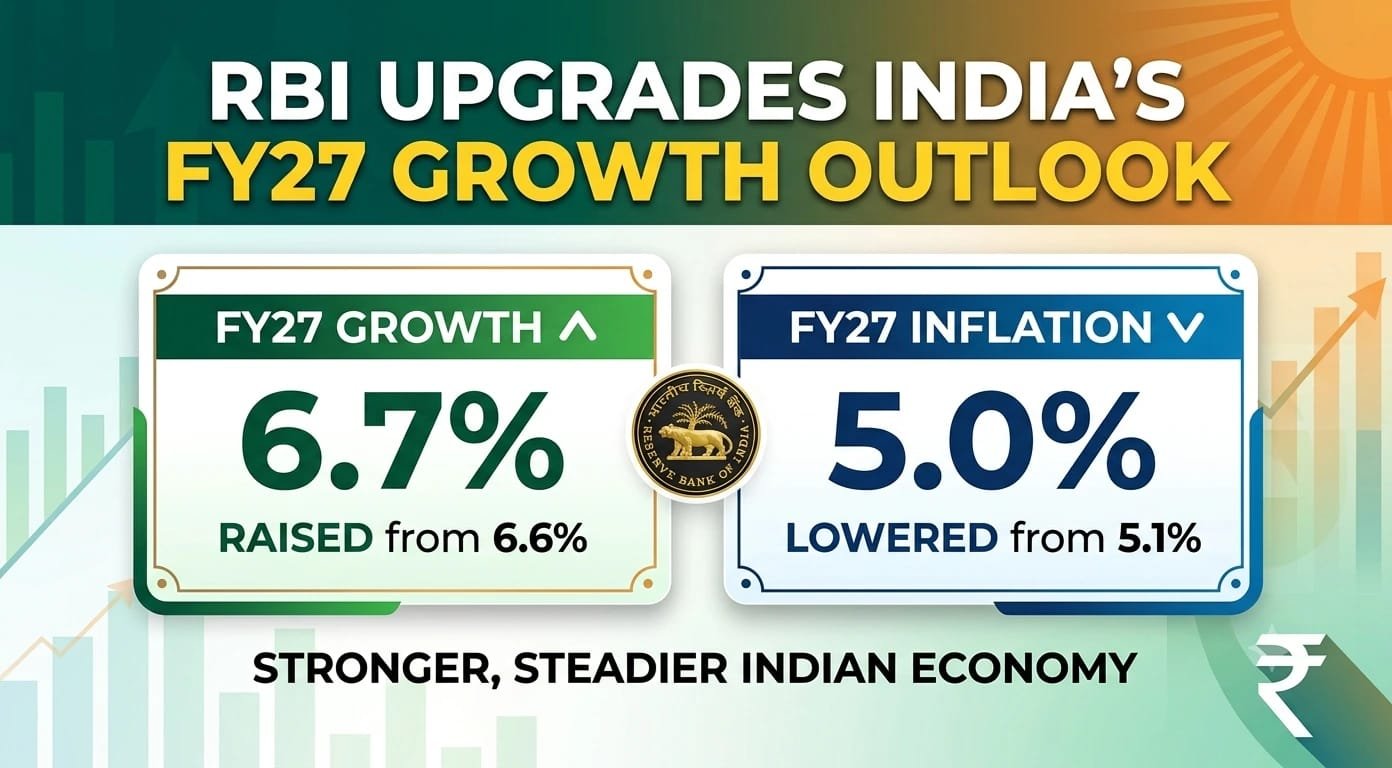
The Reserve Bank of India has struck an optimistic note on the domestic economy by raising the growth forecast for FY27 while trimming the inflation outlook. This announcement came after the Monetary Policy Committee meeting held between August 3 and August 5, where the repo rate was kept unchanged at 5.25 percent and a neutral policy stance was maintained.
Governor Sanjay Malhotra explained that resilient domestic demand, steady investment activity, and easing supply-side disruptions have strengthened macroeconomic conditions despite persistent global challenges.
Growth projection for financial year 2026-27 has been revised upward to 6.7 percent from an earlier estimate of 6.6 percent, marking a modest but meaningful improvement in outlook.
Quarterly figures show expected growth of 7 percent in the first quarter, moderating slightly to 6.4 percent in the second quarter, 6.5 percent in the third quarter, and rising again to 6.8 percent in the fourth quarter.
This pattern suggests confidence remains strong at the start of the year, with some softening expected later before recovery closer to year-end. Improved manufacturing activity, buoyant services, healthy discretionary consumption, government infrastructure spending, and expansion in exports have all been cited as reasons behind this healthier growth trajectory.
On inflation, the central bank has become noticeably more comfortable. Consumer Price Index inflation projection for FY27 has been lowered by ten basis points to 5 percent from the earlier estimate of 5.1 percent.
Quarter-wise, inflation is expected at 5.3 percent in the first quarter, easing to 4.7 percent in the second quarter, then rising again to 5.9 percent in the third quarter before settling at 5.5 percent in the fourth quarter. Core inflation, which excludes volatile food and fuel items, has been projected at 4.3 percent for the year, lower than earlier expectations, indicating that underlying price pressures away from food and energy remain fairly contained.
Even with this improved picture, caution has not disappeared from the central bank’s tone. Headline inflation is expected to rise further in the near term and peak during the third quarter, largely because of food and fuel price movements linked to seasonal patterns.
Underlying inflation is expected to moderate thereafter, but the outlook continues to face multiple uncertainties, including deficient or uneven monsoon conditions, geopolitical tensions arising from the West Asia conflict, and evolving global crude oil dynamics. Crude prices have shown sharp volatility recently, and renewed hostilities in the region since early July have added fresh unpredictability to energy markets and supply chains.
Diversification of supply chains, bilateral trade agreements, and market diversification strategies have also been highlighted as supportive factors helping India manage external headwinds better than before. At the same time, risks to both growth and inflation have been described as evenly balanced, meaning outcomes could shift in either direction depending on how global and domestic conditions evolve over the coming months.
A lower inflation projection generally brings relief because it suggests a smaller strain on daily budgets going forward. For businesses and investors, a stronger growth forecast signals continued opportunity for expansion, hiring, and investment planning.
The message emerging from this policy review appears fairly clear: the domestic economy is holding steady and even improving in several respects, but vigilance remains necessary given how quickly global energy prices, weather patterns, and geopolitical developments can alter the trajectory in either direction.

