
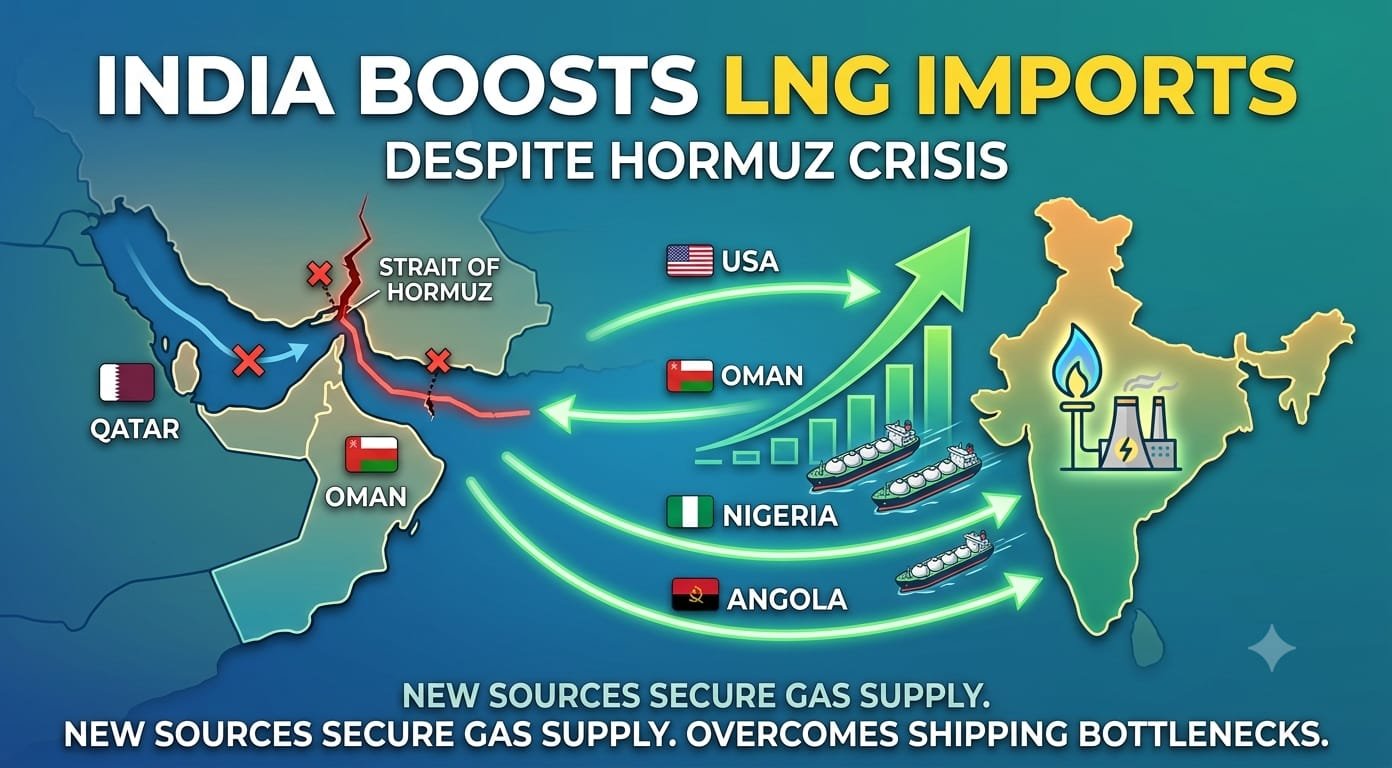
India’s liquefied natural gas imports went up in the May-July period even after the Strait of Hormuz crisis disturbed supply routes in West Asia. Ship-tracking data shows that India imported 7.08 million tonnes of LNG in these three months, which is 15.4% higher than the same period last year.
This rise came after a weak start to the conflict period. Imports fell in March and April, when the war in West Asia first affected shipping and cargo movement. The main reason was the sharp drop in LNG coming from Qatar, which is India’s biggest supplier and a country that usually sends cargoes through the Strait of Hormuz.
The simple idea behind the recovery is clear- when one route became difficult, India looked for other sources. Cargoes from the US, Oman, Nigeria and Angola helped fill the gap and kept the overall import number from falling further. This is important because LNG is used in many parts of daily life and industry, including city gas networks, fertiliser plants and other gas-based consumers.
The crisis also showed how closely India’s gas system is linked to the Gulf. A large share of India’s LNG imports normally passes through the Strait of Hormuz, so any tension in that region can quickly affect supply and prices. In earlier weeks of the conflict, reports had already shown that India was feeling pressure in its gas market, with cargoes delayed and some buyers facing supply limits.
What makes the latest data significant is that India managed to respond quickly. Instead of depending only on one or two suppliers, the market adjusted by bringing in gas from more distant and diversified sources. This kind of adjustment does not remove the risk completely, but it does reduce the shock when one region becomes unstable.
For households, this matters because LNG is part of the wider natural gas chain that supports cooking gas alternatives, piped gas, and industrial fuel. For factories, fertiliser makers and city gas companies, steady LNG supply helps avoid sudden cost spikes and production trouble.
In that sense, the rise in imports is not just a trade number, but a sign of how India is trying to protect energy supplies during a tense global period.
The larger lesson is about energy security. India cannot fully control international conflicts, but it can reduce risk by widening its supplier base, planning ahead and keeping import channels flexible. The latest figures suggest that this strategy is already helping, at least for now, by balancing the loss from Qatar with gains from the US, Oman, Nigeria and Angola.

