
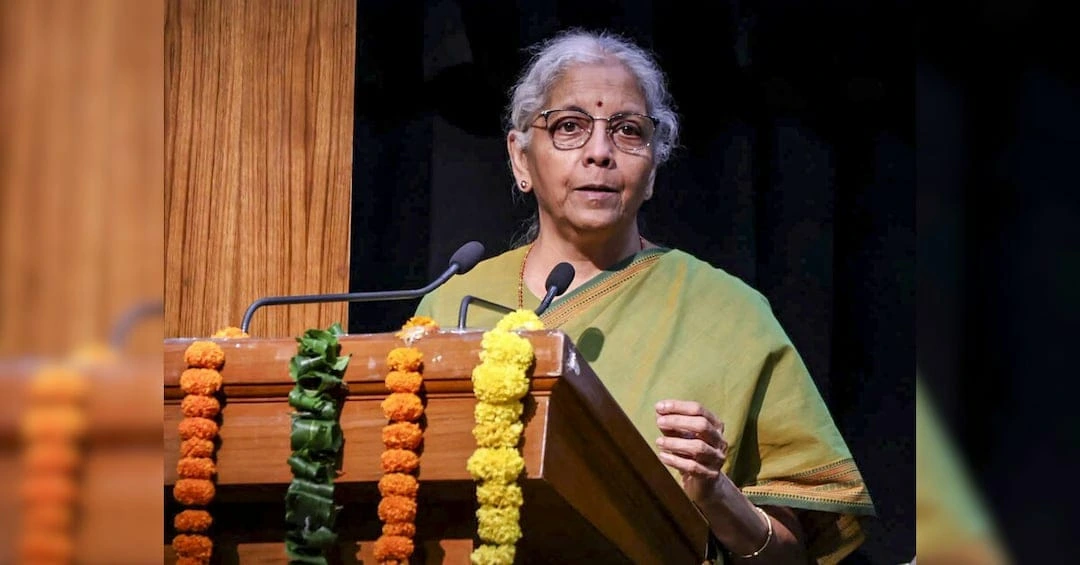
Union Finance Minister Nirmala Sitharaman has indicated that customs duty on most goods will be brought down to a single-digit rate by the Budget for 2027-28, marking a major step in the ongoing effort to simplify India’s trade and tax structure.
Speaking at the India Policy Forum organised by the National Council of Applied Economic Research in New Delhi, the minister explained that barring a handful of items, the rationalisation exercise would largely be complete by then.
At present, only about thirteen items remain outside this simplified structure, and the process of trimming duty slabs is steadily continuing. This move follows a broader pattern already seen in corporate tax, income tax and the Goods and Services Tax, where rates were rationalised in recent years, and customs duty is now the next major agenda item for reform.
It has been said in parliament earlier that such rationalisation exercises are aimed at easing compliance burden and improving predictability for trade and industry, a point that has been reiterated on this occasion as well
The statement carries weight because it reflects a long-term policy direction rather than a one-time announcement, signalling that trade costs for businesses importing goods are expected to ease gradually over the coming budgets.
Lower and fewer tariff slabs generally make it easier for industries to plan costs, reduce disputes over classification, and improve competitiveness for domestic manufacturing, which aligns with the government’s push to strengthen production-linked incentive schemes and industrial growth. Since fewer slabs also mean less complexity in compliance, smaller businesses and traders stand to benefit from a system that is easier to understand and follow.
Alongside the tariff discussion, the finance minister also spoke about borrowing and debt management, an issue that touches every citizen since government debt eventually affects public finances and services. It was noted that in the aftermath of the Covid-19 pandemic, government expenditure had to be ramped up using multiplier effects on the economy, and this trend of active public spending has continued into the last few years.
The minister explained that thinking carefully before deciding how much to borrow, when to borrow, and for what purpose money is borrowed remains central to sound fiscal management.
A recurring theme in the statement was the distinction between borrowing for consumption and borrowing for asset creation. It was emphasised that when money is borrowed with the intention of building durable assets rather than funding recurring expenses, the benefit extends both to the government and to the wider public, since such spending tends to bring long-term returns through infrastructure, employment and economic activity.
This approach, according to the minister, is already showing results, with private investment picking up as businesses gain confidence from the growth story India is experiencing, encouraging them to take risks and invest further.
State governments were also brought into the discussion, with the recommendation that state administrations should apply the same principle of borrowing to create assets rather than spending on short-term measures. Prudent debt handling by states was described as equally important as central government discipline, since infrastructure created through capital expenditure, such as schools and hospitals, tends to generate employment opportunities and economic benefits over many decades, sometimes extending fifty to sixty years into the future.
The finance minister avoided naming particular states while making this point, focusing instead on the general principle that borrowed resources ought to translate into productive capital rather than immediate consumption.
Taken together, the statement outlines two connected priorities for the coming fiscal years: simplifying customs duty into a leaner, single-digit structure and ensuring that any borrowing undertaken by central or state governments is directed toward building lasting economic capacity.
Both measures are intended to support ease of doing business, strengthen manufacturing, and keep public finances on a sustainable path as the economy continues its post-pandemic recovery and growth trajectory.

