
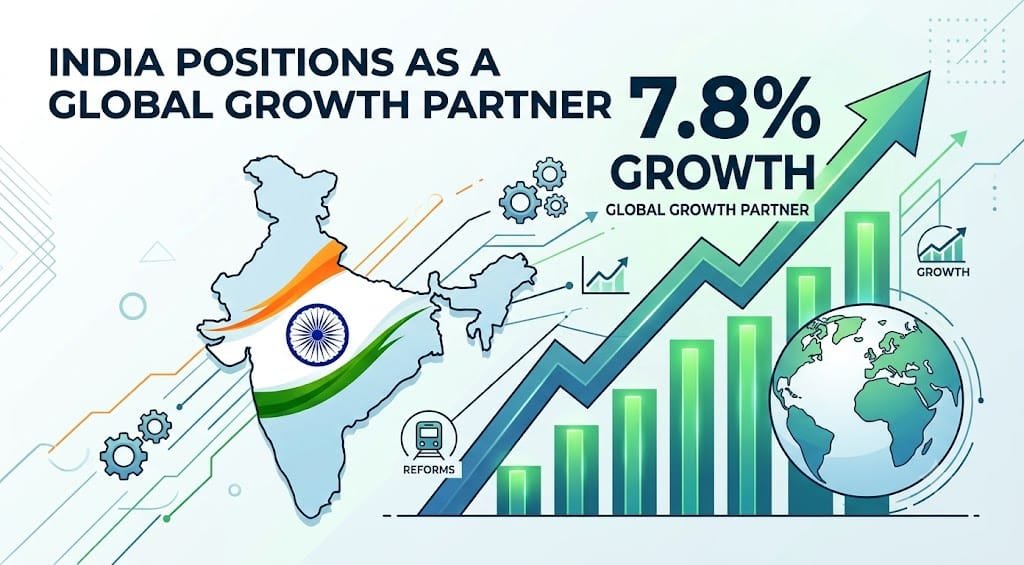
Prime Minister Narendra Modi has presented India as a dependable and steady partner for the world at a time when global trade, energy supplies, technology and payment systems are facing repeated disruptions.
Speaking at the Bloomberg New Economy Forum 2026 in New Delhi, he said India’s economic growth is not meant to come at the expense of other countries. Instead, India wants to grow along with the world and contribute to global progress. The Prime Minister described India as a “steady pillar” that can offer reliability and stability during a period of global uncertainty.
The statement comes at a time when India’s economy is showing strong momentum. According to the report, India recorded 7.8% growth in the April-June quarter. This performance has also encouraged major institutions to improve their outlook for the country.
The International Monetary Fund raised its GDP growth forecast for India to 7% for 2026-27, while the Reserve Bank of India projected growth at 7.1%. These numbers suggest that domestic demand and services activity continue to support the economy despite global challenges.
PM Modi explained that India’s confidence is at an unusually high level because the country’s economic foundation has become stronger over the years. He pointed out that India’s current account deficit, which was more than 4% of GDP about twelve to thirteen years ago, had fallen to around 0.61% last year.
He also said the country’s foreign exchange reserves have crossed $700 billion. According to him, the banking system is in its strongest position in several decades, and this strength has helped improve India’s sovereign ratings.
A major part of the Prime Minister’s message was that reforms in India are not being carried out only because of pressure or necessity. He said reforms are a matter of conviction for the government.
He referred to important changes such as the Goods and Services Tax, the insolvency law, the merger of 29 labour laws into four labour codes, and the decriminalisation of hundreds of minor business-related offences. He described these steps as part of an ongoing “Reform Express” that continues to move at high speed.
The Prime Minister also spoke about a deeper concern facing the world today: trust. He said things that once connected countries are increasingly being used as tools of pressure. Supply chains, energy, minerals, payment systems and technology are becoming instruments of dominance in some cases. Globalisation created routes for trade and cooperation, but many of those routes have now turned into chokepoints.
At the same time, artificial intelligence is changing every sector, while several countries are struggling with ageing populations. In such a situation, PM Modi said the world needs to ask whether supplies will continue during a crisis and whether promises made by partners will actually be fulfilled.
India’s answer, according to the Prime Minister, is to remain a reliable partner. He gave examples of affordable and generic medicines, digital identity systems, digital payments, skilled young people, and more than 2,000 global capability centres that serve companies across the world.
He said these are areas where the world looks towards India for practical solutions. His core message was that India does not want to keep its capabilities limited within its own borders; it wants to share them with the Global South and partner countries.
He also referred to India’s role during the Covid-19 pandemic. When vaccine manufacturing became crucial, India chose to supply vaccines to more than 100 countries. He said this showed India’s approach of using its strength to empower humanity rather than keeping benefits restricted to a few nations.
He linked this idea to the government’s wider philosophy of “power to empower,” saying that the purpose of authority should be to make citizens capable and self-reliant, not dependent on the system.
One of the most striking claims made by the Prime Minister was that India has lifted 250 million people out of poverty over the past decade. He said this number is larger than the population of many countries. The statement highlights the government’s view that economic growth becomes meaningful only when it improves everyday life for ordinary people.
Overall, the Prime Minister’s address combined economic data, policy achievements and a global vision. The message was clear: India wants to be seen not merely as a fast-growing economy, but as a stable, trustworthy and useful partner in a world dealing with conflict, supply-chain pressure and technological change.

