
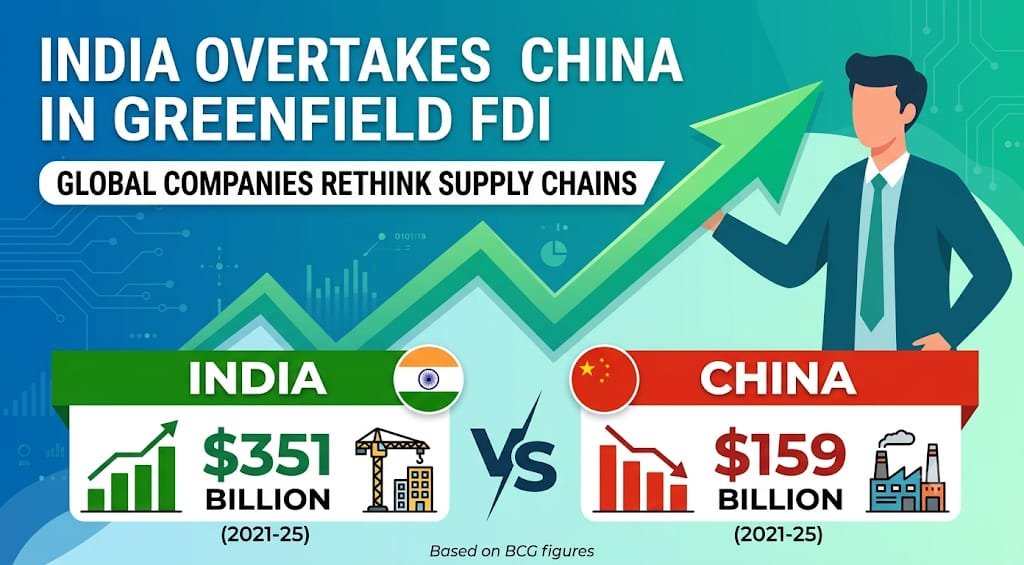
India has moved ahead of China in greenfield foreign direct investment, signalling a shift in where global companies are planning new business operations.
According to Boston Consulting Group data reported by The Economic Times, India attracted $351 billion during 2021–25, compared with China’s $159 billion. India’s total was more than twice China’s, highlighting its growing importance as companies look for additional production locations.
The comparison with 2016–20 shows how sharply investment patterns have changed. India’s figure increased from $222 billion to $351 billion, while China’s declined from $350 billion to $159 billion. The report describes these changes as a 61% rise and a 54% fall, respectively.
However, the published Indian figures calculate to around 58% growth, not 61%. That inconsistency needs clarification rather than presenting both numbers as an exact match.
Greenfield investment means establishing a new foreign business operation rather than buying an existing one. It can involve building factories or other facilities from the ground up. This makes it different from money invested in shares for short-term trading.
Still, the $351 billion figure should not be treated as money already spent on completed factories: reporting on the BCG comparison distinguishes new-project investment figures from actual expenditure and official annual FDI inflows.
The shift extends beyond India. The supplied BCG chart shows Malaysia’s investment rising from $62 billion to $140 billion and Indonesia’s from $99 billion to $133 billion. Vietnam’s figure fell from $131 billion to $115 billion.
The accompanying report describes Malaysia’s growth as 125%, Indonesia’s as 34% and Vietnam’s decline as 12%. Together, these figures show an uneven redistribution of investment across Asian economies, rather than an identical benefit for every country.
One reason is that multinational companies are reducing dependence on a single supply source. BCG managing director and senior partner Nikolaus Lang told The Economic Times that businesses are moving towards two or three sources instead of relying only on the cheapest supplier. India can benefit from this search for alternatives. The change does not necessarily mean abandoning China; it means spreading production and supply risks across more locations.
India’s large domestic market is another attraction. Lang identified the Indian market as the biggest draw for investors. A factory needs customers as well as affordable production. Strong local demand can help make a new operation commercially worthwhile, while infrastructure and cost competitiveness influence whether it can serve markets efficiently. Cheap assembly alone is therefore not the whole investment story.
Turning this opportunity into lasting manufacturing strength will require practical improvements. Lang stressed the need for workers trained in stamping, painting, assembly and mechatronics, which combines mechanical systems with electronics.
He also highlighted infrastructure, competitive costs and stronger demand. In everyday terms, investment needs people who can operate production lines, dependable systems for moving goods and enough customers to support output.
The figures mark an important opportunity, not proof of manufacturing dominance. Investment commitments must become operating facilities before their full benefits can be realised. Nor should new factories be described as impossible to close or relocate. India’s longer-term success will depend on converting investor interest into viable operations through the skills, infrastructure and market conditions highlighted by BCG.

