
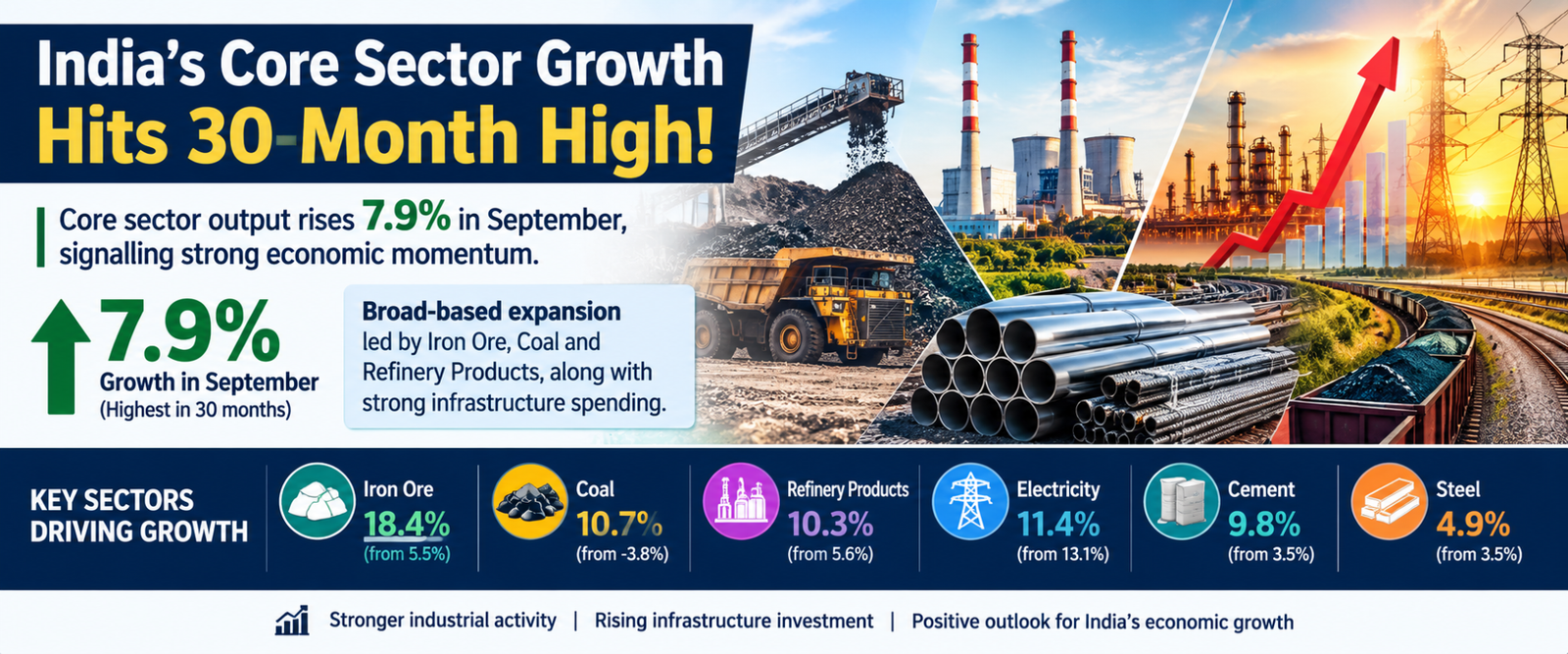
India’s core sector growth has hit a 30-Month High of 7.9% in September, signalling strong economic momentum for the country. Broad-based expansion in Infrastructure-Linked Industries, led by Iron Ore, Coal and Refinery Products, amply highlights the resilient Industrial activity and sustained Government capital expenditure.
India’s core infrastructure sector recorded its strongest growth in 30 months in September, expanding by 7.9 per cent year-on-year, signalling renewed momentum in industrial activity and strengthening the outlook for the country’s broader economic performance. The growth was the highest under the current data series, which uses 2022-23 as the base year, according to data released by the Ministry of Commerce and Industry.
The expansion marked a significant acceleration from the upwardly revised growth of 5.9 per cent in August, reflecting a broad-based improvement across key infrastructure-linked industries, including coal, iron ore, electricity, refinery products, cement and steel.
The eight core industries—coal, crude oil, natural gas, refinery products, fertilisers, steel, cement and electricity—account for approximately 40 per cent of the Index of Industrial Production (IIP), making their performance an important indicator of the health of India’s industrial economy.
Iron Ore, Coal and Refinery Products Drive Growth
Iron ore emerged as the fastest-growing core sector in September, with output surging 18.4 per cent, compared with 5.5 per cent in August. The sharp acceleration reflects strengthening demand and improving activity in infrastructure and industrial production.
Coal production growth rebounded to 10.7 per cent from a contraction of 3.8 per cent in August, marking its fastest expansion in 13 months. Refinery products, the second-heaviest component of the core index with a weighting of 22.6 per cent, grew 10.3 per cent, up from 5.6 per cent in August. This was the strongest reading under the new series.
Electricity generation, the index’s largest component with a weighting of 30.9 per cent, grew 11.4 per cent, moderating from an upwardly revised 13.1 per cent in August. A heatwave-driven increase in electricity demand contributed to the strong performance.
Cement production expanded 9.8 per cent, easing from 11.7 per cent in August but maintaining a robust pace. Steel output growth accelerated to a three-month high of 4.9 per cent from 3.5 per cent in the preceding month.
Other sectors also showed a mixed but improving picture. Crude oil production contracted 1.4 per cent, while natural gas output declined 4.6 per cent. Fertiliser production fell 11.7 per cent, although the contraction narrowed from 12.4 per cent in August.
Infrastructure Spending Provides a Strong Foundation
The September numbers underline the growing contribution of infrastructure investment and domestic demand to industrial expansion. According to Madan Sabnavis, chief economist at Bank of Baroda, government expenditure on infrastructure has supported activity across several core industries.
Road construction has boosted cement demand, while railway expenditure has supported demand for iron ore and steel. Strong electricity consumption has also contributed to industrial momentum.
Aditi Nayar, chief economist at ICRA, said the improvement was broad-based, with seven of the nine infrastructure-related sectors recording better performance in September than in August, barring electricity and cement.
Stronger Industrial Outlook for the Coming Months
Core sector output grew just 3.1 per cent in September last year. The acceleration to 7.9 per cent this September therefore represents a substantial improvement in the annual growth rate.
On a month-on-month basis, the overall index increased to 120.4 in September from 118.3 in August, a rise of 1.74 per cent. This followed a sequential decline of 1.74 per cent in August, indicating a clear improvement in industrial momentum.
For April-September 2026, core sector growth averaged 8 per cent, compared with 2.5 per cent in the corresponding period a year earlier. The improvement provides a stronger foundation for industrial production, with ICRA expecting IIP growth to moderate somewhat to 6.0-7.0 per cent in September 2026 from 8.0 per cent in August, partly because of a higher base.
Overall, the September performance reinforces the positive outlook for India’s infrastructure-led growth. Stronger production across major industrial segments, supported by public investment and resilient domestic demand, points to sustained economic activity even as weaknesses in crude oil, natural gas and fertilisers remain areas to watch.

