
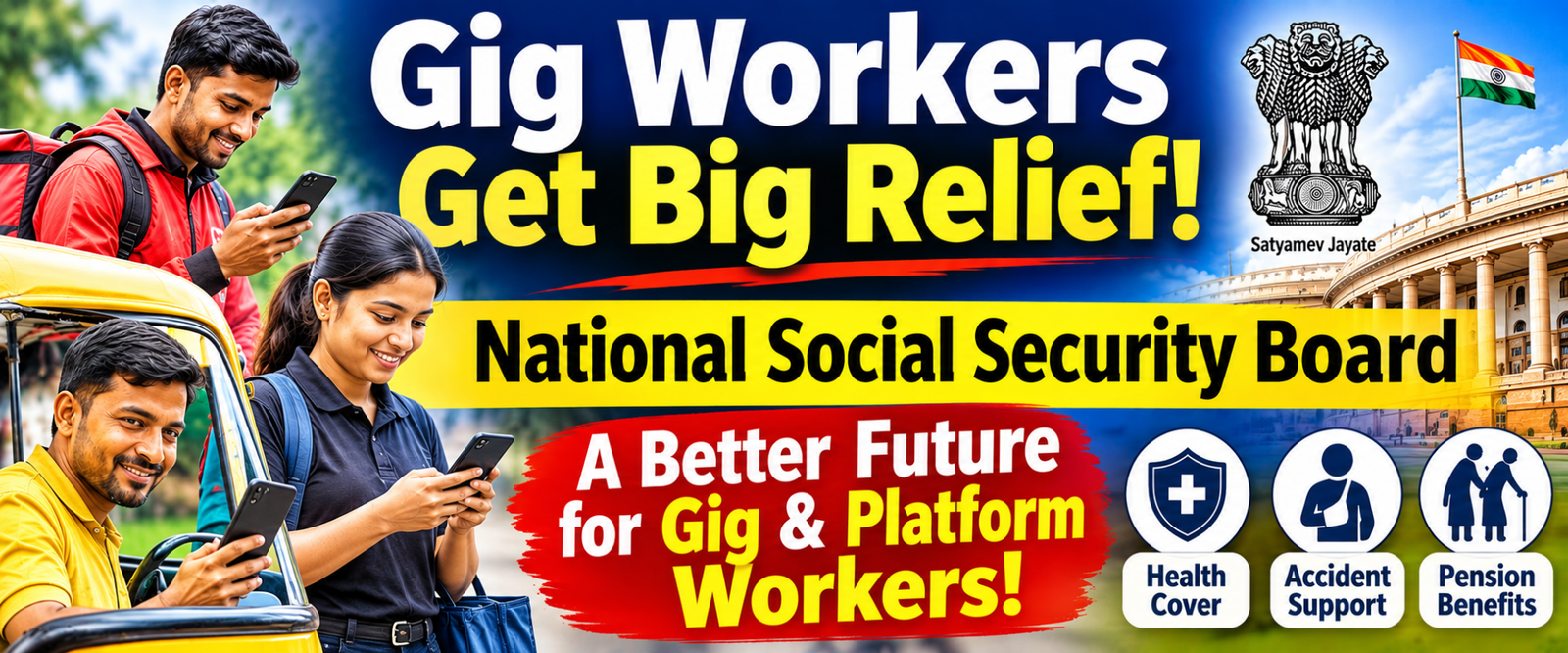
India has taken an important step to protect the people who make everyday digital life possible. The Central Government has constituted the National Social Security Board for Unorganised Workers and Gig and Platform Workers. This board will design, monitor, and recommend welfare schemes for delivery partners, cab drivers, app-based service providers, and other workers connected with digital platforms. The move aims to bring such workers into the country’s formal welfare system, so that they receive better protection during illness, accidents, old age, and other difficult situations.
The board has been created under the Code on Social Security, 2020. It will be chaired by the Union Minister for Labour and Employment. Its members will include representatives from the Central Government, State Governments, aggregator companies, employers, civil society organisations, workers’ unions, and gig and platform worker associations. This wide representation is important because gig work involves many parties: the worker, the platform, the government, and society. The board is expected to meet at least three times a year and will follow rules set by the Centre for conducting its work.
The main responsibility of the board is to suggest suitable welfare schemes for different categories of unorganised workers, gig workers, and platform workers. It will also advise the Central Government on matters related to the implementation of the Code on Social Security. In addition, the board will monitor welfare schemes run by the Centre, review record-keeping at the State level, examine expenditure from funds and accounts, and perform other duties assigned by the government. In simple terms, it will not only make recommendations but also keep a watch on whether welfare measures are actually reaching the workers.
This decision matters because gig and platform workers often do not have the same security as regular salaried employees. A food-delivery partner, a taxi driver working through an app, or a household-service provider may earn income every day, but may not have a fixed salary, paid leave, health insurance, pension, or compensation in case of an accident. When work depends on mobile applications, ratings, and demand, income can also change from month to month. Therefore, social security becomes essential for such workers and their families.
The size of this workforce shows why the step is significant. According to a NITI Aayog report on India’s gig economy, the country had about 77 lakh gig and platform workers during the 2020–21 baseline period. This was around 2.6 per cent of India’s non-agricultural workforce. Industry estimates suggest that the number could rise to 2.35 crore by 2029–30, driven by the growth of e-commerce, quick commerce, and digital logistics. As online shopping, food delivery, ride-hailing, and digital services expand, more people are joining this flexible but uncertain form of work.
The National Social Security Board was originally established under the Unorganised Workers’ Social Security Act, 2008. It was later included within the framework of the Code on Social Security, 2020. The latest notification gives the board a clearer and more direct role in protecting gig and platform workers. It represents a historic shift because digital workers, who were earlier outside the traditional employment structure, are now being recognised as an important part of India’s labour force.
This development also reflects the changing idea of the Indian state. Indian, which was long described as a welfare state, has moved beyond only providing welfare. Along with welfare, it has also become a development state, where the focus is not only on giving support to vulnerable groups but also on building digital infrastructure, expanding markets, creating jobs, and enabling new forms of work. The challenge now is to ensure that development reaches every worker with dignity, security, and opportunity.
For millions of gig and platform workers, this board can become a bridge between flexible work and formal protection. If its recommendations turn into practical schemes, workers may get better access to health cover, accident support, pension benefits, and other forms of assistance.
The success of the initiative will depend on timely implementation, proper funding, simple registration processes, and strong coordination between the Centre, States, platforms, and worker organisations. Still, the creation of the board is a meaningful beginning towards a more inclusive and secure future for India’s growing digital workforce.

