
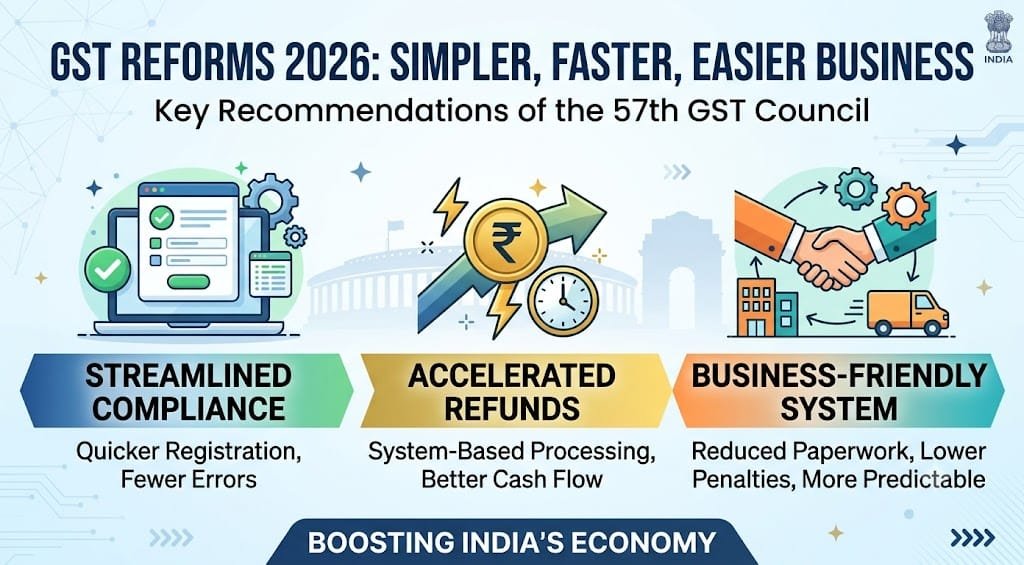
India’s Goods and Services Tax (GST), introduced on 1 July 2017, brought several central and state taxes under one common system, advancing the vision of “One Nation, One Tax.” Nearly nine years later, the government is focusing on next-generation GST reforms to simplify compliance, speed up refunds and improve ease of doing business.
The 57th GST Council meeting, held in October 2026, recommended changes covering registration, return filing, refunds, input tax credit (ITC), dispute resolution and e-commerce. The objective is to reduce paperwork, improve transparency and make taxation more predictable for businesses of all sizes.
The Council recommended a more user-friendly GST portal, simplified application forms, detailed documentation guidelines and FAQs to reduce errors and avoidable rejections. Automatic acceptance of routine registration amendments, except changes to the principal place of business, could further reduce delays.
Registration cancellation may also become easier once pending returns are filed and outstanding dues are cleared. In phases, automatic cancellation could reduce manual intervention and help businesses close or restructure more efficiently.
Small e-commerce sellers could benefit from simplified PAN-based registration for supplying goods outside their home state. Eligible sellers may use an e-commerce operator’s warehouse as their principal place of business without maintaining a separate physical office, subject to prescribed conditions, helping them expand into new markets.
The proposed reforms aim to improve consistency between GST returns, including GSTR-1 and GSTR-3B, and strengthen the reporting of tax liabilities and input tax credit. The Invoice Management System will allow buyers to accept, reject or keep supplier invoices pending. An electronic statement will also track credit reversals and subsequent claims, reducing mismatches and improving accuracy. The new correction mechanism is proposed from the April 2027 return period.
For exporters and businesses, system-based refund processing could unlock working capital faster. The first phase proposes automatic refunds of excess cash ledger balances and reducing the acknowledgement period from 15 days to 10 days. Eligible zero-rated supply and inverted duty structure claims may receive around 90% provisional refunds after risk assessment. Further automation could reduce officer intervention while retaining verification safeguards.
Input tax credit allows businesses to offset eligible taxes paid on goods and services used for operations. The Council recommended wider refund eligibility for accumulated ITC. Refunds of input services in inverted duty structure cases may be permitted from 1 November 2026, while specified capital-goods refunds may be introduced from 1 April 2027, spread over 60 months.
Proposed changes to certain ITC restrictions could reduce cascading taxes and improve cash flow. Export-related recommendations may also help Indian companies providing services through overseas branches qualify for export benefits, subject to prescribed conditions. These measures could strengthen India’s services exports and global competitiveness.
The recommendations seek to reduce disproportionate penalties and unnecessary litigation. Show-cause notices may not be issued for tax amounts below ₹10,000. The general maximum penalty could fall from ₹25,000 to ₹10,000, while reduced penalties may encourage timely payment of tax and interest.
E-way bill interceptions would require specific intelligence and appropriate authorisation. Restrictions on inspections outside relevant states and proposed safeguards against confiscation of goods in transit could reduce transportation delays and improve supply-chain efficiency.
Selected delivery services may attract 5% GST without ITC, while certain electric-vehicle transport services may receive a similar rate option with restricted credit. Exemptions have been proposed for specified seed storage, coffee-curing and helicopter transport services. Eligible late fees may also be waived for taxpayers with turnover up to ₹5 crore who file delayed returns by the prescribed month-end deadline.
Overall, these recommendations aim to make GST simpler, faster and more business-friendly. If implemented effectively, they could lower compliance costs, improve liquidity and support small sellers, manufacturers, exporters and service providers across India.

