
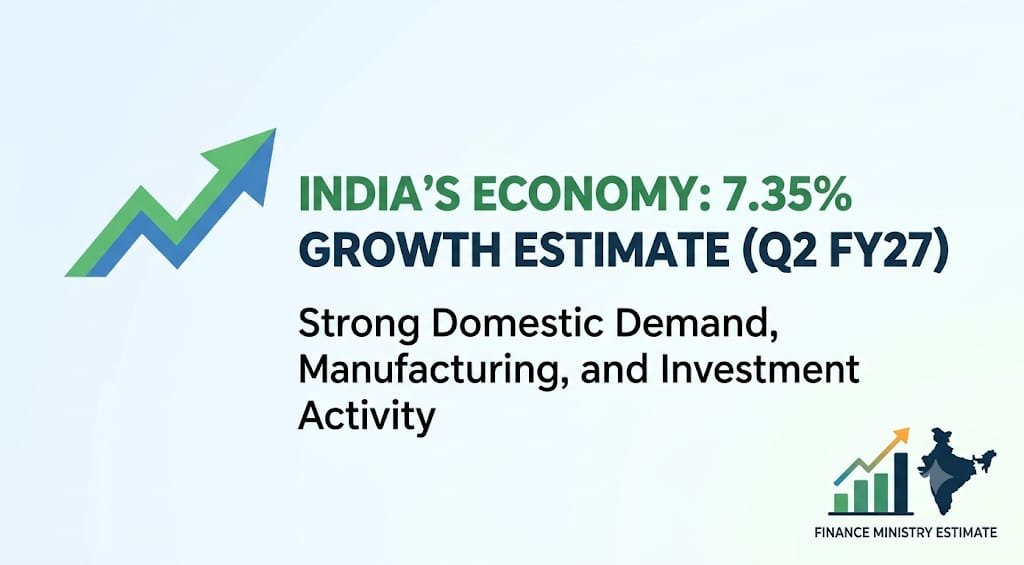
India’s economy is expected to grow at 7.35 percent during July to September, according to the Finance Ministry’s latest estimate for the second quarter of the financial year 2026-27.
This is a small improvement from the earlier estimate of 7.3 percent and comes after the economy recorded strong growth of 7.8 percent in April to June. The estimate suggests that India’s growth story remains strong even when many parts of the world are facing slower economic activity.
The Finance Ministry has also raised its growth forecast for the full financial year 2026-27 to 7.3 percent. Earlier, the Economic Survey had estimated growth between 6.8 percent and 7.2 percent.
This upward revision reflects confidence in India’s domestic demand, continued investment, strong financial system and better management of supply-side pressures. In simple words, people are spending, companies are investing, banks are lending, and the government is trying to keep essential supplies stable.
One of the main reasons behind this strong estimate is the improvement seen in high-frequency indicators. Industrial production, electricity consumption, port traffic, GST collections and automobile sales all grew faster in July-September than in the previous quarter.
These indicators are important because they give an early signal of economic activity before official GDP data is released. For example, higher GST collections generally mean more business transactions, while higher automobile sales show stronger consumer demand.
The manufacturing sector is also playing an important role in this growth. The Finance Ministry has noted that recent policy support, investment activity and company-level developments are helping India expand manufacturing, local production and technological capability.
The ministry believes that India will need to increase production scale, domestic value addition, supply-chain depth and export competitiveness to make manufacturing even stronger. This is important because a larger manufacturing base can create more jobs and reduce dependence on imports.
Global institutions have also become more positive about India’s economy. The International Monetary Fund has raised its growth forecast for India to 7 percent for FY27, up from 6.4 percent earlier, citing resilient domestic demand and strong services activity.
The Reserve Bank of India has also increased its GDP growth projection to 7.1 percent. These estimates show that India is expected to remain one of the fastest-growing major economies in the world.
However, the positive growth outlook does not mean there are no challenges. Crude oil prices remain high, and this can increase the cost of fuel, transport, raw materials and many everyday products.
The Finance Ministry has also flagged higher food inflation and uncertainty around the kharif crop. Household inflation rose to 5.54 percent in September from 4.83 percent in August, which means many families may already be feeling pressure on their monthly budgets.
The government is trying to control prices through supply-side measures. These include releasing onions through the Kanda Express, imposing stock limits on sugar dealers and cutting customs duty on crude edible oils.
Such steps are meant to improve the availability of essential kitchen items and reduce sudden price rises. The RBI has also taken measures to provide dollar liquidity to public-sector oil marketing companies and reduce currency speculation, which may help control imported inflation.
The official GDP number for July-September will be released by the Ministry of Statistics and Programme Implementation on November 30. Until then, the 7.35 percent figure remains an estimate based on the Department of Economic Affairs’ nowcasting model.
Still, the overall message is clear: India’s economy is moving with strong momentum, supported by consumption, investment, services and manufacturing, while policymakers must carefully manage inflation and global risks to keep this growth stable.

