
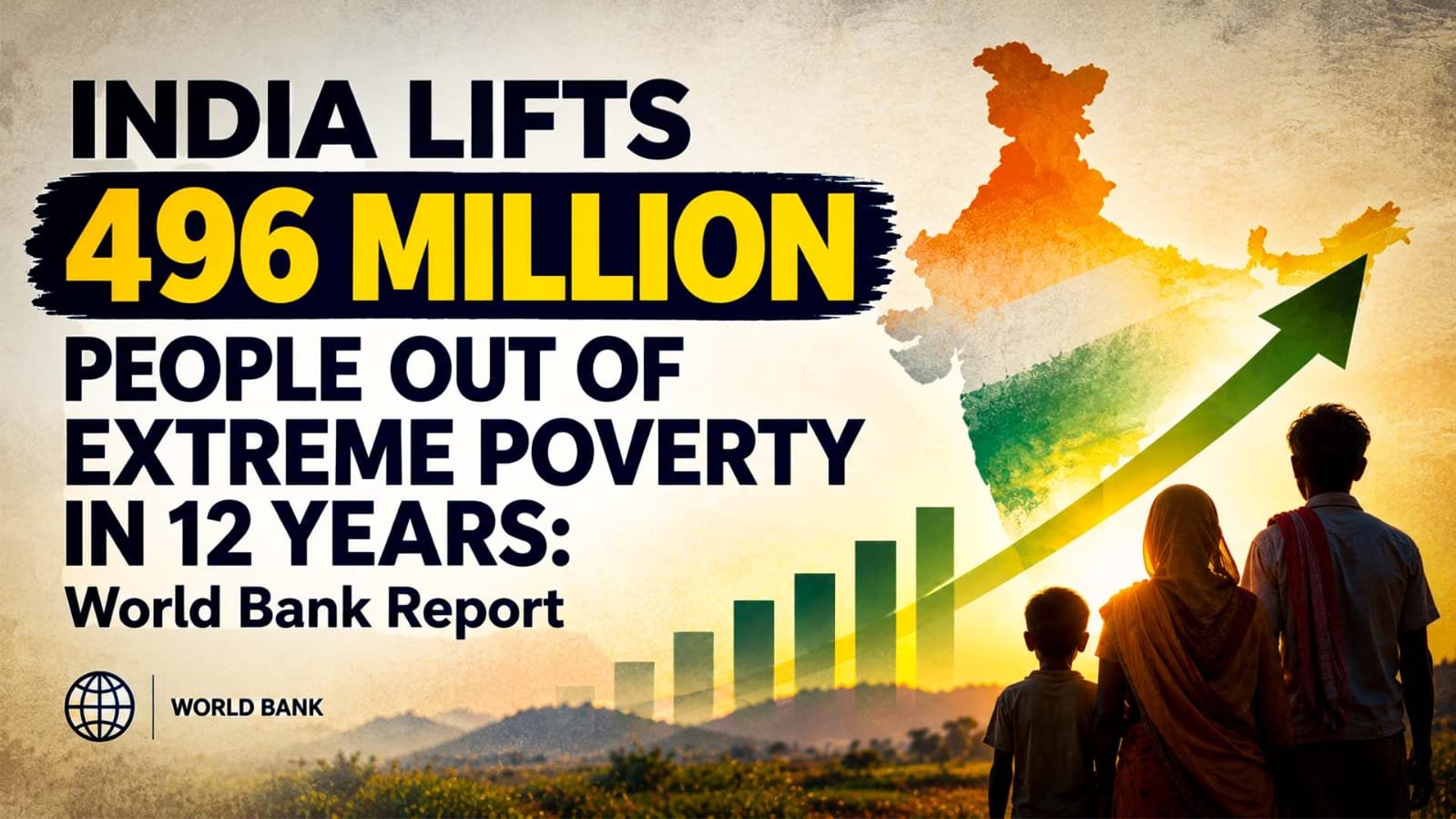
India has achieved one of the fastest reductions in poverty seen anywhere in the world, according to the World Bank’s October 2026 Poverty and Equity Brief. Between 2011 and 2023, an estimated 496 million people in India moved out of extreme poverty.
This means that a very large section of the population, which earlier struggled to meet even basic daily needs, is now living above the extreme poverty line. The report describes this as a major social and economic achievement for the country.
The most important number in the report is the fall in extreme poverty. In 2011, 27.1 per cent of India’s population lived in extreme poverty. By 2023, this share had come down to just 2.6 per cent.
In simple words, people who earlier could not afford basic food, clothing, shelter, and other essential needs have gradually moved towards a better standard of living. This change did not happen overnight; it reflects years of economic growth, higher household spending, and wider access to government support.
The improvement is also visible at a slightly higher poverty level. The World Bank measures poverty at $4.20 per day, adjusted for purchasing power in 2021. At this level, the share of Indians living in poverty fell from 57.7 per cent in 2011 to 16.1 per cent in 2023.
This shows that the progress was not limited to the poorest households alone. Many families that were earlier close to poverty have also improved their income and consumption levels.
According to the report, stronger consumption growth has been one of the main reasons behind this decline. When households earn more and spend more on food, education, health, housing, and daily necessities, their quality of life improves.
Rising employment has also played a major role. India added about 134 million people to its workforce between 2017 and 2023, which was nearly twice the increase in the working-age population. A large part of this growth came from rural women entering paid work, giving many families an additional source of income.
Government support has also helped vulnerable families. Expanded social transfers, especially food subsidies, have protected poor households from sudden price shocks and helped them maintain access to essential food items.
Such support becomes especially important during periods of inflation, job uncertainty, or economic disruption. The World Bank believes that these measures, along with employment growth, supported the sharp fall in poverty.
Poverty is not only about money. It also includes access to electricity, clean cooking fuel, safe drinking water, sanitation, education, and basic assets. India has made progress on these fronts as well.
The Multidimensional Poverty Index, prepared by the Oxford Poverty and Human Development Initiative, fell from 53.8 per cent in 2005-06 to 16.4 per cent in 2019-21. The World Bank’s own multidimensional poverty measure stood at 15.5 per cent in 2022-23. These numbers show that living conditions have improved beyond income alone.
The report expects poverty to decline further, though at a slower pace. It estimates that poverty at the $4.20-a-day level may fall from 14.2 per cent in 2026 to 12.1 per cent by 2028. However, these are indicative estimates based on simulations and may change as new labour-market and economic data become available.
The World Bank has also cautioned that some part of the recent improvement could be linked to changes in measurement, along with real gains in household welfare.
Challenges still remain. Around 57 per cent of India’s poor population is concentrated in a continuous geographical belt from Uttar Pradesh to West Bengal. Creating productive jobs in these states will be important to sustain the progress.
Youth unemployment has also risen slightly, from 14.6 per cent to 15.9 per cent between the first quarters of FY26 and FY27, with rural young women facing particular difficulty. Real earnings have remained broadly unchanged, and much of the new employment is in low-productivity work.
India’s poverty story is therefore one of remarkable progress, but not a completed journey. Millions have moved towards a more secure life, yet the next stage will depend on better-quality jobs, higher real incomes, stronger regional development, and continued support for vulnerable households.

