
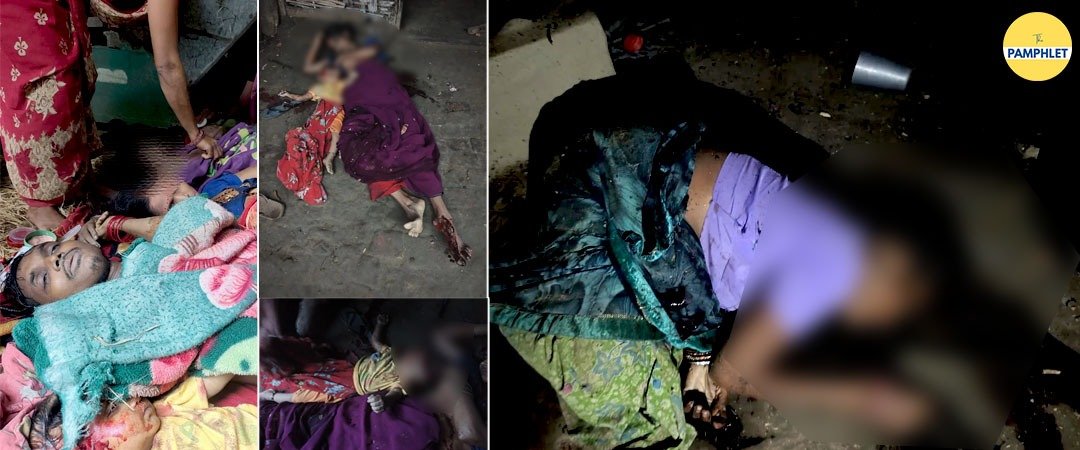
Very few know about atrocities against Hindus in Myanmar, a Southeast Asian nation that shares borders with India. A military-backed establishment has recently resorted to drone bombings and indiscriminate artillery shelling in Hindu-predominant towns, leading to a large number of reported deaths. The Hindus have been forced to flee and take shelter in temples.
Not just geography; India and Myanmar are also linked historically. Zeyawaddy and Kyauktga (Chauktaga) towns in Bago Region are home to large populations of Myanmar Hindus. They are mainly descendants of north indian communities who migrated and settled in Myanmar from Uttar Pradesh and Bihar, India, during the colonial period.
It all began with agricultural settlements. Around 1891, people from Bihar began arriving in the Zeyawaddy and Kyauktaga areas under British agricultural land development projects. They soon proved to be some of the best agriculturalists of the region. In1932, following the collapse of the global rice market, these farmers shifted from rice cultivation to sugarcane cultivation. This became successful and contributed to the development of the local economy, including the establishment and operation of sugar mills.
Although the Myanmar Hindu community has lived in the area for many generations, the community has faced the loss of basic human rights as a result of systematic discrimination under successive governments. Starting with restrictions on citizenship. Although many community members have established citizenship rights, they have not been issued citizenship verification cards or National Verification Cards and have instead been restricted to NVC documents, leaving them effectively in a stateless-like situation.
The Hindus also face loss of basic rights. The lack of citizenship cards has restricted access to higher education, formal healthcare services, freedom of movement, and other basic rights in daily life. They face socio-economic hardship. Restrictions and loss of employment opportunities and land ownership rights have created severe economic hardship and contributed to a cycle of poverty.
But in the past couple of years, the military-backed government in the country have systematically targeted Hindus. Since the beginning of 2024, mobile phone signals in Zeyawaddy and surrounding villages have reportedly been deliberately reduced. Internet access has also been completely cut off. As a result, local residents have been isolated from external information and communication, causing serious impacts on their social and economic lives.
Beginning on 10th August 2026, the forces has established military positions and launched blockade and attack operations in Semawtaw and Gahdugadh villages, located near Zeyawaddy and inhabited by Myanmar Hindu minority communities. Military has even blocked Myanmar Hindu residents from the villages of Laybinggyi, Thit To Chit Khin, Kywe Inn, Patawya, Yetaung Khin, Shan Su, Hasnapur, Gopalganj, Badaitola, Lyukhin, Girmyiti, Nawanagar (East), and Nawanagar (West) from travelling to Zeyawaddy. They have also prevented residents from leaving these villages, leaving them trapped within the affected areas.
The military-backed government’s “Four Cuts” strategy in Myanmar has shattered the faith of Hindus even as the military reportedly carry out daily drone bombings and indiscriminate artillery shelling against the above-mentioned isolated Hindu villages. These bombings have led to the killing of a large number of innocent Myanmar Hindu civilians. These atrocities are still to come to public glare across globe. Long-term internet shutdowns and the blockade of villages have also cut off communication with the outside world and severely restricted the flow of information.
As a result of military operations and air attacks by the military council, more than 1000 plus Hindu civilians have been forced to flee their homes and seek refuge. Many of these are currently taking shelter in the following religious and community buildings in Zeyawaddy and urgently require humanitarian assistance, which includes Mahatma Gandhi Prayer Hall, Sri Ram Janaki Temple, Shri Kali Temple and Shri Shiv Temple and Phyu Town in Zeyawaddy.
Known as a counter-insurgency doctrine, Myanmar’s “Four Cuts” strategy was initially intended to isolate armed resistance groups from the civilian population by cutting off four sources of support: food, funds, intelligence and recruits. But it has proved to be a tool to hurl atrocities on minority Hindus.
Significantly, Myanmar also has a connection to the Indian Independence Movement. Zeyawaddy played an important role in the history of the freedom struggle. Notably, Netaji Subhash Chandra Bose, the founder of the Indian National Army, personally visited Gahdugadh Village in Zeyawaddy, where he addressed INA soldiers and carried out military mobilisation activities. After India gained independence, former INA soldiers returned to Myanmar and continued to live and earn their livelihoods through agriculture and livestock farming.

