
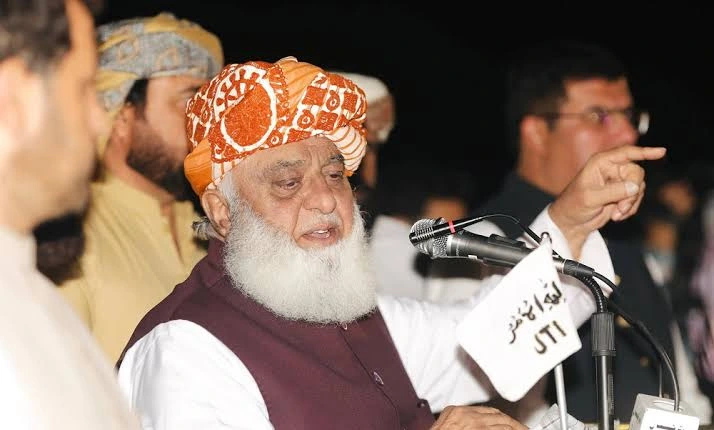
Maulana Fazlur Rehman, while holding a press conference after the meeting of the central Majlis-e-Shura of Jamiat Ulema-e-Islam (JUI) in Islamabad on Tuesday, rejected the imposition of Governor’s Rule in Khyber Pakhtunkhwa and declared the government’s justification baseless.
The chief of Jamiat Ulema-e-Islam, Maulana Fazlur Rehman, said on Tuesday that if the government has complaints against his party or any other party, then instead of making accusations, an in-camera session of Parliament should be convened and discussed, while the Prime Minister’s Advisor Rana Sanaullah has also offered to build consensus with the opposition on the issue of counter-terrorism.
Maulana Fazlur Rehman, while holding a press conference after the meeting of the central Majlis-e-Shura of JUI in Islamabad on Tuesday, rejected the imposition of Governor’s Rule in Khyber Pakhtunkhwa and declared the government’s justification as baseless.
He said that his party believes in political dialogue and all matters, including change of power, should be in accordance with the constitution instead of force. According to him, Governor’s Rule was imposed in the past as well, but the question is whether it was accepted?
Maulana Fazlur Rehman claimed that the merger of former FATA and the operations conducted there did not achieve the desired results. According to him, the purpose of these measures is to gain control over the minerals of Khyber Pakhtunkhwa. He clarified that JUI had also opposed the merger of FATA five years ago and their stance should not be linked to the narrative of any other party.
He said that he does not need to get certificates of patriotism from anyone and that love for the homeland should not be taught to him with a machine gun. He said that his life and madrassas are not safe.
On the other hand, Prime Minister’s Advisor Rana Sanaullah has said that the government is ready to build consensus with the opposition on measures against terrorism. He offered that if all political parties agree to sit together, Prime Minister Shehbaz Sharif can invite them and talk about resolving the issue of militancy and gaining national support for counter-terrorism operations.
According to Rana Sanaullah, in the context of increasing incidents of terrorism in Khyber Pakhtunkhwa, an attempt was made to seek cooperation from the provincial government, however, according to him, the desired cooperation was not received. He said that if the opposition’s attitude is cooperative, a national consensus against terrorism can be built.
The federal government has linked the move of Governor’s Rule in Khyber Pakhtunkhwa to the security situation and the non-cooperation of the provincial government, while opponents, including JUI, are expressing reservations over this decision.
Pakistan’s Prime Minister Shehbaz Sharif’s aide for political affairs Rana Sanaullah has said that the government is ready to build consensus with the opposition against terrorism to deal with the growing security challenges in the country and has invited all political parties for talks for this purpose.
Speaking in Parliament on Tuesday, Rana Sanaullah said that Prime Minister Shehbaz Sharif is ready to sit with all political parties to find a solution to the problem of terrorism and to discuss gaining the support of the entire nation for counter-terrorism operations.
His statement comes at a time when militant attacks have increased in Pakistan’s western provinces bordering Afghanistan. In recent months, Pakistan has seen a significant increase in militant violence, with most incidents occurring in the northwestern province of Khyber Pakhtunkhwa and the southwestern province of Baluchistan.
Islamabad has repeatedly blamed militant groups active in neighboring Afghanistan for these attacks, however, Kabul rejects these accusations.
Earlier this month, the federal government, citing a deteriorating security situation, removed the Pakistan Tehreek-e-Insaf (PTI)-led provincial government in Khyber Pakhtunkhwa and imposed a state of emergency in the province. The federal government had also accused the provincial leadership of not cooperating in national-level counter-terrorism efforts.
This move came after long-standing differences between Islamabad and the now-dismissed provincial government of former Prime Minister Imran Khan’s party PTI over security policy. The federal government’s position has been that a joint strategy is necessary to counter rising militancy.
Rana Sanaullah said in Parliament, “I offer them today that if all parties agree to sit together, Prime Minister Shehbaz Sharif is still ready to invite them and sit with them to find a solution to this issue (militancy) or to discuss how the entire nation can support these (counter-terrorism) operations. “Rana Sanaullah said, “When this is the attitude, I think this is not national service nor is it the right way to solve this problem.”
The President of Pakistan had imposed a state of emergency in Khyber Pakhtunkhwa on October 11 under Articles 232 and 234 of the Constitution. Article 232 relates to the declaration of a state of emergency in case of war or internal disturbance, while Article 234 gives the President the authority to impose a state of emergency in case of failure of the constitutional machinery in a province.
The federal government has blamed PTI for failing to control rising militancy in the province. However, PTI has rejected these allegations, calling the move ‘undemocratic. PTI said that this decision was made at a time when thousands of its workers were marching towards the capital to demand the release of their detained leader Imran Khan.
Meanwhile, Minister of State for Parliamentary Affairs Tariq Fazal Chaudhry also said on Tuesday that if the PTI provincial government had cooperated with the federal government in the war against militancy, there would have been no need to impose a state of emergency in the province.
Addressing a press conference, he said, “Our entire effort was to get the cooperation of the provincial government and to make it realize that they are fighting this war against terrorism and the entire province and Pakistan are being affected by it.”
Tariq Fazal Chaudhry said that peace in Pakistan and the future of its children depends on adopting a united stance on the issue of militancy. He said, “Today, once again, I invite all opposition parties to come forward and build a consensus against terrorism.”
By- Laiba yousafzai

