
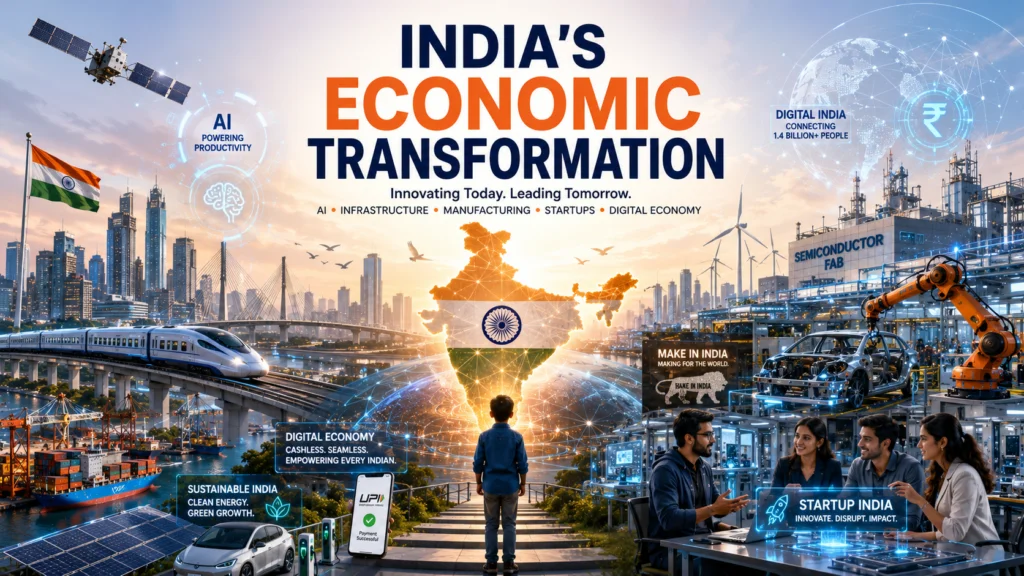
India’s economic transformation over the past decade needs to be understood against two simultaneous developments: the expansion of its domestic productive capabilities and the changing requirements of a global economy ever more shaped by geopolitical competition and rivalry. The country is no longer simply seeking markets for its goods or capital to finance infrastructure. It is positioning itself as a production base, technology partner and strategic economic participant in a world attempting to diversify supply chains and reduce excessive dependence on concentrated manufacturing networks.
A recent assessment of Narendra Modi’s 25 years in public life by The Economist questioned whether India had achieved the structural transformation necessary to become a major manufacturing economy. The arguments and comparisons made in the article were disingenuous. India is a genuine democracy with a federal system that’s completely different from China’s authoritarian CCP-led model. The Economist’s comparison between Gujarat and China’s Fujian province focused particularly on the limited movement of Indian workers out of agriculture. The underlying concern is legitimate, but the assessment misses a wider transformation involving infrastructure, technology, consumption, industrial capabilities and India’s growing international economic relationships.
India’s manufacturing share of GDP remains around 16%, and its transition towards labour-intensive industrialisation has been slower than that of several East Asian economies. Yet the Annual Survey of Industries for 2024–25 recorded manufacturing gross value added growth of 9.59%, employment growth of 7.19% and a workforce of approximately 2.10 crore in registered manufacturing. Gross fixed capital formation, at approximately 32% of GDP in 2024, also compares with 30% in South Korea, 29% in Vietnam and 28% in Japan. These indicators point to a substantial investment and production base, even though the employment-generating potential of manufacturing remains underdeveloped.
Electronics exemplifies India’s strategy and the emerging change. Production increased from ₹1.9 lakh crore in 2014–15 to ₹11.3 lakh crore in 2024–25, while exports expanded from ₹38,000 crore to ₹3.27 lakh crore. Mobile manufacturing has emerged as an important export activity, generating an estimated 25 lakh jobs over the decade. The next challenge is to move beyond assembly towards domestic components, semiconductors, design and higher-value manufacturing.
Employment data also require a more differentiated reading. The worker-population ratio for people aged 15 and above increased from 46.8% in 2017–18 to 58.2% in 2023–24, while unemployment declined from 6% to 3.2%, according to the Periodic Labour Force Survey. Female workforce participation has risen considerably. These figures do not resolve the problems of educated youth unemployment, informal work or low productivity, but they complicate the description of India’s growth as simply jobless.
The social foundations of this transformation are equally significant. The World Bank’s October 2026 India Poverty and Equity Brief estimates that the proportion of Indians living below the lower-middle-income poverty threshold of $4.20 per day, measured in 2021 purchasing-power parity, declined from 57.7% in 2011 to 16.1% in 2023. An estimated 496 million people moved above this threshold. The Bank attributes the improvement to consumption growth, increased employment, particularly among women, and expanded social transfers. This represents a considerable enlargement of the country’s economic base, although persistent rural poverty and stagnant real earnings remain concerns.
Infrastructure has provided another foundation. The expansion of highways, airports, railways and digital public infrastructure has reduced economic distances between markets and improved connectivity. UPI has transformed the scale and accessibility of digital transactions. These developments are not merely improvements in public services; they create conditions for greater productivity, formal economic participation and private investment.
The global investment context is also vital to consider. UNCTAD’s World Investment Report 2026 recorded global FDI growth of just 6% to $1.6 trillion in 2025. Investment in developed economies increased by 11%, compared with 2% in developing economies. Against this uneven recovery, India’s inflows rose 44% to approximately $39 billion. This does not minimise India’s difficulties in attracting and retaining capital, but its performance needs to be considered against a global environment characterised by geopolitical tensions, trade restrictions and investment concentration.
India’s expanding network of trade agreements is an important advantage. The agreements with the UAE, Australia, EFTA and the UK provide preferential access to substantial markets, while the agreements concluded or announced with the EU, Oman and New Zealand widen the country’s potential commercial reach. The UK agreement entered into force in July 2026. India’s exports to Australia increased from $4 billion in 2020–21 to approximately $7.3 billion in 2025–26, while merchandise exports to the UAE reached $37.4 billion. These arrangements create opportunities in textiles, pharmaceuticals, engineering goods, processed food, services and technology. More importantly, they signal India’s growing relevance as a trade partner capable of connecting multiple economic regions rather than depending on a single market.
The growing relationship with Japan complements this development. Cooperation now extends beyond infrastructure financing into semiconductors, critical minerals, telecommunications, naval engineering and defence technology. The July 2026 summit between Narendra Modi and Sanae Takaichi reinforced this agenda. For Japan, India offers an important production base and strategic partner in the Indo-Pacific; for India, Japanese technology, investment and industrial expertise can strengthen domestic capabilities and diversify supply chains.
The industrial capability growth dimension is also seen in the defence manufacturing sector. Production reached ₹1.78 lakh crore in FY2025–26, while exports rose to ₹38,424 crore, a 62.66% annual increase, admittedly boosted by electronics. Private manufacturers contributed approximately 45% of exports. Missiles, naval equipment, radar, ammunition and aerospace production are developing capabilities in electronics, precision engineering and advanced materials. India remains a major importer of sophisticated military systems, but the expansion of domestic production is creating a broader industrial ecosystem.
A particularly revealing illustration of India’s industrial relevance came with US Secretary of State Marco Rubio’s October 2026 visit to Reliance Industries’ Jamnagar complex. Discussions covered energy security, advanced manufacturing, new-energy facilities, data centres and opportunities for commercial cooperation. The visit was significant not simply because of the scale of the refinery, but because Jamnagar represents an integrated industrial capability with implications for global energy markets and international partnerships. India’s refining, engineering and energy infrastructure are now vital to the health of the wider global economy.
The comparison between Gujarat and Fujian, meanwhile, overlooks the institutional differences between the two development models. Gujarat operates within a federal democracy in which states compete for investment, negotiate political constraints and function within a plural institutional system. India’s states also operate within a system where opposition parties exist. Election agendas can upset economic calculations based on party ideology.
Fujian’s industrialisation took place within China’s highly centralised, state-directed, export economy. Comparing their per capita incomes without controlling for purchasing power, initial conditions and different development and socio-economic structures is inadequate. Gujarat’s real per capita income increased approximately fourfold between 2003–04 and 2024–25 at constant prices. The relevant question is not why Gujarat failed to become Fujian, but how India’s distinct political and economic institutions shape its development trajectory.
Yet, India’s industrial transition remains incomplete. Manufacturing must grow to generate more productive employment, domestic suppliers need greater technological depth, and investment conditions require further improvement. Yet the evidence points to an economy acquiring new capabilities across manufacturing, technology, defence, infrastructure and international trade. Its development is taking place through a noisy, contested and genuinely federal democratic system, rather than China’s centralised model. India has not replicated the East Asian industrialisation experience. It is building a different economic trajectory, whose significance will increasingly be measured by its capacity to connect domestic production with global trade, technology and strategic security.
(The author – Vivek Y. Kelkar is a researcher and analyst whose work explores global power shifts, trade transitions, and the intersection of geopolitics and corporate strategy.)

