
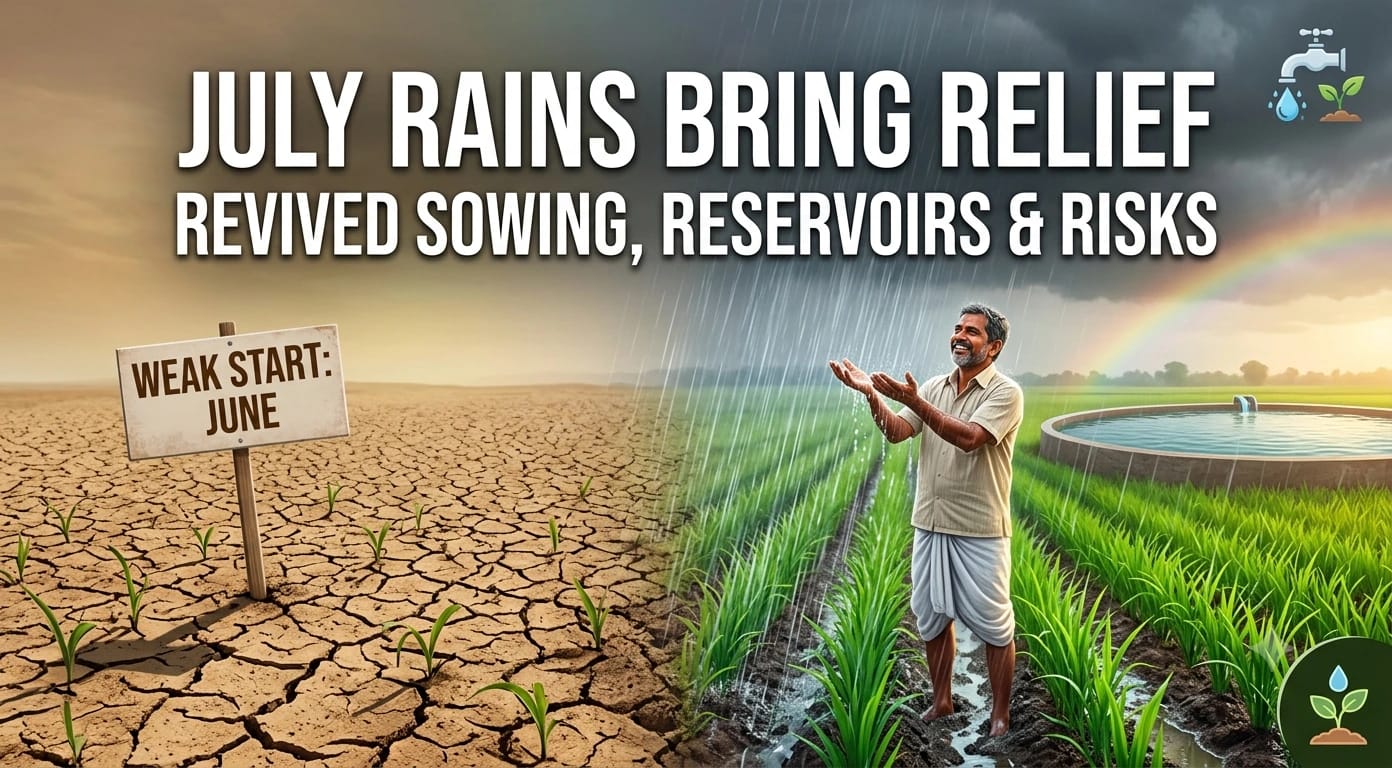
After a slow onset, July rains largely erased the early-season monsoon shortfall, improving sowing prospects and reservoir levels while exposing regional flood and water-management challenges.
The long-awaited rains returned in July and quickly changed the outlook for the agricultural season, with widespread showers narrowing the earlier seasonal shortfall and giving farmers a clearer window to resume kharif sowing.
The upswing was especially important because a slow start and below-average June rainfall had left many sowing plans delayed and reservoir levels under strain, raising concerns about crop choices and short-term water security.
By the first half of July, weather agencies reported that monsoon coverage had reached the farthest regions after a lag, and several central and coastal areas received copious rainfall that replenished local tanks and brought forward planting activity.
Government and state officials noted that the number of rainfall-deficient districts fell notably following these July spells, which directly helped farmers who had postponed sowing of paddy and other kharif crops.
Still, forecasters warned that the month’s improvement does not fully remove the season’s risk because longer-term forecasts expect overall rainfall to remain below long-period averages, influenced by the El Niño pattern.
The rainfall bounce had three practical effects for rural livelihoods and food production. First, surface-water storage and many local reservoirs registered meaningful increases after fresh inflows, easing immediate irrigation pressure in several basins and allowing agencies to resume planned water releases.
Second, the revived rains offered sowing windows for water-sensitive crops; extension advisories encouraged farmers to prioritise short-duration and less water-intensive options wherever planting was still behind schedule.
Third, the pattern of heavy localized showers also raised acute risks of flash floods, landslides and inundation in low-lying areas making disaster preparedness and rapid relief planning essential in vulnerable districts.
According to the IMD, the southwest monsoon has now covered the entire country, but the season still carries a mixed picture because the all-India cumulative rainfall from 1 June to 8 July 2026 remained 15 percent below normal, even though early July brought a strong revival in rain activity.
The IMD’s latest outlook also says rainfall activity is likely to weaken again over parts of central and south peninsular India in the next few days, so the improvement should be seen as a recovery phase, not a full end to concern.
In Maharashtra, the fear that was very strong about 20 to 25 days ago has clearly eased after heavy July rains, with key reservoirs such as Khadakwasla, Ujani and Jayakwadi rising sharply, while the state had earlier been under serious pressure when storage had dropped to 24.53 percent and drinking water supply had to be prioritised.
Gujarat has also improved meaningfully, with reservoir storage now around the 60 percent range and Sardar Sarovar near the mid-60s in recent reports, which shows that the state is no longer in the same level of worry it faced during the monsoon delay.
Madhya Pradesh, however, still looks relatively more fragile, with reservoir storage reported around the low-30 percent range in early July, so it still needs careful watching despite the broader July rainfall revival.
Despite the recovery, underlying vulnerabilities remain because seasonal totals are still forecast to be below long-period averages, which can affect overall crop yields, groundwater recharge and the need for conservation measures later in the season.
Meteorological authorities have signalled the possibility of another lull or break period where rainfall weakens over large regions; such breaks can widen deficits quickly, especially if reservoirs and soil moisture do not reach healthy levels before crop critical stages.
For producers and policy planners, this mix of improved short-term rains plus lingering seasonal risk calls for flexible measures: targeted input support where sowing is late, irrigation prioritisation for core cereal areas, and crop diversification advice for farmers in water-stressed districts.
At the household and community level, simple actions can reduce risk and capture the July gains. Farmers can check local reservoir and canal release schedules before sowing to avoid wasted seed, choose short-duration seeds when monsoon timing is uncertain, and adopt soil-moisture conservation practices to extend the benefit of each rainfall event.
Local administrations should maintain early-warning communication for heavy-rain events and keep relief teams ready in landslide- and flood-prone pockets.
In short, July’s rainfall revival delivered much-needed relief and created practical opportunities to recover lost sowing time while simultaneously reminding stakeholders that seasonal uncertainty persists.
Policymakers and farming communities should treat the improvement as a chance to accelerate adaptive steps, water-saving cropping choices, careful reservoir management and stronger local preparedness to convert this mid-season recovery into a resilient harvest period.

