
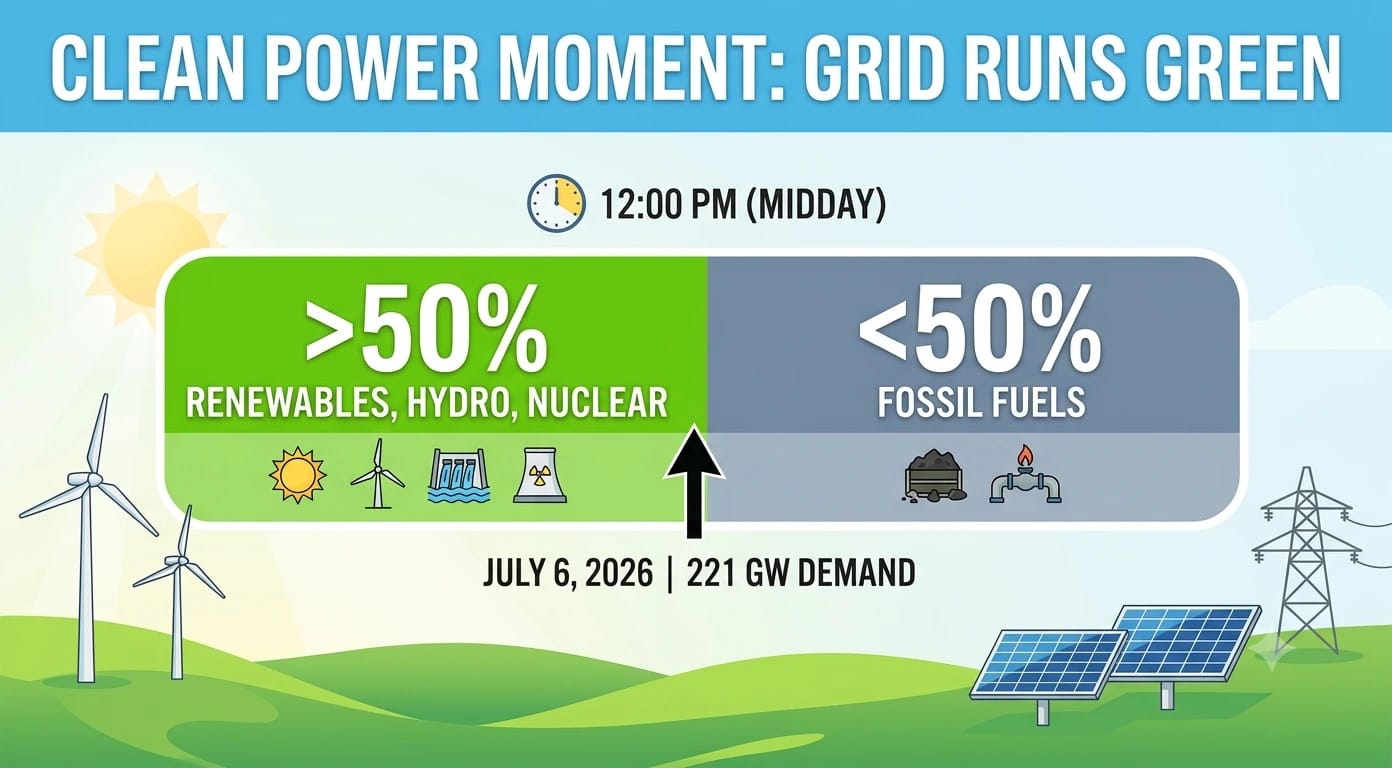
A notable milestone was observed on 6 July 2026 when, for a short period around late morning, the combined output of renewable, large-hydro and nuclear plants exceeded half of the electricity being generated while system demand reached 221 GW.
Data visualizations produced by energy analysts show a pronounced midday bulge in non‑fossil generation driven mainly by solar, with hydro and nuclear providing steady baseload support, together lifting the clean share above 50% before the evening ramp-up.
This event did not signal a permanent replacement of thermal generation but did provide a clear snapshot of how the grid behaves when solar production peaks and flexible hydro can be dialed up or down to balance supply.
The technical drivers behind the peak are straightforward: high solar output during clear midday hours raises instantaneous renewable generation sharply, while large hydro and nuclear continue to contribute fixed or slowly varying output that supports grid stability.
India’s renewable energy push also stands out in the global context of the Paris Agreement, where many developed and developing nations are struggling to meet their climate targets.
While several countries have fallen behind on emissions reduction goals or delayed transitions, India remains one of the few major economies that is broadly on track to meet, and in some areas even exceed, its commitments particularly in expanding non‑fossil fuel capacity and reducing emissions intensity.
This strengthens India’s position as a key player in the global clean energy transition and reinforces the credibility of its policy framework in renewable energy expansion.
On days when overall demand is around 221 GW, a strong solar contribution can push the non‑fossil share to unusually high levels; however, as sun sets and demand stays high, thermal (coal and gas) swiftly returns to cover the shortfall, especially during the evening peak.The result is a daily generation shape with a clear “hump” of clean energy in the middle of the day and higher fossil reliance in the late afternoon and night.
Economically and policy‑wise, the moment underscores the rapid expansion of installed clean capacity over recent years and the success of deployment programs that have brought large volumes of solar and wind online, often ahead of projected timelines.
Capacity additions have been particularly strong for solar, which accounted for the bulk of new capacity in recent reporting periods, and this increasing capacity changes the grid’s instantaneous mix even if average daily shares remain lower.
This transition also creates opportunities and challenges: lower marginal costs during high renewable output reduce short‑run generation costs, but maintaining reliability requires investments in flexibility storage, demand response, flexible hydro operation, and stronger grid management systems.
Operationally, the system operator’s ability to safely accommodate these rapid swings is crucial. Short windows when clean generation dominates test market signals, dispatch protocols, and reserve arrangements; they also offer practical lessons on how to sequence thermal unit ramping, deploy ancillary services, and use forecasting to reduce uncertainty. Experience from the observed peak highlights the importance of investments in forecasting and grid-scale storage to capture midday renewables for evening consumption, which would reduce the need to recommission coal units each evening and cut overall emissions.
The social and environmental meaning of the peak is simple yet powerful: when conditions align, more of everyday electricity can come from low‑emission sources, lowering the carbon intensity of the grid even if briefly.
This creates visible evidence of progress for stakeholders looking for tangible proof that the energy transition is underway, and it strengthens the case for policy measures that accelerate flexibility solutions and grid upgrades.
An illustrative comparison helps: a midday period when renewables dominate is like a rush of clean water filling a reservoir valuable while it lasts, but its benefits depend on storage and management to be available later when demand is still high. Without storage or demand shifts, that midday resource remains under‑utilized, and fossil plants must return to meet evening needs.
The recent clean‑power peak is not only a headline moment but also a practical prompt to act. Continued growth of renewables must be paired with strengthened transmission, smarter grid operations, targeted storage deployment, and market reforms that reward flexibility and quicker response. Together, these measures can convert intermittent midday surpluses into sustained emissions reductions and cost savings.
The brief period when over half of the electricity came from clean sources at a 221 GW demand level is a convincing preview of the grid’s trajectory showing both the potential and the limits of current infrastructure.
It highlights that ambition and capacity growth have brought the system to this threshold, while the next phase must focus on converting fleeting clean peaks into durable, system‑wide benefits through storage, flexibility and smarter operations.

