
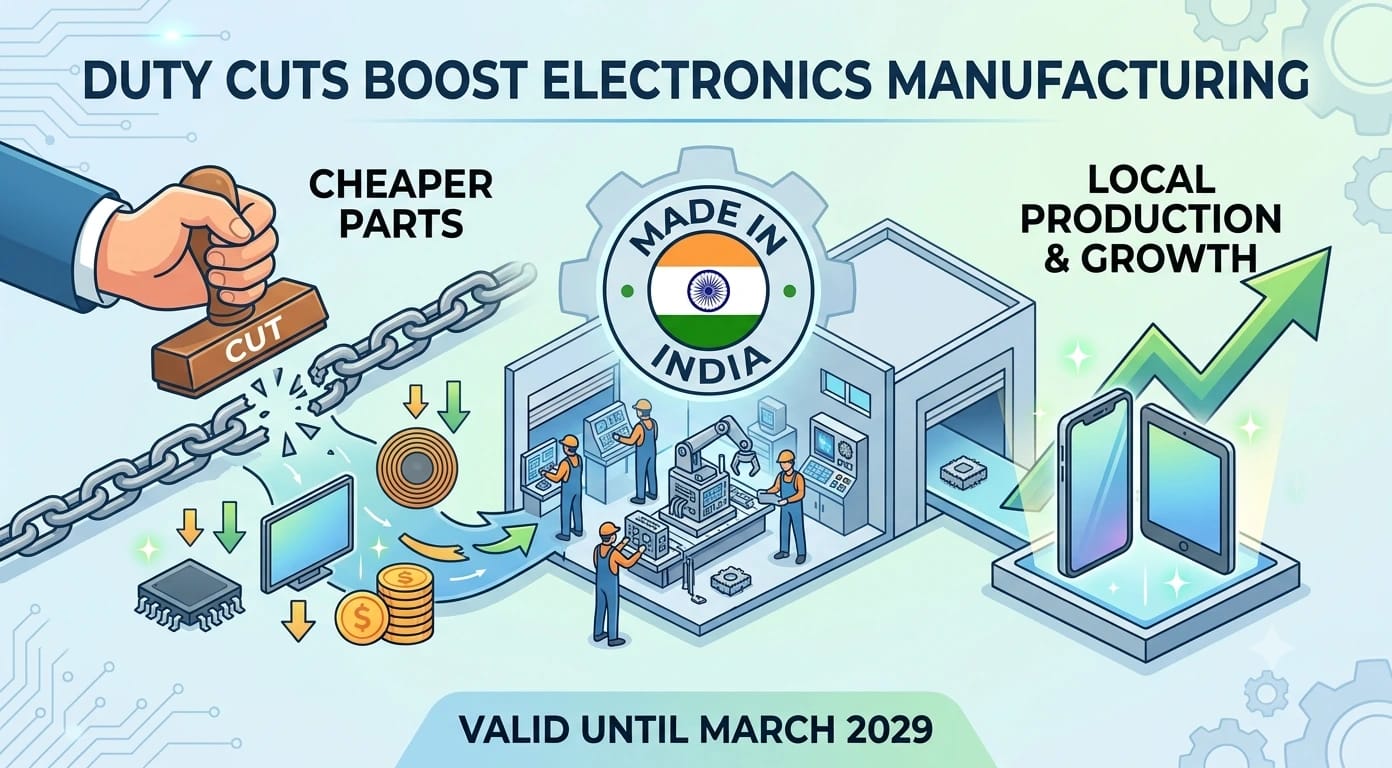
The government has taken another step to support electronics manufacturing by extending customs duty exemptions on several important parts used in making display modules, smartphone wireless charging systems, and lithium-ion batteries.
This relief will stay in force until March 31, 2029, and it begins immediately. In simple words, the aim is to make it easier and cheaper for companies to produce advanced electronic products locally instead of depending too much on imported finished items.
This move matters because electronics manufacturing uses many small but costly parts. The exempted items include display cells, backlight units, flexible printed circuit assemblies, frames, and anisotropic conductive film for display module production.
The relief also covers parts linked to wireless charging systems, such as NFC-related components, coils, nano-crystalline assemblies, E-shields, PET liners, PC shims, and NdFeB magnets. By reducing the tax burden on these inputs, the government wants manufacturers to save money and improve their margins.
A major point is that the benefit is not for every display product. The exemption does not apply to display assemblies used in mobile phones, televisions, smartwatches, smart meters, or interactive flat-panel displays.
This shows a clear policy choice: support the making of key parts and modules, but avoid giving the same relief to complete finished assemblies in every category. In very simple terms, the policy is designed to encourage more real manufacturing work inside the country rather than just assembly or import-based business.
The battery segment also gets a strong push. The revised notification expands concessional customs duty for lithium-ion battery machinery to 85 categories of equipment, covering almost the full production cycle from material mixing and coating to welding, testing, inspection, and packaging.
It also includes support systems like solvent recovery, heat recovery, dust collection, and effluent treatment equipment. This is important because battery production is a complex process, and lower machinery cost can help more companies set up plants and expand capacity.
For ordinary people, the effect may be seen over time in a few ways. If manufacturers spend less on parts and machinery, they may be able to produce more efficiently, increase investment, and possibly keep prices more stable in the long run.
The policy may also help create more jobs in factories, testing units, and supply chains tied to electronics production. For a simple example, when a company can import a key machine or component without extra duty, it can put that saved money into production, workers, or new lines of business.
Overall, this is a clear manufacturing-friendly move. It supports the broader goal of building a stronger electronics base, lowering import dependence, and making local production more competitive.
In plain language, the government is trying to make it easier for companies to build more of the electronic products people use every day, with fewer cost barriers and more room for investment.

