
A busy industrial month often begins in silence. Before the numbers appear, there is only the steady rhythm of machines, the glow of power lines, and the movement of raw materials from one stage to another.
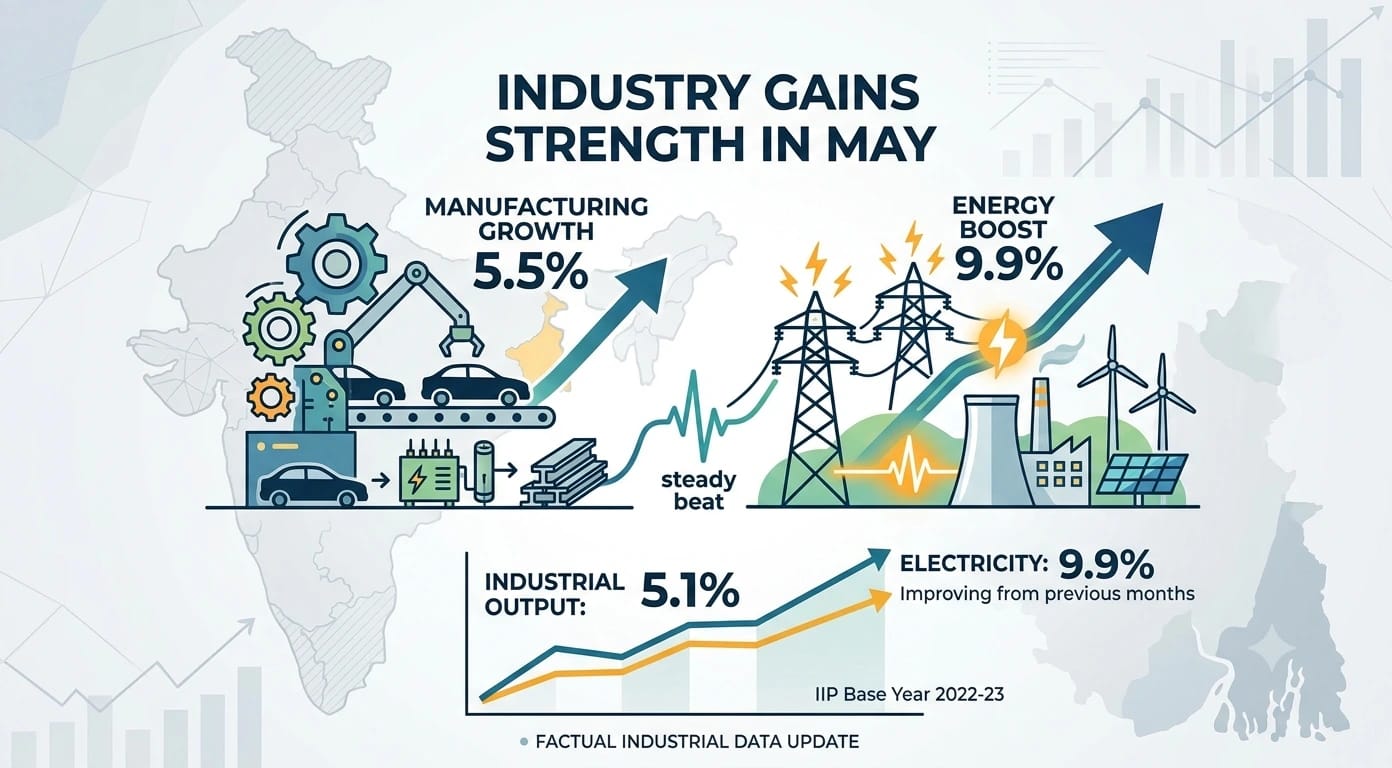
In May, that rhythm became stronger, and the result was a clearer pulse in the broader production story. Industrial output rose to a five-month high of 5.1 percent, improving from 4.9 percent in April, and the lift came mainly from manufacturing and electricity-related activity. This was not a sudden burst, but a careful climb, the kind that suggests confidence growing step by step rather than all at once.
At the center of this rise stood manufacturing, the largest part of industrial production. It grew 5.5 percent in May, even though the pace was a little softer than in April. That still mattered because manufacturing carries the heaviest weight in the index, so even a moderate rise there can move the overall picture in a meaningful way .
The change was visible across many factory groups, with 16 of the 23 industry groups posting growth during the month . This kind of spread matters because it shows that the improvement was not limited to one corner of the industrial world; it reached into several lines of production, from transport equipment to electrical goods .
Electricity and gas supply added another strong push. The sector grew 9.9 percent, a sharp gain from 4.6 percent in April . That strength reflected both higher demand and stronger supply support, especially at a time when heat and working activity increased the need for power.
Renewable generation also rose strongly, while non-renewable output expanded as well, showing that the energy system was carrying more load from both directions . In simple terms, more power meant more working capacity, and more working capacity allowed factories to stay active for longer and with greater consistency .
Not every part of the industrial story moved forward together. Mining and quarrying contracted by 1.6 percent in May, which showed that the climb was uneven and still had weak spots . Water supply, sewerage, and waste management did grow, but at a slower pace than before.
This mix of strength and softness gives the month a realistic feel. It was not a perfect rise, but a balanced one, where some sectors pulled ahead while others lagged behind. That uneven pattern is often how a real recovery looks before it becomes fully broad-based.
A closer look inside manufacturing reveals the kinds of goods that helped the month stand out. Motor vehicles, trailers and semi-trailers, electrical equipment, and basic metals were among the stronger performers.
These are not small names in the production chain; they are connected to transport, infrastructure, machines, and daily industrial needs. When these areas improve, the effect often spreads through suppliers, transporters, and related workspaces. The result is not only more output on paper, but also a more active industrial environment in daily life.
The measurement itself also changed. The new IIP series uses a 2022-23 base year and a revised method, including Output PPI as the deflator instead of WPI . That makes the reading more current and more aligned with present industrial patterns.
Such a shift is important because industrial data must follow the shape of the economy it measures. A better base does not simply change statistics; it helps capture the real mood of production with greater clarity.
In the end, May looked like a month where the industrial engine found a steadier beat. Manufacturing kept the main wheel turning, electricity gave it extra force, and weaker mining did not stop the overall climb.
The picture was simple but meaningful: when factories work with reliable power, the economy usually speaks in a firmer voice . This month’s rise suggested exactly that kind of voice: calm, grounded, and moving forward with purpose.

