
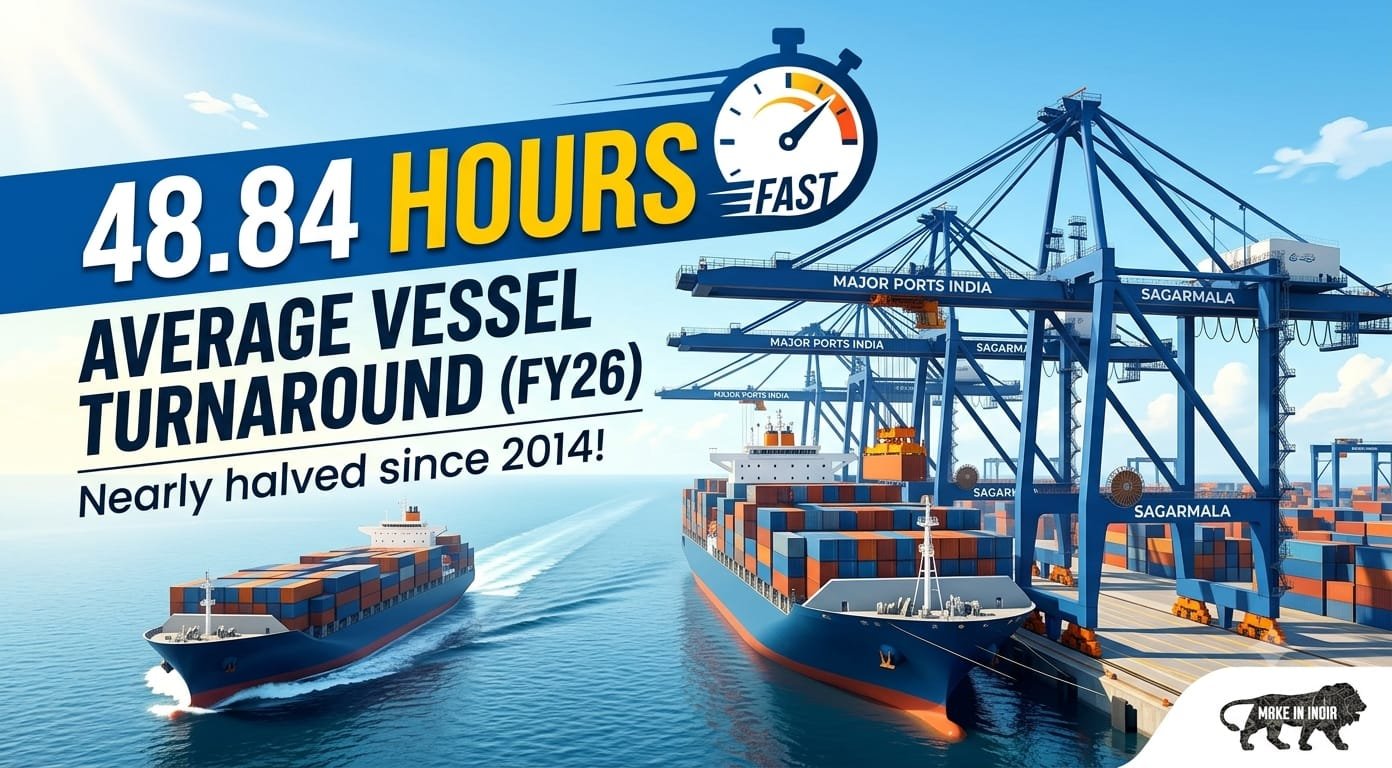
India’s ports have become noticeably faster over the past few years, and the numbers tell a clear story. The average time a ship spends from arrival to departure after finishing cargo work, called vessel turnaround time, has come down to 48.84 hours in the financial year 2025–26, compared with 52.87 hours in 2021–22.
This may look like a small change on paper, but in the world of shipping, even a few saved hours mean lower costs, less waiting, and more cargo moving through the system. The improvement also fits into a larger trend: In 2014, the same average stood around 96 hours, so the time has almost halved in little over a decade.
The reason this matters is simple. Ships are expensive to keep waiting. Every extra hour at port adds to fuel costs, charter charges, and delays in the supply chain. When ports clear ships faster, exporters get their goods out sooner, importers receive raw materials quicker, and the overall cost of doing business comes down.
This is especially important for a country where about 95 percent of merchandise exports by volume and a large share by value move through the sea route. Faster ports, therefore, touch not only big companies but also small traders, farmers sending produce out, and consumers who depend on imported goods.
Behind the drop in turnaround time is a mix of physical upgrades and process changes. New berths and terminals have been built to handle more ships at once. Existing berths and yards have been mechanised with better cranes, conveyors, and storage systems so that loading and unloading happen faster. Supporting infrastructure, such as central parking plazas for trucks, has reduced crowding near the docks.
At the same time, digital tools now guide berth allocation, cargo documentation, and gate entry, cutting down paperwork and idle time. All these steps together mean that a ship does not wait long to get a spot, and once it is at the berth, work proceeds without long breaks.
A key policy push behind these gains is the Sagarmala programme, which links port-led development with better roads, rails, and inland waterways. Under this umbrella, hundreds of projects have been completed to deepen channels, add capacity, and improve connectivity to the hinterland.
Alongside this, the One Nation One Port Process has standardised procedures across major ports, so that a trader or shipping line faces similar rules and forms whether the ship calls at Kandla, Chennai, Visakhapatnam, or Kolkata. Standardisation reduces confusion, speeds up approvals, and makes it easier to compare performance across ports.
The data also shows that the pace of improvement has not been perfectly smooth every year. After falling to about 48.06 hours in 2023–24, the average nudged up slightly to 49.47 hours in 2024–25 before settling at 48.84 hours in 2025–26. Such small swings can happen when cargo volumes surge, when global disruptions reroute more ships to Indian ports, or when specific ports face temporary bottlenecks. Even so, the overall direction over the decade remains strongly positive, with the average time almost halved from the 2013–14 level of 93.59 hours.
Port-wise figures reveal that some ports are already well below the national average. Jawaharlal Nehru Port, for instance, has been hovering in the mid-20s in terms of hours, while others like Deendayal, Mumbai, and Visakhapatnam have historically taken longer due to their cargo mix, depth constraints, or hinterland congestion. The fact that the all-ports average keeps falling suggests that even the slower ports are catching up gradually through targeted investments and process tweaks.
Container turnaround time, a related measure focused on box-handling, has also improved, moving from 32.39 hours in 2021–22 to around 30.08 hours in 2024–25, reflecting faster movement of containerised cargo in particular.
Faster ports also feed into larger economic goals. With ships spending less time idle, the same infrastructure can handle more traffic without the immediate need for massive new builds. This helps keep logistics costs in check, supports the “Make in India” push by making exports more competitive, and strengthens India’s position as a potential trans-shipment hub in the Indian Ocean region. The impact may not be visible directly, but it shows a steadier supply of goods, fewer sudden price spikes caused by transport delays, and more reliable delivery times for online orders that depend on imported components.
Looking ahead, the focus is likely to shift from just cutting average time to making performance more consistent across all major ports and across different types of cargo.
Deepening channels for larger vessels, expanding rail and road links to ports, and further digitising clearances are expected to be priority areas. If these efforts continue, the current gains in turnaround time can be converted into sustained advantages for Indian trade, industry, and everyday commerce.

