
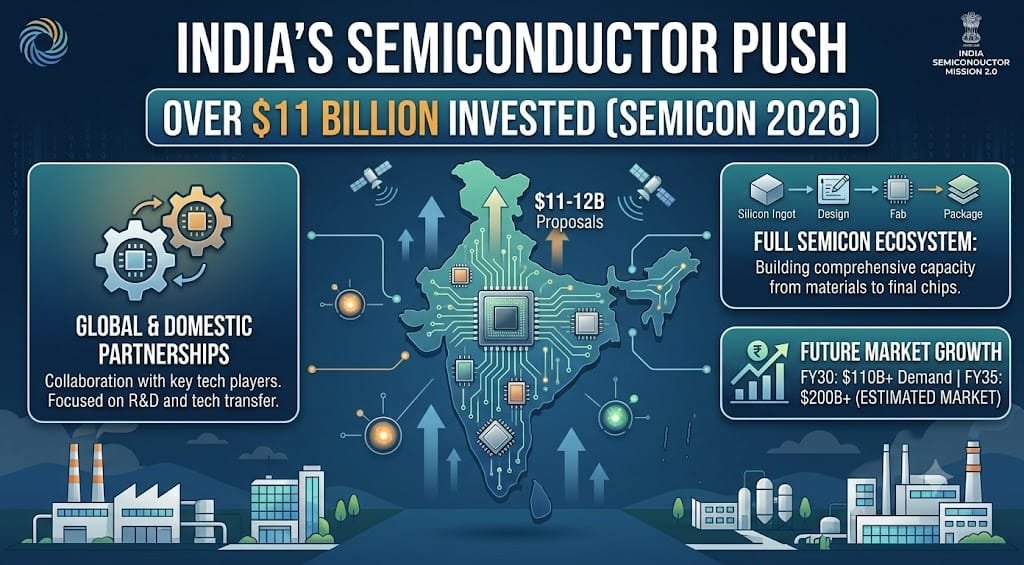
India’s semiconductor story moved from promise to pipeline at Semicon India 2026, where the government revealed that investment proposals worth about $11–12 billion have landed under the second version of the national chip programme.
The money is not just for chip factories; it covers equipment, materials, gases, chemicals and substrates every link needed to make the ecosystem self-reliant. Most of this capital is expected to flow in over the next two to three years, though company names were held back until board and shareholder approvals are in place.
The scale matters because India’s chip demand is racing ahead, projected to touch $110 billion by FY30 and cross $200 billion by FY35, while imports have already added up to nearly $150 billion between FY17 and FY25.
The policy engine behind these numbers is the India Semiconductor Mission 2.0, a Rs 1.27 lakh crore framework that supports design, manufacturing, assembly and the wider supply chain through subsidies and structured incentives.
This approach aims to cut import dependence and turn semiconductors into a national priority, much like digital public infrastructure did for payments and identity. With annual imports on track to potentially reach $240 billion by 2035 if the 23% CAGR continues, the urgency is clear: building capacity at home is not optional, it is strategic.
Two global equipment leaders signalled deep commitment during the conference. Applied Materials unveiled India Vision 2035, outlining a $5 billion decade-long plan focused on R&D, supply-chain expansion and talent development.
A new 140-acre advanced semiconductor research park was announced, and the company set a goal to grow its India-based supply-chain capacity ten times by 2035. This is significant because equipment and process know-how sit at the heart of chip manufacturing; stronger local capacity means faster ramp-up, lower costs and better resilience for fabs and OSAT units coming online.
Lam Research added another pillar with a plan to invest around Rs 10,000 crore over the coming years to set up its first silicon-component manufacturing facility in India and expand advanced R&D operations.
The facility is expected to cover silicon ingot production and processing for advanced semiconductor technologies, building on the company’s existing engineering presence. Silicon ingots are the starting point for wafers, so this move supports the very first step in the chip value chain and reduces dependence on imported base materials.
While global firms scaled up their India roadmap, domestic industry moved to strengthen the supplier base around upcoming fabs. Tata Electronics signed an agreement with Singapore-based Ascendas First Space to develop a 363-acre vendor park near its semiconductor fab in Dholera, Gujarat.
Such a park clusters suppliers close to the fab, shortening logistics, improving quality control and enabling just-in-time delivery critical for high-precision manufacturing.
Tata also inked deals with Japan’s Fujifilm for localisation of critical semiconductor materials and with JSR Corporation for photoresists and advanced chemicals needed at the Dholera facility. These materials are often the bottleneck in chip production, so localising them improves reliability and cuts lead times.
Taken together, the announcements point to a shift from isolated projects to an interconnected ecosystem. Equipment makers are committing long-term capital, materials specialists are moving towards local production, and a vendor park is being built to ensure that small and medium suppliers can plug into the fab’s needs.
This matters for employment, skills and technology absorption, because a fab does not run on machines alone; it runs on a dense network of vendors, chemists, engineers and quality systems. It also matters for cost competitiveness, since importing gases, chemicals and substrates adds risk and expense that local sourcing can reduce.
For the wider economy, the implications are straightforward. A stronger semiconductor base supports electronics manufacturing, defence, automotive, telecom and computing sectors that drive jobs and exports. It also reduces vulnerability to global supply shocks and currency swings that make imports costlier.
The next phase will depend on clear approvals, steady power and water supply, skilled workforce pipelines and predictable policy execution. If these pieces fall into place, the $11–12 billion in proposals can translate into a durable manufacturing base that grows with demand rather than chasing it.
The narrative emerging from Semicon 2026 is not about one big factory, but about many moving parts locking into place. With global equipment leaders scaling India plans, materials localisation gaining traction and supplier infrastructure being built around Dholera, the foundation for a self-sustaining chip ecosystem is taking shape.
The test now is speed and consistency turning proposals into production, and production into scale so that India’s semiconductor ambition matches its market size.

