
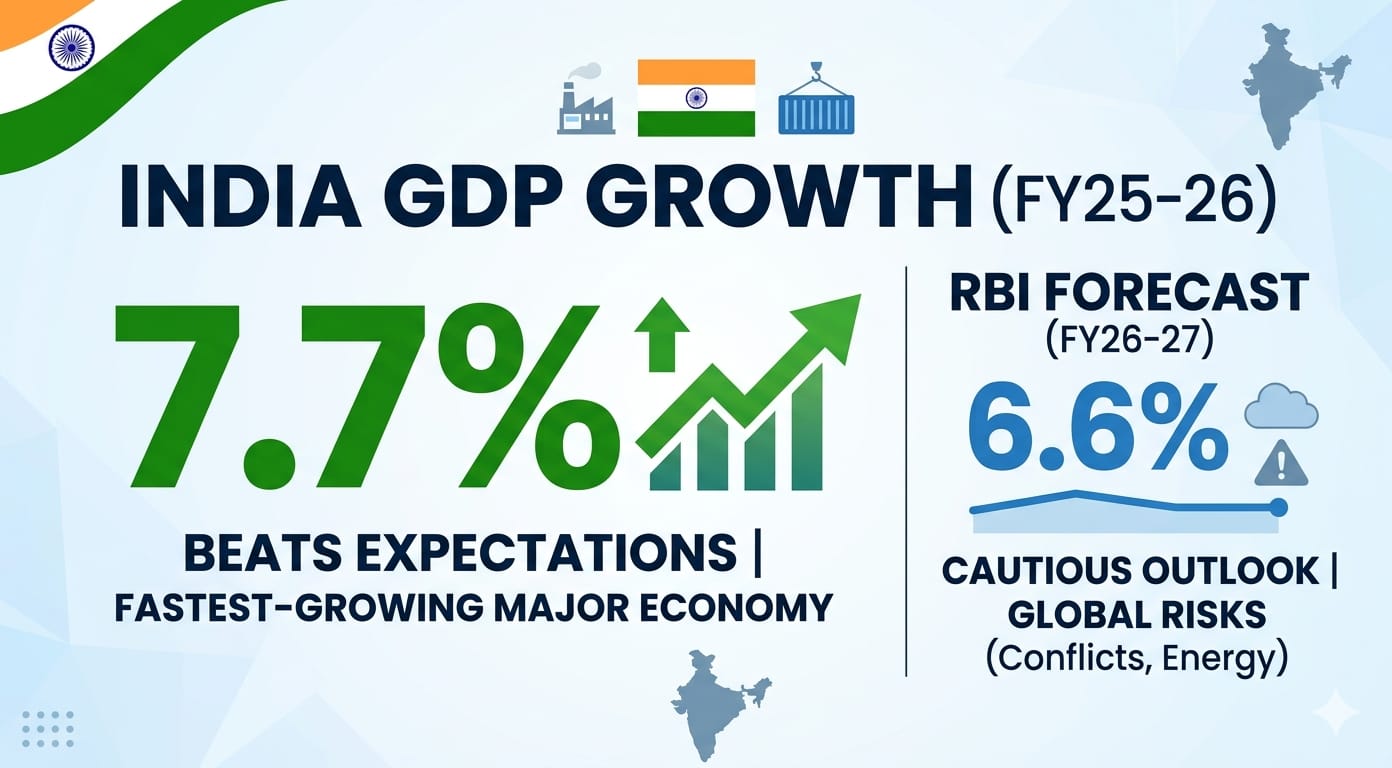
The economy has shown remarkable strength by growing at 7.7 percent in the financial year 2025–26, according to the latest official data released by the Ministry of Statistics and Programme Implementation.
This figure is slightly higher than the government’s earlier forecast of 7.6 percent and reinforces India’s position as the fastest-growing major economy in the world. This positive development comes at a time of global uncertainty, making it important to understand its broader implications.
The fourth quarter of the fiscal year, from January to March 2026, was particularly strong, with the economy expanding by 7.8 percent. This growth was driven by robust performance in trade, hotels, transport, communication, and broadcasting services, which grew by 12.5 percent.
Manufacturing also performed well with 7.3 percent growth, while the construction sector expanded by 8.4 percent. These sectors have a direct impact on everyday economic activity—transport and communication improve connectivity, manufacturing supports job creation, and construction leads to new infrastructure and housing development.
What makes this growth more notable is that it has been achieved despite multiple global challenges. The real GDP, which measures the value of all goods and services produced in the country adjusted for inflation, is estimated to reach Rs 323.12 lakh crore for the fiscal year. This is a significant increase from Rs 299.89 lakh crore in the previous year.
Nominal GDP, which includes inflation, is estimated at Rs 346.36 lakh crore, reflecting an 8.9 percent increase. These figures indicate both higher production and rising value of output.
However, there is an important caveat. While the government has highlighted strong FY26 performance, the Reserve Bank of India has adopted a more cautious outlook for the next financial year.
In its June 2026 monetary policy meeting, the RBI reduced its GDP growth forecast for FY27 to 6.6 percent from 6.9 percent. This revision is based on concerns such as the ongoing conflict in West Asia, rising energy prices, supply chain disruptions, and the risk of a below-normal monsoon.
These factors carry significant implications. Tensions in West Asia can push up oil prices, increasing fuel costs. Higher energy prices raise transportation and manufacturing expenses, which can eventually lead to inflation in essential goods.
The RBI has kept the repo rate unchanged at 5.25 percent, indicating a focus on maintaining stability while monitoring growth risks. The central bank expects GDP growth of 6.6 percent in Q1 FY27, 6.3 percent in Q2, 6.5 percent in Q3, and 6.8 percent in Q4, suggesting initial pressure followed by gradual recovery.
This creates a mixed outlook. Strong growth in FY26 indicates favorable conditions for employment, business activity, and investment performance. At the same time, the moderated forecast for FY27 signals the need for caution amid global uncertainties.
The services sector continues to be the backbone of India’s growth, including industries such as banking, insurance, tourism, and telecommunications. Sustained performance in this sector supports employment and income generation.
Additionally, the government’s continued focus on capital expenditure—such as roads, ports, and digital infrastructure—remains a key driver of long-term growth by enhancing productivity and creating jobs.
Overall, the 7.7 percent GDP growth reflects more than just strong numbers. It represents expanding opportunities, improving infrastructure, and a resilient economic trajectory. At the same time, the RBI’s cautious outlook serves as a reminder that global risks remain, and economic conditions can shift.

