
Imagine walking into a shop and noticing that the prices of things you buy daily have changed over the years. Now think about how the government tracks these price changes to understand how the economy is doing.
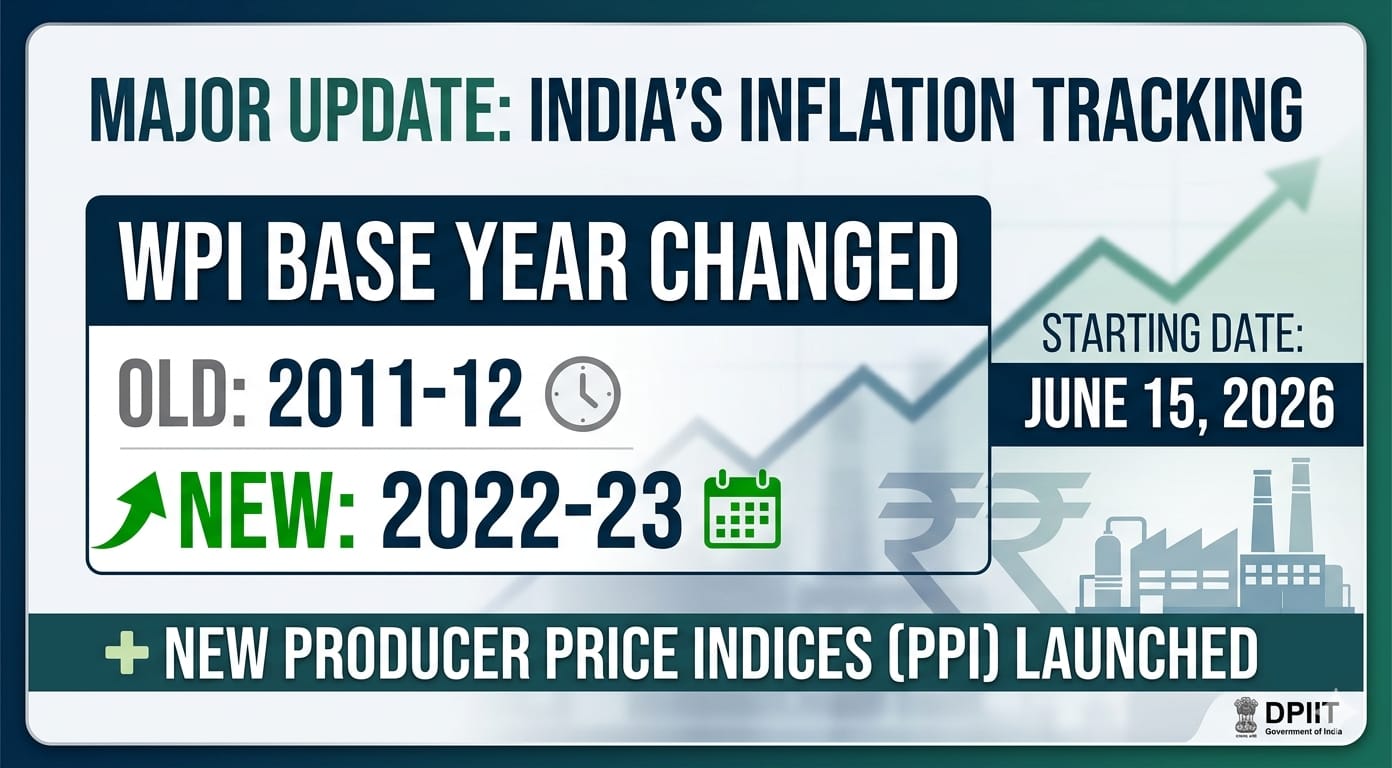
This is exactly what India’s new price measurement system does, and it just got a major upgrade that will affect how inflation is measured across the country. The competent authority has approved changing the base year of the Wholesale Price Index from 2011-12 to 2022-23, and this decision was taken in a meeting held on May 25, 2026.
Starting June 15, 2026, at 12:00 noon, the Office of Economic Adviser under DPIIT will release the revised WPI series with the new base year 2022-23, which will completely replace the old series that has been in use for over a decade.
What makes this change truly special is that it is not just about updating numbers. The government is also introducing entirely new price indices that India has never had before.
Along with the revised WPI, people will now see three new indices being released: the Output Producer Price Index which tracks prices of goods produced by manufacturers, the Trial Input Producer Price Index that follows prices of raw materials industries buy, and the Service Producer Price Index covering seven important service sectors including banking, securities transactions, insurance, pension fund management, railways, air passenger transport, and telecom. These seven services were chosen in the first phase based on data availability from government agencies, and more services will be added later as more data becomes accessible.
The timing of this release is carefully planned to give everyone access to both new and historical data. On June 15, 2026, people will get the WPI and Output PPI data for May 2026 on a provisional basis, along with a back series covering thirty-seven months from April 2023 to April 2026.
This back series is important because it allows economists and policymakers to compare current data with past data seamlessly, even though the base year has changed. The Trial Input PPI will be published experimentally starting from March 2026 but only for the manufacturing sector, while the Service PPI will be released quarterly with the first release covering the fourth quarter of 2025-26 along with historical data from the first quarter of 2023-24 to the third quarter of 2025-26.
Understanding how these indices are calculated makes the system even more interesting. The WPI, Output PPI, and Service PPI are all compiled using what is called Basic Price, which means they exclude net taxes and trade and transport margins.
This approach gives a clearer picture of what producers actually receive for their goods and services. On the other hand, the Input PPI uses Purchaser’s Price because industries buy their inputs from the market with taxes and margins included, so this method reflects what manufacturers actually pay. This distinction matters because it helps different stakeholders understand price movements from different perspectives in the economy.
For anyone following India’s economic story, this change represents a significant step toward global standards. The new system provides more accurate measurement of price changes at the producer level, which eventually affects what consumers pay in shops. When businesses face higher input costs, they often pass those costs to consumers, and when they receive better prices for their output, it can boost investment and employment.
The updated base year 2022-23 reflects the current structure of India’s economy better than the old 2011-12 base, which was becoming outdated as new products and services emerged and consumption patterns changed.
This revolutionary change in India’s inflation identification system aligns the country with global standards and will help policymakers make better-informed decisions about monetary policy, fiscal measures, and economic planning that affect everyone from farmers to factory workers to service providers.

