
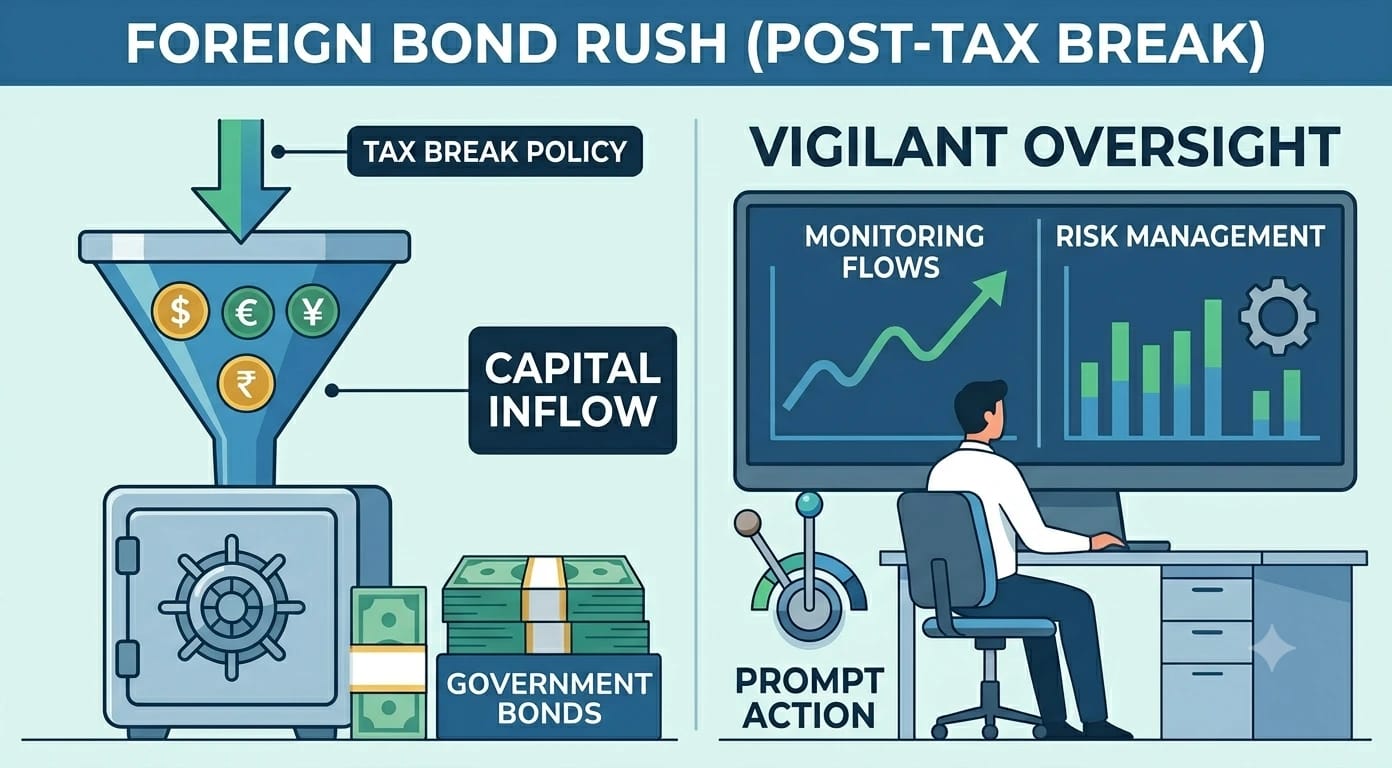
A recent policy change that removed taxes on interest and capital gains for non-resident investors in government debt prompted a rapid and sizable return of foreign capital, with roughly thirty-five thousand crore rupees being invested into dated government securities in June alone.
These flows followed an ordinance that guaranteed tax relief on such earnings, applied retroactively to the start of the previous financial year, and were bolstered by wider access for foreign investors to specified longer-dated securities under the fully accessible route.
The combination of better post-tax returns and improved market access made debt instruments more attractive to overseas funds, leading to a marked increase in holdings within weeks. International asset managers and bond funds signalled intentions to expand exposure after the measures, describing the opportunity created by clearer post-tax economics and an enlarged investable universe.
The surge in demand helped ease some pressure on the currency and suggested renewed confidence in local debt markets, though market participants remained mindful that such inflows can be episodic and sensitive to global risk sentiment.
Policymakers and regulators have been observing the situation closely, emphasising continuous monitoring of capital flows, bond yields, and currency movements to assess durability and risks. Central bank and treasury authorities have tools ready to act if volatility threatens macro stability; these include liquidity operations, adjustments to the pool of accessible securities, and communication measures to manage expectations and deter speculative swings.
The interplay between global yields, commodity prices especially crude oil and geopolitical developments remains critical, since sudden adverse shocks to those variables could reverse capital flows quickly and pose balance-of-payments stress.
Officials have signalled readiness to deploy targeted interventions should inflows or outflows start exerting destabilising pressure on interest rates or the exchange rate, while also weighing the longer-term benefits of deeper foreign participation in the domestic debt market.
Market participants are parsing whether the recent wave marks the start of a sustained reallocation into local debt or a shorter-term rebalancing driven by favourable policy optics. Some economists and fund managers see the early inflows as the beginning of a more durable trend, provided global conditions remain supportive and domestic yields offer a premium over developed-market alternatives.
Others caution that once the immediate incentive is widely priced in, the pace of gross inflows could moderate, and episodes of profit-taking or external shocks could prompt sudden reversals. The quality of reserves, the stance of monetary policy, and the credibility of fiscal anchors will determine how thick and resilient foreign participation becomes over time.
For debt markets and fiscal managers, the key challenge is to harness the benefits of foreign participation, better liquidity, lower borrowing costs and deeper secondary markets while limiting vulnerability to abrupt stops. Continuous analytics and real-time surveillance of non-resident positions, supplemented by scenario-based stress-testing, are being deployed to detect early signs of destabilising flows.
Contingency playbooks now include calibrated open-market operations, temporary restrictions on certain portfolio movements if needed, and layered communications to foreign investors and domestic market-makers to reduce herd behaviour and smooth transition dynamics. These measures are intended to preserve market functioning without undermining the incentives that attracted the inflows in the first place.
The broader implication is that policy signals when clear, prompt and market-friendly can mobilise substantial external capital, but they also require steady follow-through in the form of vigilant monitoring and readiness to take targeted measures.
If global interest-rate differentials and risk appetite remain favorable, foreign participation in government debt may rise further, reinforcing monetary and exchange-rate stability; if not, the authorities’ ability to act quickly and transparently will matter more than ever to prevent sharp dislocations.
This underscores a simple lesson that policy tweaks can open the door to capital, but continuous stewardship and timely actions are essential to turn episodic flows into resilient market development.

