
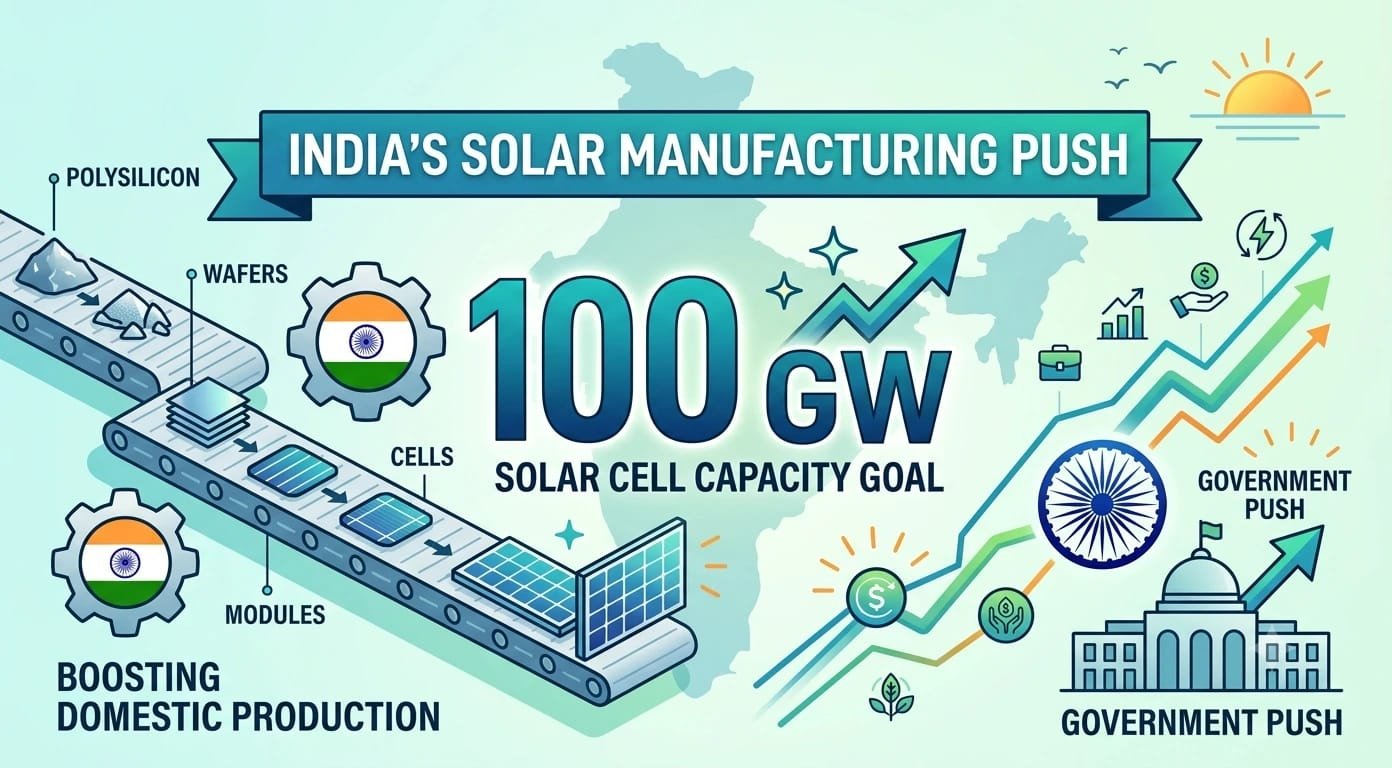
The renewable energy sector is moving toward remarkable growth, with solar cell manufacturing capacity expected to reach 100 GW within just one year. The announcement came from Santosh Sarangi, Secretary of the Ministry of New and Renewable Energy, while speaking at the International Energy Conference and Exhibition organised by Confederation of Indian Industry.
Present solar cell capacity stands at around 32 gigawatts, meaning production strength will more than triple in the coming months. Such rapid expansion reflects growing confidence in the domestic manufacturing ecosystem and shows how policy support is translating into real industrial capacity on the ground.
In simple terms, the idea is to make more of the solar value chain inside the country instead of relying heavily on outside suppliers. That is why this announcement matters not only for the energy sector but also for manufacturing, trade, and future investment plans.
The next stage of growth is expected in wafer and ingot manufacturing, which are important upstream parts of solar production. According to the statement, this capacity may reach 80 GW by June 2028, when the approved list of models and manufacturers’ policy for these components comes into effect.
This policy is important because it can help create a stronger domestic supply chain and reduce pressure from imported raw material and components. At present, this part of the industry remains weak compared with cells and modules, so the planned increase is being seen as a necessary step.
Another major point from the report is the government’s plan to support polysilicon manufacturing. Polysilicon is one of the most critical inputs in solar production, and India still depends heavily on imports for this material. The ministry is said to be working on a support scheme so that more polysilicon can be made in India itself.
This is especially significant because a stronger local supply of polysilicon can lower import dependence and make the solar sector more stable in the long run. Such a move also fits the wider goal of building a complete and more secure clean energy ecosystem.
The broader picture is very encouraging for India’s renewable energy journey. Solar module manufacturing has already crossed 100 GW under the ALMM framework, showing how fast the sector has expanded in recent years.
This rise has been supported by policy measures, industrial growth, and the push for self-reliance in clean energy manufacturing. The new target for solar cells and the expected rise in wafer-ingot capacity suggest that the next phase will be deeper and more balanced, covering more stages of production. That means the country is not stopping at final assembly alone, but is now trying to strengthen every layer of the supply chain.
This shift can matter in everyday life more than it first appears. A stronger domestic solar industry can support more jobs, more local investment, and better long-term energy security. It can also help reduce the risk of sudden price changes caused by import dependence.
In the larger national picture, this kind of growth can support India’s clean energy goals while also making industry more competitive. The message coming from parliament is simple but powerful: India wants to become not just a big user of solar power, but also a strong maker of solar technology.

