
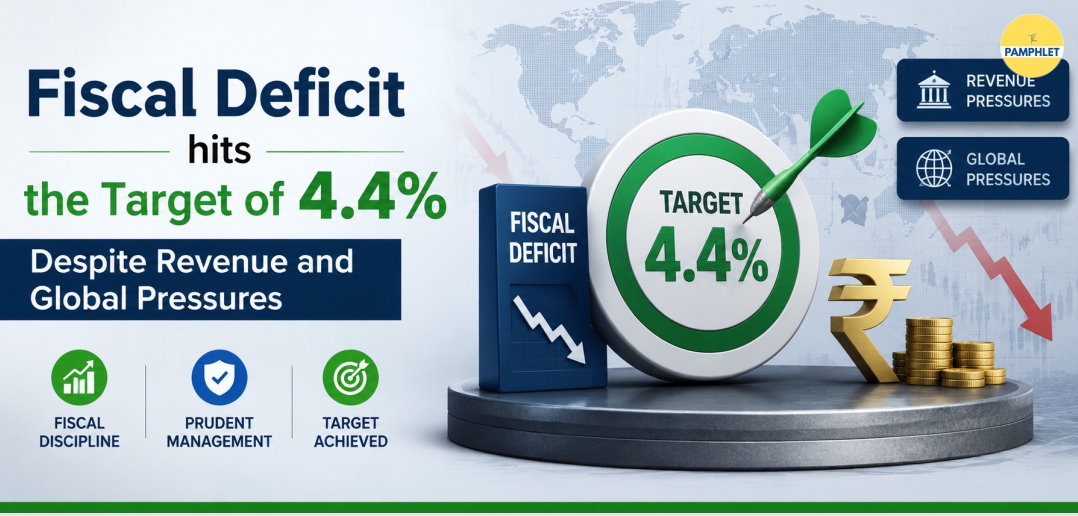
The government has quietly achieved something many thought would be difficult this year. The government managed to keep its fiscal deficit at exactly 4.4% of GDP for financial year 2026, matching the target it had set for itself.
This is notable because the country faced both lower-than-expected tax collections and global economic pressures, including global tensions that could have easily pushed spending higher. The news might sound technical at first, but it actually touches something everyone can relate to: How a household manages its income and expenses when things don’t go exactly as planned.
Think of the government’s budget like a family’s monthly budget. The family knows how much money it expects to earn, and it also knows how much it needs to spend on essentials like food, education, and rent.
Sometimes income falls short, or unexpected expenses come up. The smart move is to carefully control spending so that the family doesn’t end up borrowing too much. That is essentially what happened here.
Even though net tax receipts reached only 98.1% of the expected target, the government kept total spending well within limits, which helped it meet the deficit goal. In absolute terms, the fiscal deficit came to ₹15.19 lakh crore, slightly better than the revised estimate of ₹15.58 lakh crore.
What made this possible was a combination of careful control over spending and some pleasant surprises on the income side. Non-tax revenues, which include things like dividends from public companies and interest income, actually exceeded expectations.
They touched ₹6.79 lakh crore against a target of ₹6.68 lakh crore. Total revenue receipts, which combine tax and non-tax income, stood at ₹33.86 lakh crore or 99.4% of the target. On the spending side, the total government expenditure was ₹49.05 lakh crore, which is 98.8% of the planned amount. Both capital spending (long-term investments like infrastructure) and revenue spending (day-to-day expenses) stayed close to their targets, at 97.6% and 99.1% respectively.
This achievement is especially meaningful when one considers how the year began. In April, the fiscal gap had already touched 21.4% of the annual target, much higher than the 11.9% seen at the same time the previous year.
That early stretch looked worrying because both tax and non-tax revenues had dropped while expenditures had risen. Yet, by the end of the year, the picture changed completely. The government trimmed its net market borrowing to ₹10.06 lakh crore from the revised estimate of ₹10.40 lakh crore, likely to keep bond markets calm.
At the same time, it increased its offtake from the National Small Savings Fund to ₹4.86 lakh crore against ₹3.72 lakh crore, which helped reduce the pressure on borrowing.
For everyday people, this matters because a controlled fiscal deficit usually means the government is not taking on too much new debt. When the government borrows less, it puts less pressure on interest rates, which can help keep borrowing costs lower for businesses and even individuals.
It also signals to investors, both domestic and global, that the country is being financially responsible. A senior official described this as a commitment to fiscal discipline despite global headwinds, including risks like the Iran war. The fact that this was achieved even after a downward revision in the estimated size of GDP under the new series makes it even more impressive.
Looking ahead, the focus will naturally shift to the next financial year, where the consolidation target is expected to be more ambitious, possibly around 4% of GDP. Rising subsidy costs and other pressures may make that a tougher challenge, but FY26 has shown that the government can adjust and stay on track when needed.
The story here is not just about numbers; it is about a system that, when faced with unexpected difficulties, found a way to balance its books without cutting back sharply on essential spending. That kind of balance is something any household, business, or country can appreciate, because it reflects careful planning, flexibility, and a steady hand in uncertain times.

