
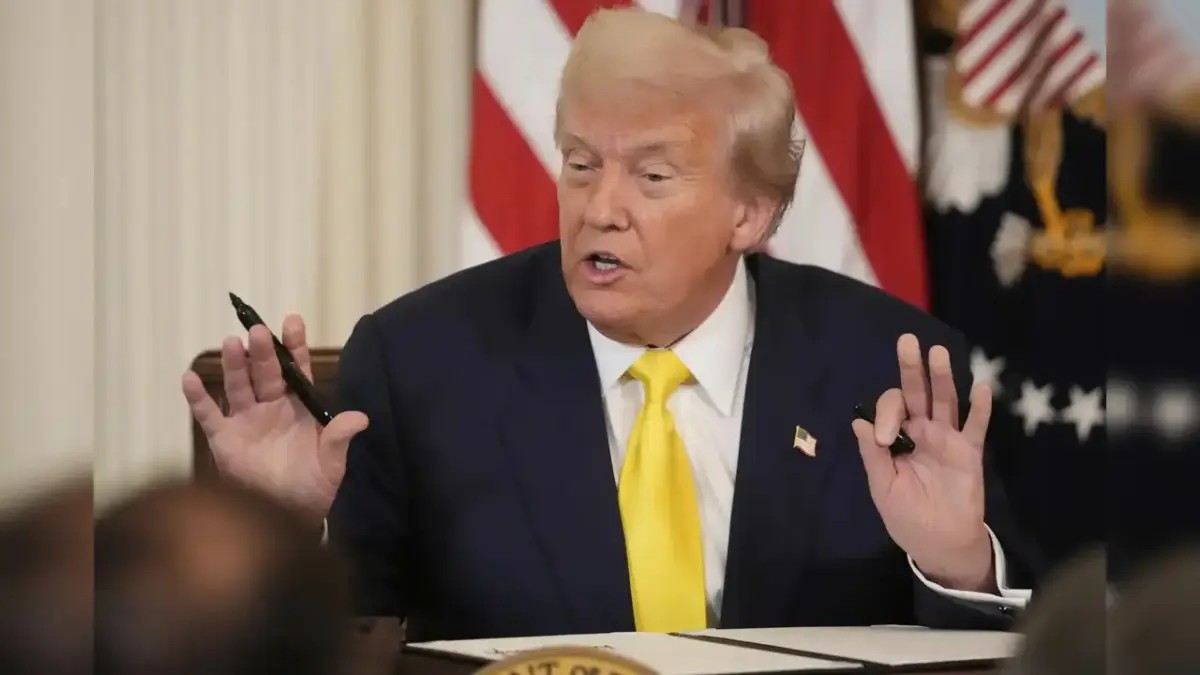
On Monday, May 25 (US time), US President Donald Trump added a new complication to the already complicated Iran peace talks by linking them to the Abraham Accords. In a post on his social media platform Truth Social, Trump said that it should be mandatory that all the Countries involved in the peace talks, at a minimum, should simultaneously, sign onto the Abraham Accords.
In his long post on Truth Social, Trump said that he has had discussions on Saturday with President Mohammed bin Salman Al Saud, of Saudi Arabia, Mohammed bin Zayed Al Nahyan, of The United Arab Emirates, Emir Tamim bin Hamad bin Khalifa Al Thani, Prime Minister Mohammed bin Abdulrahman bin Jassim bin Jaber Al Thani, and Minister Ali al-Thawadi, of Qatar, Field Marshal Syed Asim Munir Ahmed Shah, of Pakistan, President Recep Tayyip Erdoğan, of Türkiye, President Abdel Fattah El-Sisi, of Egypt, King Abdullah II, of Jordan, and King Hamad bin Isa Al Khalifa, of Bahrain. Out of these, UAE and Bahrain are already signatories to the accords.
The countries discussed during the meeting were Saudi Arabia, The United Arab Emirates, Qatar, Pakistan, Türkiye, Egypt, Jordan, and Bahrain. Notably, for Pakistan, Trump had a discussion with Field Marshal Asim Munir and not the Prime Minister of the country Shehbaz Sharif, further underlining where the real power in Pakistan lies.
While US-Iran peace talks are already moving at a snail’s pace during the fragile ceasefire agreed upon on April 8, Trump making it mandatory to sign Abraham Accords for parties involved has thrown another spanner in the works. As if Iran’s denuclearisation, sanctions on Iran, future control of Strait of Hormuz were not complicated enough, now we have to wait and watch if all these countries sign the Abraham Accords.
What are the Abraham Accords
The Abraham Accords Peace Institute was launched by Jared Kushner, US President Donald Trump’s senior adviser and son-in-law, during Trump’s first term. The accords aimed to normalize relations between Israel and the Arab nations after decades of hostilities. Notably, Israel wasn’t even recognised by several Arab countries before these accords.
With Gulf countries UAE and Bahrain signing the accords in 2020 during a ceremony at the White House in Washington in 2020, it marked a significant shift in the Middle East politics.
After UAE and Bahrain signed the accords, North African countries Sudan and Morocco also joined in, spreading the impact of the accords through the Middle East and North Africa (MENA) region.
After these diplomatic agreements, these countries agreed to formal ties with the Jewish country of Israel which didn’t exist earlier due to the long-standing Israeli-Palestinian conflict.
Before these agreements, the position of majority of the Arab world was that normalisation of ties with Israel could happen only after the establishment of an independent Palestinian state. But, these accords were a major departure from that policy. The Abraham Accords represented a major departure from this policy. By signing these accords, these Arab countries showed that they are open to strategic, economic and security partnerships with Israel and the Jewish state will not remain a pariah within the region, and their relationship with Israel won’t be held hostage to the resolution of Palestinian issue.
One of the biggest factors that drove these Arab nations to sign the accords was the growing influence of Iran in the region. With Iran’s proxies active in Yemen, Lebanon, Iraq, and Syria, Israel and the Arab nations shared concerns about Iran’s increasing influence in the region. These concerns helped bring these countries together. The United States did rest of the work by providing security assurances to the signatories if they sign these accords.
Apart from countering Iranian influence, economically as well the accords made sense for the Arab countries. In the region, Israel has the most advanced technology and a thriving innovation sector, commercial ties with Israel will only help these nations get access to Israeli technology. The cooperation expanded into areas such as renewable energy, agriculture, cybersecurity and water management. Tourism also increased significantly, with thousands of Israelis visiting Gulf countries and vice versa.
Predictably, the accords were opposed by Palestinian authority who accused these Arab countries of abandoning the Palestinian cause and cozying up to Israel. They said that they have been sidelined and these accords with Israel have reduced pressure on the Israelis to accept a two-state solution. However, the supporters of the accords argued that these accords will provide long term stability and reduce tensions in a region which is always at a boiling point.
However, for Donald Trump, these Abraham Accords are very important personally as he views these accords as part of his legacy. The US President wants to be remembered in history and the man who brought peace between Arabs and Israelis will definitely go down in history, though it hasn’t quite happened yet, and maybe that is why Trump is now pushing Muslim countries to sign the accord to broaden the horizon of the accords.
Pakistan facing a difficult decision
With US President Donald Trump saying it is mandatory for the countries involved in Iran peace negotiations to sign the Abraham Accords, Pakistan, which positioned itself as the mediator, faces a difficult choice.
During the peak of bombardment in West Asia, Pakistan jumped to become the mediator between US and Iran. Pakistan aimed to enhance its global reputation by bring to an end the war that was disrupting the entire world dur to the energy crisis.
Now that Donald Trump has said that it is mandatory for them to sign Abraham Accords, even spoke to Pakistan’s ‘democratically’ elected leader Asim Munir about it, what will Pakistan do?
The two options before Pakistan are now, either withdraw from their role of mediator between US and Iran, or, begrudgingly, recognise Israel as a country and agree to have diplomatic relations with them. Though whether Israel want any relations with them is another issue. Notably, right now, Pakistan passports are not valid to travel to Israel, a line printed on their passport.
Now, will Pakistan sign the Abraham Accords and not just recognise the state of Israel, but try to develop relations with them, or will they offend Donald Trump, a man they have spent the last year courting. Don’t forget that Pakistan even proposed Trump’s name for Nobel Peace Prize in order to appease him. Lets wait and watch.

