
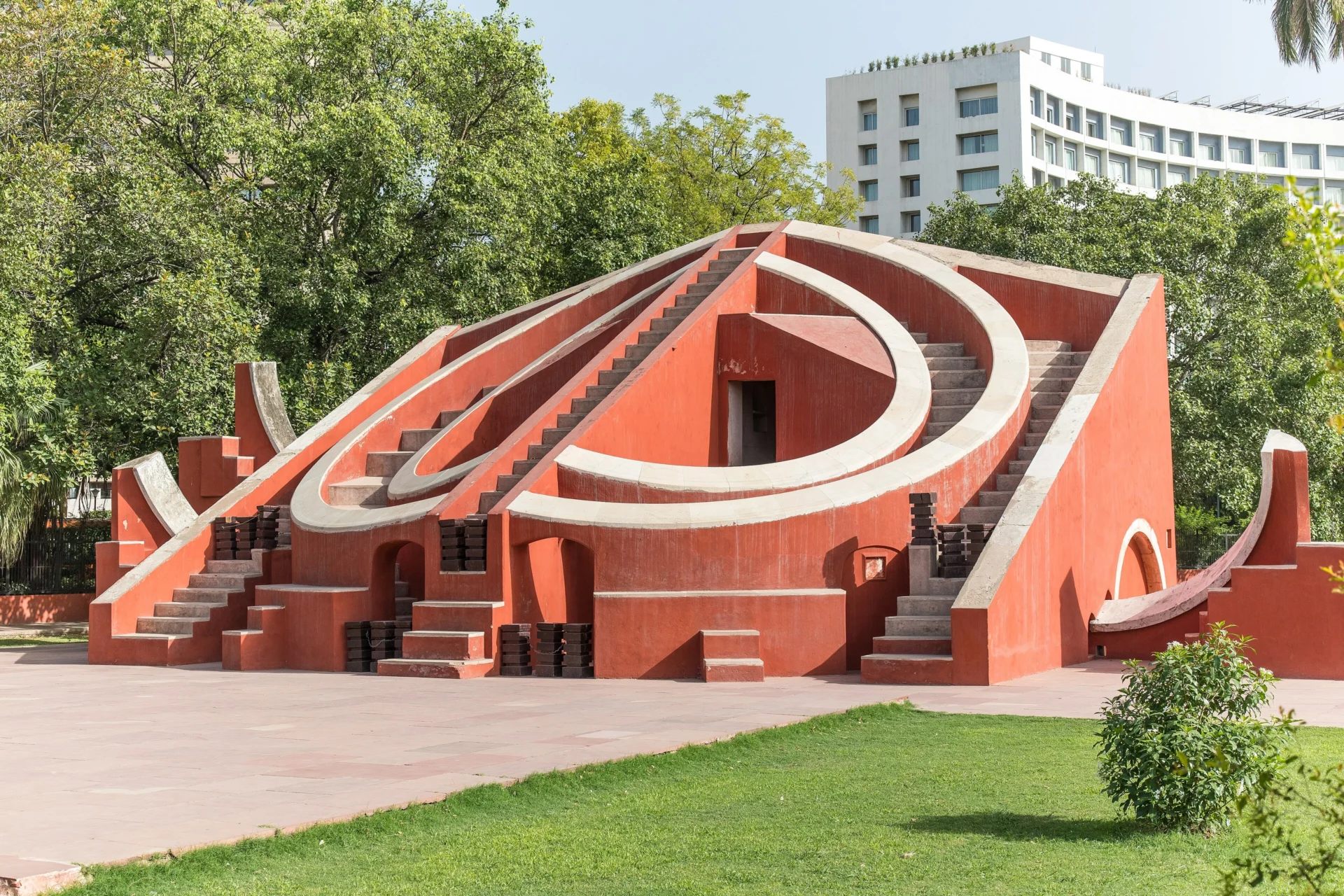
If a place has hosted enough protests, it must have been built for protests. That is the image of Jantar Mantar in Delhi now, that it must have been built to host protests only. Oh, how the leftists have reduced a place of scientific learning to just a protest site.
Maharaja Sawai Jai Singh II did not build Jantar Mantar in Delhi as a designated protest venue. He built it as an astronomical observatory, and not just any casual stargazing spot. It was an ambitious scientific project designed to make astronomical observations more accurate. Jai Singh constructed the observatory in 1724, because the astronomical instruments then available were considered not advanced enough for sufficiently accurate measurements.
In other words, while today’s visitors may hear protest slogans echoing around Jantar Mantar, Jai Singh was far more interested in hearing what the planets and stars were saying.
The observatory contains large astronomical instruments designed to observe celestial positions and calculate the movements of the Sun, Moon and planets. Instruments such as the Samrat Yantra, Jayaprakash Yantra and Misra Yantra were created for scientific measurements, including determining time, tracking celestial positions and identifying the longest and shortest days of the year.
Jai Singh’s project was part of a much larger intellectual exercise. He established five astronomical observatories in northern India, one each in Delhi, Jaipur, Ujjain, Mathura and Varanasi. This reflected his interest in improving astronomical calculations and compiling more accurate tables.
So no, the original plan apparently wasn’t: “Let’s construct a giant astronomical instrument and leave enough road space for future protesters to demand someone’s resignation.” That particular transformation came much later as leftists took control of central Delhi.
Over time, Jantar Mantar’s location, close to the Indian Parliament and the central institutions of government, made it an attractive venue for protests. The site’s emergence as a major protest venue dates back to 1993, when restrictions on demonstrations at the Boat Club pushed protests towards Jantar Mantar. Its relatively manageable size and proximity to the political heart of Delhi made it convenient for authorities as well as demonstrators. After that, India’s astronomical observatory acquired a second, rather unexpected profession.
Jantar Mantar has hosted numerous high-profile demonstrations. It has become one of Delhi’s most recognisable locations for political and social dissent. There is something almost wonderfully ironic about it.
A place created to measure the movements of celestial bodies is now famous for measuring the size of political crowds. The Samrat Yantra was designed to measure time, today’s protesters use the same surroundings to demand that governments stop wasting theirs. The Jayaprakash Yantra was meant to help locate stars;,Jantar Mantar today helps protesters locate television cameras. But the historical distinction matters.
Jantar Mantar was an observatory first and a protest venue much, much later. Its present identity is the result of Delhi’s political geography and decades of public demonstrations, definitely not the intention behind Jai Singh’s original scientific project.
So the next time someone confidently announces that Raja Jai Singh built Jantar Mantar as India’s first designated protest site, perhaps point them towards the astronomical instruments.
They have been sitting there for about three centuries, quietly suggesting that the place was originally built to study the heavens, not to organise a dharna.

