
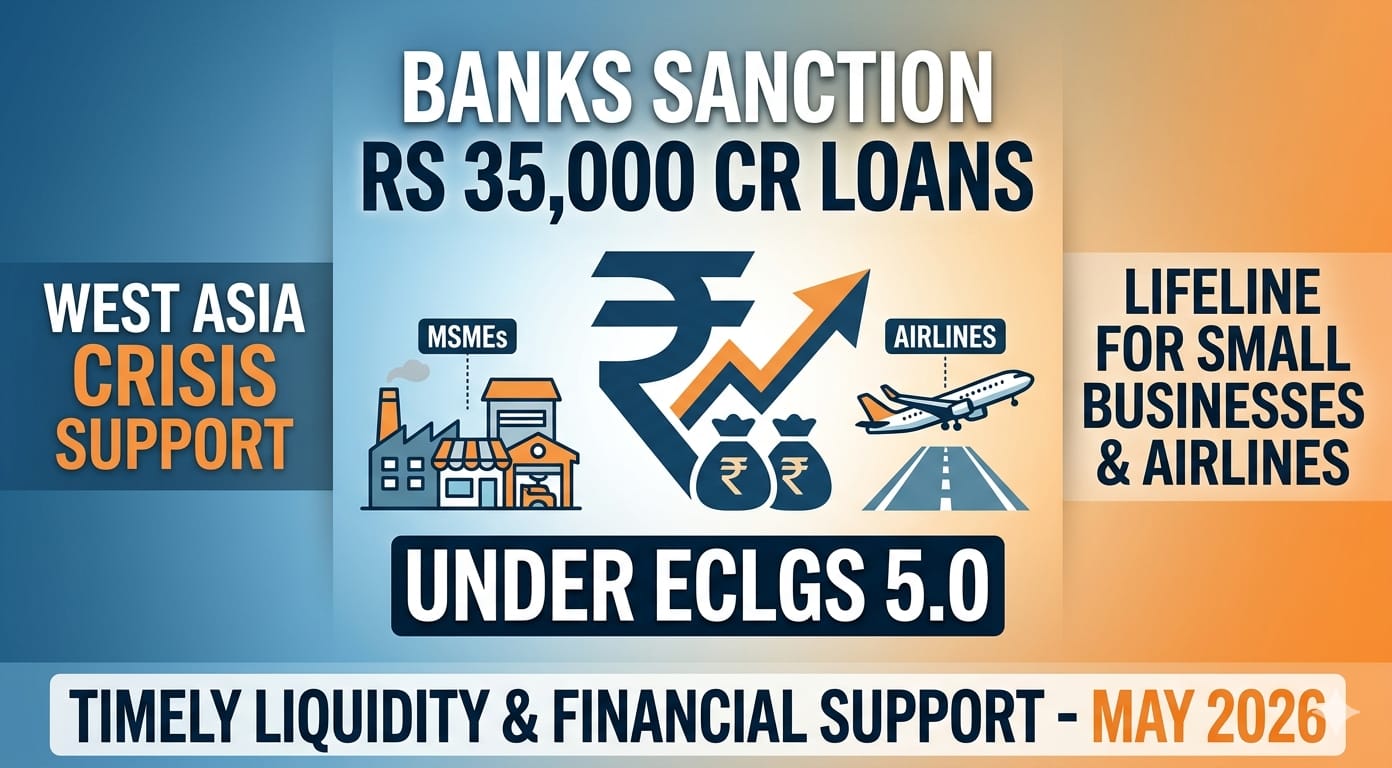
Banks across India have taken a significant step to support small businesses by sanctioning Rs 35,000 crore in loans under the Emergency Credit Line Guarantee Scheme, commonly known as ECLGS, to help micro, small, and medium enterprises cope with the financial impact of the West Asia crisis.
This initiative, approved by the Union Cabinet on May 5, 2026, provides an additional credit flow of Rs 2.55 lakh crore, including Rs 5,000 crore specifically set aside for airlines affected by the ongoing geopolitical situation .
The lending institutions have cleared approximately 80,000 applications with loans totaling Rs 35,194 crore, while guarantees worth Rs 15,720 crore have been issued as of May 29, according to Manoj Muttathil Ayyappan, Joint Secretary at the Department of Financial Services .
The scheme was created to provide timely liquidity to businesses struggling due to the West Asia conflict that began in February 2026, with the main goal of sustaining operations and preventing job losses across the country .
What makes this program particularly accessible is that the entire process is completely digital and can be finished end-to-end within 5 to 7 days, allowing businesses to get the financial support they need quickly without lengthy paperwork or delays .
The government has kept the scheme generally liberal to ensure that maximum beneficiaries can avail the benefits, with only customers who were classified as SMA 2 as of March 31, 2026, kept outside the scheme .
Under ECLGS 5.0, which has an outlay of Rs 18,100 crore, passenger airlines can receive up to 100 per cent of their peak credit up to Rs 1,500 crore, while institutions can access up to 20 per cent of fund-based working capital up to Rs 100 crore .
For MSMEs and other businesses, banks can provide an additional 20 per cent credit over their existing working capital, giving these enterprises the extra financial breathing room needed to continue operations during uncertain times .
The credit guarantee coverage is particularly generous, with 100 per cent coverage for MSMEs and 90 per cent for non-MSMEs provided by the National Credit Guarantee Trustee Company Limited for amounts in default under the additional credit facility .
The loan tenor varies by sector, with the airline sector getting seven years from the date of first disbursement including a two-year moratorium, while MSMEs and non-MSMEs receive five years including a one-year moratorium .
This structure allows businesses to manage their cash flow better during the recovery period without immediate pressure on repayments. MSMEs and airlines have been facing substantial financial headwinds due to the West Asia conflict, which disrupted supply chains, increased costs, and created uncertainty in domestic and international markets .
The Emergency Credit Line Guarantee Scheme was originally launched in May 2020 to mitigate economic distress during the coronavirus pandemic, and this new version builds on that experience to address current challenges .
The objective extends beyond just providing money, as the scheme aims to promote uninterrupted domestic production and maintain the resilience of the entire business ecosystem . Outreach programmes are being carried out across the country to ensure maximum benefit reaches those who need it most, with officials expressing confidence that customers would benefit from the scheme now that a good number of applications have been processed .
This comprehensive approach demonstrates how financial support, when combined with simple digital processes and generous guarantee coverage, can help small businesses survive and thrive even during difficult geopolitical times.
The success of this initiative so far, with nearly Rs 35,200 crore disbursed and 80,000 applications approved, shows that when the right support system is in place, businesses can access help quickly and effectively.
The scheme represents a collaborative effort between the government, banks, and businesses to ensure that the ripple effects of international conflicts do not derail India’s economic progress or cause widespread unemployment among small enterprise workers who form the backbone of the economy.

