
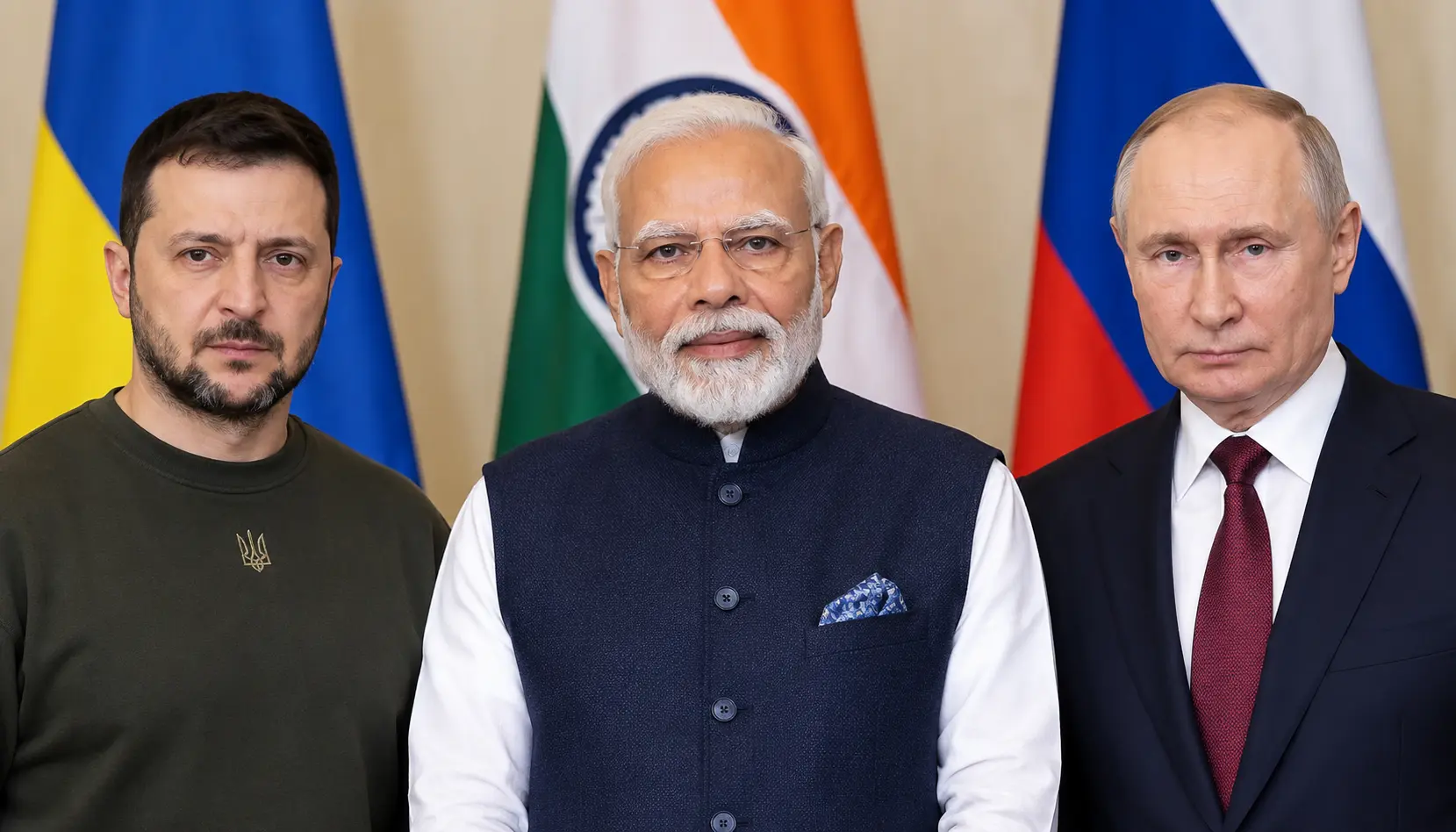
After more than four years of war, Russia and Ukraine appear to be increasingly looking towards India as a potential bridge between the two sides. New Delhi’s diplomatic credibility with both Moscow and Kyiv has given it a unique position that no other major power currently holds. Thanks to the PM Modi government’s handling of geopolitics, and maintaining good relations with both warring countries, India is seen as a country which can finally broker peace between the two nations.
India has consistently maintained that the Russia-Ukraine conflict cannot be resolved on the battlefield and that dialogue and diplomacy remain the only sustainable way forward. Now, as both sides confront the enormous human and economic costs of the conflict, India has reportedly put forward a three-point peace proposal aimed at creating a pathway towards negotiations and bringing an end to the war.
India’s peace plan talks about halting attacks on energy facilities of Russia and Ukraine and other infrastructure, grain and energy transport through Black Sea ports, and an end to strikes on commercial shipping passing through the Black Sea, NDTV reported.
The first and most immediate element to have discussions about ending the war is obviously a ceasefire. Stopping the fighting is needed to create the basic conditions necessary for meaningful diplomacy. Without an end to missile strikes, drone attacks and military operations, any peace process is an exercise in futility.
The second point is direct dialogue between Russia and Ukraine. India has repeatedly emphasised that lasting peace cannot be imposed by outside powers. Ultimately, Moscow and Kyiv will have to sit across the table and address the issues that have kept the conflict alive. New Delhi’s role would be more of a facilitator rather than an arbitrator, helping create communication channels without dictating the final settlement. Communication between all the parties involved in an absolute must if one wants to end the war, and India is the one country that can facilitate it.
The third element is a broader diplomatic framework involving key international stakeholders. Any agreement will have to address not only immediate military issues but also questions surrounding security guarantees, territorial disputes, economic reconstruction and the future security architecture of Europe.
India’s advantage is obvious. Unlike many Western countries, New Delhi has maintained strong diplomatic and economic relations with Russia. At the same time, India has continued engaging with Ukraine and Western powers. Prime Minister Narendra Modi’s repeated interactions with both Russian President Vladimir Putin and Ukrainian President Volodymyr Zelenskyy have allowed India to maintain trust that many traditional mediators have struggled to establish.
For years, the dominant diplomatic question was which side India would choose. New Delhi has increasingly demonstrated that it does not intend to choose a camp, it intends to push for peace. As PM Modi said, this is not the time for war.
And now, with both Russia and Ukraine receptive to India’s diplomatic outreach, New Delhi may have an opportunity to turn its carefully maintained neutrality into something far more valuable, peace in the region.
While powerful countries have spent years arguing over who should lead the peace process, India may simply be positioning itself to ask the more practical question- Why not start talking?

