
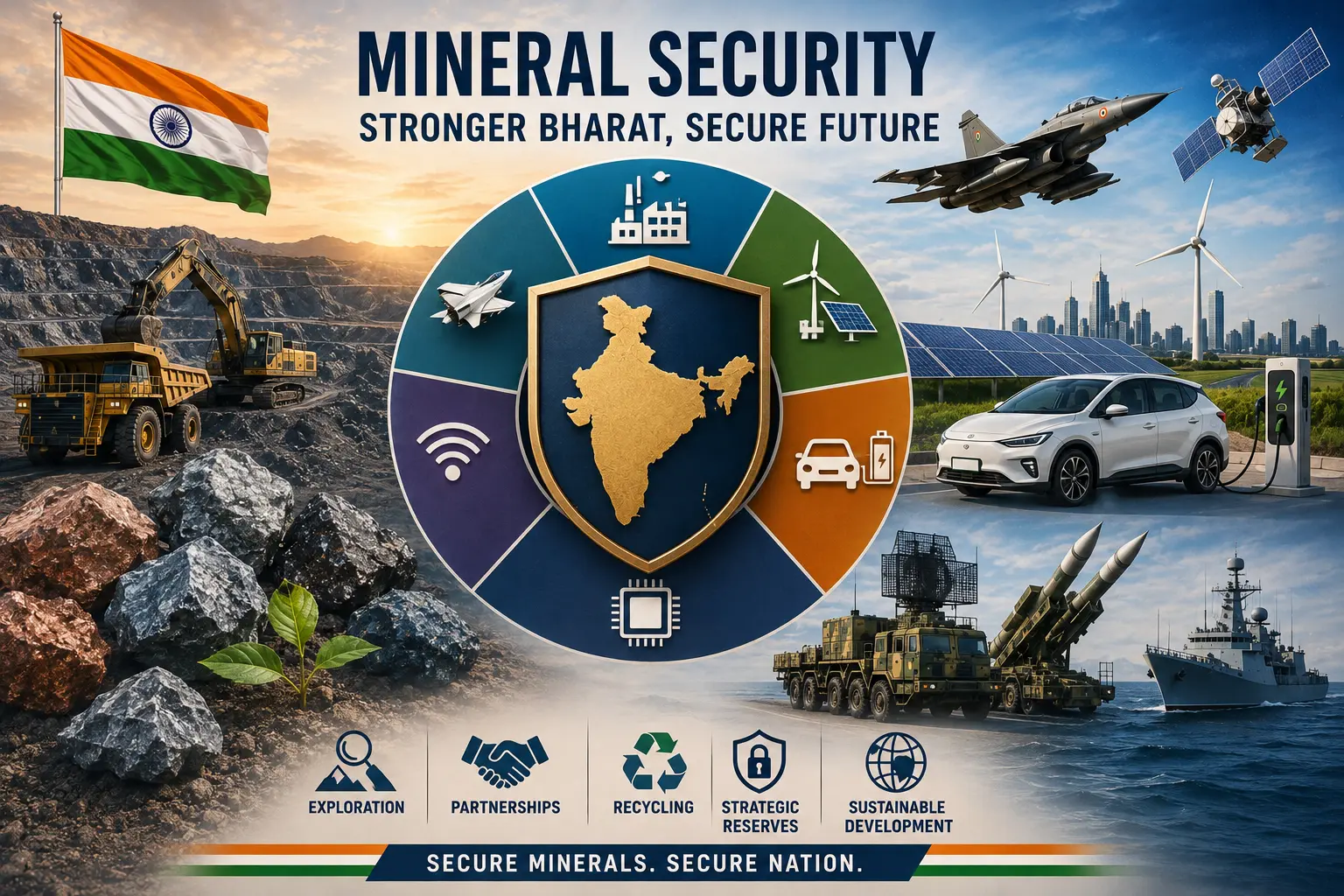
Minerals constitute the backbone of modern civilisation and industrial development. From infrastructure and manufacturing to defence, energy, electronics, and advanced technologies, every sector of the economy depends upon a secure and uninterrupted supply of minerals. In the twenty-first century, mineral security has evolved beyond being merely an economic concern; it has become a strategic imperative directly linked to national security, technological sovereignty, and geopolitical influence.
For India, one of the world’s fastest-growing economies, ensuring mineral security is indispensable to achieving the vision of Viksit Bharat 2047, the energy transition towards net-zero emissions, and the objective of becoming a global manufacturing hub. The increasing demand for critical minerals required in electric vehicles, renewable energy, semiconductors, aerospace, telecommunications, and defence manufacturing has made mineral security a key component of India’s National Security Architecture.
Understanding mineral security
Mineral security refers to the assured availability of minerals in sufficient quantities, of acceptable quality, and at affordable prices to meet present and future developmental needs without excessive dependence on uncertain external sources. It encompasses exploration, extraction, processing, transportation, recycling, strategic reserves, international cooperation, and sustainable utilisation of mineral resources. Unlike conventional minerals such as iron ore and coal, the emerging focus is on critical minerals whose supply chains are highly concentrated in a few countries, making importing nations vulnerable to geopolitical disruptions.
Importance of mineral security for India
India’s mineral security directly influences several strategic sectors such as Industrial manufacturing and infrastructure development, Defence production and indigenous military capability, Renewable energy and solar power, Electric vehicle manufacturing, Battery technology and energy storage, Electronics and semiconductor industries, Space technology and telecommunications, Artificial Intelligence and digital infrastructure etc. The Government of India aims to increase domestic manufacturing under initiatives such as Make in India, Atmanirbhar Bharat, and the National Critical Mineral Mission. These initiatives require reliable access to critical minerals.
Critical Minerals- The new strategic assets
Critical minerals are those that are economically important but face a high risk of supply disruption. India’s list includes minerals such as Lithium, Cobalt, Nickel, Graphite, Rare Earth Elements (REEs), Copper, Silicon, Titanium, Tungsten, Vanadium, Niobium, Molybdenum etc. These minerals are essential for manufacturing lithium-ion batteries, wind turbines, solar panels, fighter aircraft, missiles, communication equipment, precision-guided weapons, drones, and advanced computing systems.
India’s mineral resource base
India possesses substantial reserves of several minerals, including iron ore, bauxite, manganese, limestone, chromite, coal, mica, zinc, copper, rare earth-bearing beach sands etc. However, India remains heavily dependent on imports for several strategic minerals, particularly lithium, cobalt, nickel, and high-purity graphite. The discovery of lithium reserves in Jammu & Kashmir and subsequent exploration efforts in Rajasthan, Karnataka, and Chhattisgarh have generated optimism regarding India’s future mineral security.
Challenges to India’s mineral security
The first and foremost challenge is Import Dependence. India imports a significant proportion of its critical mineral requirements. Heavy dependence on imports exposes the country to international price fluctuations, geopolitical conflicts, and supply chain disruptions. Followed by the global supply chain concentration. Many critical minerals are geographically concentrated.
For instance, lithium production is dominated by Australia, Chile, and Argentina, while cobalt production is concentrated in the Democratic Republic of Congo. Processing capacity for several critical minerals is concentrated in China. Moreover, the limited domestic exploration is also a major concern. Large portions of India’s geological potential remain unexplored. Modern exploration technologies, geophysical surveys, and private sector participation are still developing. On the other hand, environmental concerns play important roles in mining activities, which may lead to deforestation, biodiversity loss, soil degradation, and water pollution. Balancing economic development with environmental sustainability remains a major challenge. The technological constraints also challenge the mineral security of India. Extraction and processing of critical minerals require sophisticated technologies and specialised expertise, areas where India is still building capacity.
The important government initiatives
Recognising the strategic importance of minerals, the Government of India has undertaken several initiatives, such as the National Critical Mineral Mission, which seeks to strengthen the entire critical mineral value chain, including exploration, mining, processing, recycling, strategic stockpiling, and overseas acquisition of mineral assets.
Secondly, the amendments to the Mines and Minerals (Development and Regulation) Act Policy reforms have liberalised mineral exploration and mining by encouraging private investment and transparent auction mechanisms.
Thirdly, the Geological Survey of India (GSI) has intensified exploration activities using advanced technologies to identify new mineral deposits across the country. Fourthly, the Khanij Bidesh India Limited (KABIL) has been established to identify, acquire, and develop overseas mineral assets to secure India’s long-term supply of critical minerals. Fifthly, the Strategic International Partnerships India has signed agreements with countries including Australia, Argentina, Chile, Canada, and several African nations for cooperation in critical mineral exploration and supply chain development.
Mineral security and national security
Mineral security has become inseparable from national security. Modern military equipment, including fighter aircraft, submarines, satellites, missiles, radars, drones, communication systems, and cyber infrastructure, depends heavily on
rare and strategic minerals. Supply disruptions during geopolitical conflicts can directly affect defence production and military readiness. Consequently, securing mineral supply chains is now considered a strategic priority alongside energy security and food security. Furthermore, as global competition over critical minerals intensifies, access to these resources increasingly influences diplomatic relations and international alliances.
Role of recycling and circular economy
A sustainable approach to mineral security requires reducing dependence on primary mining through recycling and resource efficiency. Urban mining, which may play an important role in the recovery of valuable minerals from electronic waste, batteries, and industrial scrap, offers significant opportunities. India generates substantial quantities of e-waste annually, creating the potential to recover lithium, cobalt, copper, gold, silver, and rare earth elements. Promoting a circular economy can simultaneously enhance mineral security, reduce environmental impacts, and create new employment opportunities.
The way forward
To strengthen mineral security, India should adopt a comprehensive strategy that includes 1. Accelerating geological exploration using advanced technologies, 2. Promoting private investment and public-private partnerships, 3. Developing domestic mineral processing and refining capabilities, 4. Establishing strategic reserves of critical minerals, 5. Expanding overseas mineral asset acquisitions, 6. Investing in research and innovation for alternative materials and recycling technologies, 7. Strengthening environmental safeguards and sustainable mining practices, 8. Enhancing skill development in mining, metallurgy, and mineral processing, 9. Integrating mineral security into national security planning, 10. Building resilient and diversified global supply chains through strategic diplomacy.
Mineral security is emerging as one of the defining strategic challenges of the twenty-first century. For India, securing access to critical minerals is not merely an economic necessity but a prerequisite for technological advancement, energy transition, defence preparedness, and sustainable development. As the global competition for strategic resources intensifies, India must pursue a balanced approach that combines domestic resource development, international cooperation, technological innovation, environmental stewardship, and circular economy practices. A resilient mineral security framework will strengthen India’s strategic autonomy and support its aspiration to become a leading global economic and technological power.
Author Dr Hitesh Goyal is an Assistant Professor (Police Administration) and Assistant Director (Projects) at Rashtriya Raksha University Lucknow campus

