
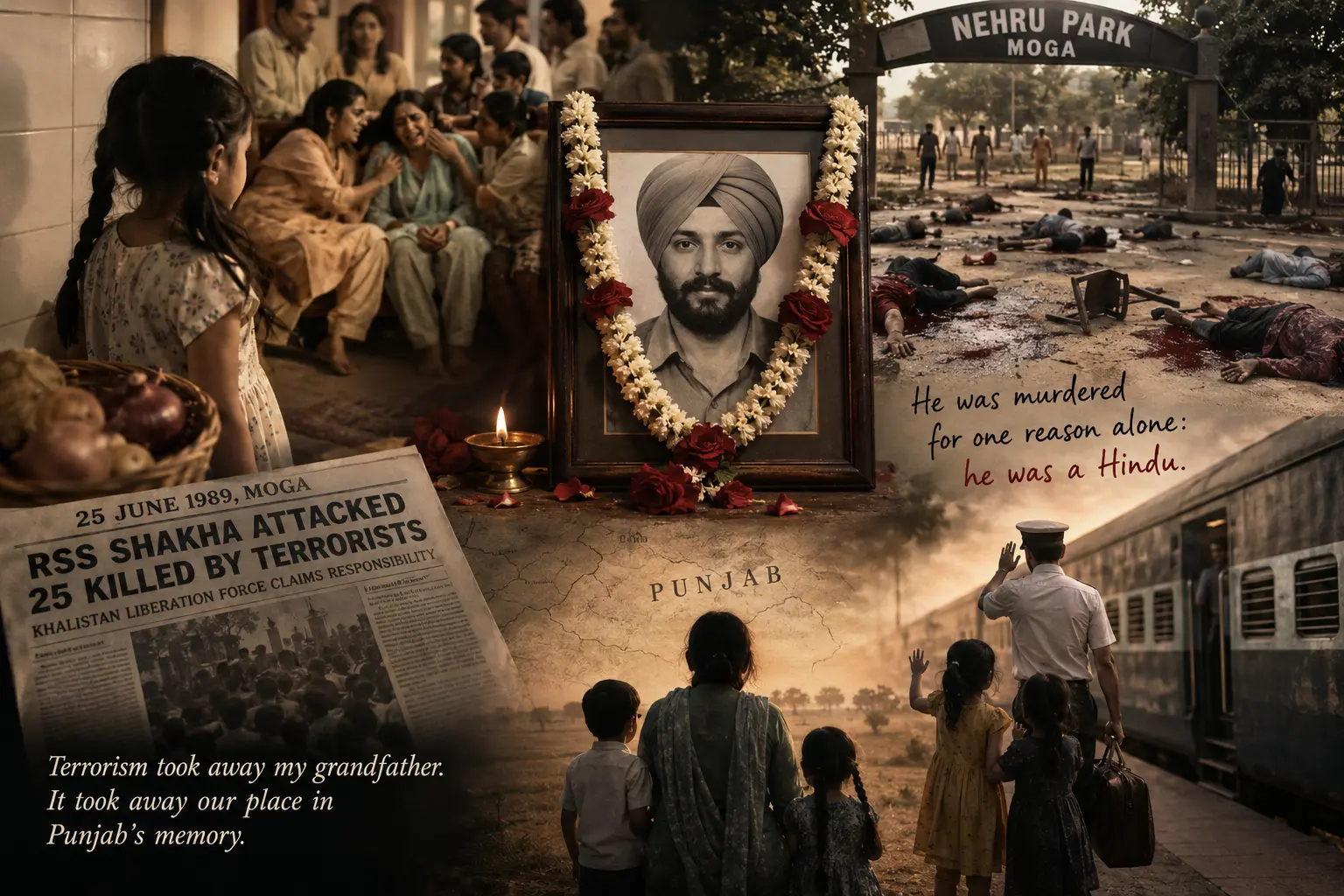
25 June 1989. Around 7.00 a.m. Kandivali, Bombay.
I wake up to piercing shrieks. I push myself out of bed, my eyes still half closed, my tiny feet hurrying out of the bedroom. The screams grow louder. There is chaos. My parents, my massi and massad, six of us children. Ma and Massi have collapsed onto the sofa while someone tries to make them sip water. The room is packed. I find myself standing in the kitchen, pressed against the white-tiled wall beside the basket of potatoes and onions.
My five-year-old mind tries to make sense of it all, but no one has the time to explain. I catch fragments of conversation, shards of sentences that have pierced Ma and Massi’s hearts.
Phaaji, as we lovingly called my Nana ji, had been shot dead by terrorists of the Khalistan Liberation Force at 6.25 that morning in Moga. I understood only one thing: He was dead. I did not understand what death meant. I did not understand grief or terrorism. I only knew that something catastrophic had happened.
Ma and Massi flew to Delhi and travelled by road to Moga with my younger brother and cousin for the last rites. Even in that moment, the greater concern for my father and uncle was making sure they reached safely. That was Punjab in those years. Even after a loved one had been murdered, families first worried whether those travelling to mourn would themselves make it back alive.
After Nana ji’s death, my mother travelled regularly to Moga to be with her family. Until she reached safely and called home, a quiet dread settled over our house. It never really left me. Even today, I need to know that the people I love have reached their destination safely.
In truth, fear had entered our lives even earlier. My parents had returned from Bombay and were living in Chandigarh, planning to build a home there. After 1984, my father decided we would settle in Panchkula instead. As a merchant navy officer who spent long periods away at sea, he could not bear the thought of leaving his young family alone in Chandigarh while he was away.
My sister and I travelled later with my father by train, the first train journey I remember. It was filled with confusion, separation anxiety because I had never been away from my mother, and a sense of dread that I could not yet understand.
That morning of 25 June 1989 remains one of my earliest and most vivid memories. The previous evening had been my aunt’s wedding anniversary. I remember eating fruit custard for dessert. The next morning, my Nana ji was among the twenty-five people killed when terrorists of the Khalistan Liberation Force opened fire at a morning RSS Shakha in Nehru Park, Moga. The bedside clock in his room stopped at the exact moment he was killed. Others may see that as coincidence. For us, the clock that stopped, and with it a part of our lives and all the possibilities that died with him, became part of our family history.
My Nana ji was murdered for one reason alone: he was a Hindu. That is a truth I came to understand much later.
It was my first encounter with death, grief and loss, long before I was old enough to understand why any of it had happened.
I have remarkably few memories of my grandfather. The fingers of one hand are enough to count them. Terrorism did not merely take away my grandfather; it took away from me, and from all his grandchildren, the chance to ever know him. I do not know what advice he would have given me, what stories he would have told, or what made him laugh. I do not know his love. What little remains is the memory of a kind man who, as bullets rained around him, shielded two children with his own body.
My mother survived, as people do. She raised us, celebrated birthdays, argued, laughed and carried on because there was no alternative. But something in her had changed forever. I would sometimes wake in the middle of the night and find her quietly crying into her pillow. I was five years old. There was nothing I could do. I felt utterly helpless. It is the first memory I have of that feeling.
For most of my life, I believed this was simply my family’s tragedy. It took me decades to realise that another loss had taken place alongside it. We had not only lost my grandfather and countless other Hindus; we had slowly begun to lose the place of Punjabi Hindus in Punjab’s collective memory.
This essay is about that second loss: The gradual erasure of Punjabi Hindus from Punjab’s public memory, not only from the history of its darkest years, but from the telling of Punjab itself. As a community’s dead are forgotten, so too are its contribution, its identity and, eventually, its place in its own homeland. Punjab’s story cannot be told truthfully while one of its oldest communities is reduced to a footnote in its own past.
Punjab is the land of my ancestors, my home. It has always been and will be, for as long as I breathe. Yet that belonging is increasingly neither acknowledged nor recognised, within the state or beyond it.
If you were to rely on popular culture, school textbooks, social media discourse or even many contemporary retellings of Punjab’s recent history, you could be forgiven for believing that Punjabi Hindus were either spectators to the violence or, worse, its villains. Neither is true. Punjabi Hindus lived through Partition. Punjabi Hindus lived through terrorism, which, for many families, was 1947 all over again. Yet it increasingly feels as though our place in Punjab’s history requires explanation, while our absence from it requires none.
Punjab’s recent history is often told as though it began with Operation Blue Star. By June 1984, Punjab had already endured years of escalating radicalisation, political violence and targeted killings. The 1978 clash between orthodox Sikhs and the Nirankaris, the emergence of separatist organisations, the assassination of Lala Jagat Narain in 1981 and a growing campaign of intimidation had already begun to reshape everyday life. Blue Star was a watershed, not the beginning.
The violence did not spare ordinary civilians. As terrorism spread, Hindus were increasingly targeted not because of what they had done, but because of who they were. Buses were hijacked and passengers separated by religion before being shot. Trains were stopped and travellers identified by name before being executed. Markets, places of worship, villages and public gatherings became targets. My Nana ji’s murder in Moga was not an isolated act of terror. It was one episode in a sustained campaign that claimed thousands of civilian lives over more than a decade.
The chronology below is illustrative rather than exhaustive. Drawn from publicly available records, it documents the systematic targeting of Hindu civilians during the years of terrorism. Data published by the South Asia Terrorism Portal (SATP), together with estimates cited by former Punjab DGP K.P.S. Gill, show that 11,694 civilians were killed by Sikh militant groups during the Punjab insurgency, of whom approximately 4,500 were Hindus. Why, then, have these events faded so completely from our collective memory?
| Selected Incidents Illustrating the Targeting of Hindu Civilians (1981–1991) | |||
| Date | Location | Incident | Casualties |
| 9 Sep 1981 | Ludhiana | Assassination of Lala Jagat Narain (Hind Samachar founder) | 1 killed |
| 20 Sep 1981 | Jalandhar | Gunmen open fire in a marketplace following Bhindranwale’s arrest | 4 killed, 12 injured |
| 5 Oct 1983 | Dhilwan, Kapurthala | Bus hijacked; Hindu passengers separated and shot | 6 killed |
| 18 Nov 1983 | Kapurthala | Bus hijacked; Hindu passengers targeted | 4 killed |
| 23 Feb 1984 | Punjab | Hindu passengers pulled off buses and trains and executed | 11 killed, 27 wounded |
| 21 May 1984 | Near Moga | Bus hijacked; Hindu passengers singled out | 4 killed |
| June 1984 | Amritsar | Operation Blue Star | — |
| 25 Jul 1986 | Muktsar | Bus attack targeting Hindu civilians | 14–15 killed |
| 30 Nov 1986 | Khuda, Hoshiarpur | Bus stopped; Hindu passengers gunned down | 24 killed |
| 6 Jul 1987 | Lalru | Haryana Roadways bus hijacked | 38 killed |
| 7 Jul 1987 | Fatehabad | Two Haryana Roadways buses attacked | 34 killed |
| 25 Jun 1989 | Moga | RSS morning shakha attack | 25 killed |
| 15 Jun 1991 | Baddowal | Passenger trains stopped; Hindu passengers separated and shot | 80–125 killed |
There is no single reason for forgetting this. It happened gradually through politics, popular culture, selective remembrance and, perhaps, the silence of Punjabi Hindus themselves. Over time, omission became its own version of history.
Politics shaped that process. Punjab’s insurgency did not emerge from a single cause, but from the convergence of genuine grievances, political opportunism, failures of governance, religious mobilisation, foreign support for separatism and a series of catastrophic political decisions. By the time terrorism reached its peak, ordinary Punjabis, Hindu and Sikh alike, were paying the price.
Reducing those years to a simple contest between heroes and villains does a disservice to everyone who lived through them. Sikh families lost fathers, mothers, sons and daughters. Hindu families lost theirs. Moderate Sikhs who opposed extremism were murdered alongside journalists, police officers, civil servants and ordinary citizens. Punjab’s suffering was shared, even if it was not identical or remembered equally.
The story we now tell about Punjab has become narrower than its history. Increasingly, Punjab’s story has come to revolve around two defining events: Operation Blue Star and the anti-Sikh massacres that followed Indira Gandhi’s assassination. Both deserve to be remembered. Blue Star remains one of the most consequential military operations undertaken by the Indian State, and the anti-Sikh massacres remain one of independent India’s greatest moral failures.
But neither is the whole story.
Remembering one set of victims does not require forgetting another. My grandfather’s murder does not diminish the suffering of Sikh families, just as the atrocities committed against Sikhs do not diminish what happened to families like mine. A truthful history has room for both.
I realised how complete this erasure had become when Satluį was released and I began reading the conversations surrounding it. The film powerfully captures the fear, suspicion and trauma that engulfed Punjab during the years of terrorism. Yet it remains silent about one uncomfortable reality: the systematic targeting of Hindu civilians. I was left wondering whether someone with no prior knowledge of Punjab’s history would ever know that thousands of Hindu families also lived through those years in fear; that thousands were killed, countless others fled, and many who stayed learnt to live with uncertainty. Their stories remain largely absent from the narratives through which the rest of the country has come to understand Punjab’s darkest years.
That omission extends far beyond film. Spend a few minutes on social media and Punjabi Hindus scarcely appear except as the oppressors. The years of terrorism are discussed as though no Hindus were deliberately targeted, no families uprooted, and no children orphaned. It is as though our loss and our grief never existed.
The silence extends beyond social media. This year, June 25, the anniversary of the Moga massacre in which my grandfather was killed, passed without remembrance of any kind.
No television debates. No newspaper editorials. No commemorations. No statements from political leaders. Not even from the RSS, the organisation whose morning shakha my grandfather had attended when he was killed. Some victims have simply been forgotten.
This is how historical erasure happens. Certain tragedies are discussed, documented and commemorated until they become part of a society’s shared memory. Others survive only in family conversations, fading a little more with every passing generation. Public memory becomes selective, not necessarily through malice, but through repetition. What is never told is eventually forgotten.
When a community disappears from the telling of a place, it slowly disappears from the place itself, not physically but historically. Punjabi Hindus become a footnote, as though they were merely bystanders to a tragedy that unfolded around them rather than a community that lived through it, suffered because of it and, for generations before it, helped shape Punjab’s language, literature, commerce and culture.
Every innocent life lost diminished Punjab. Every family carries its own wound. A history that excludes one set of victims is, by definition, incomplete. In our case, that exclusion has not only erased a chapter of Punjab’s history; it has gradually erased Punjabi Hindu identity itself.
Since the erstwhile state of Punjab was reorganised into present-day Punjab, Haryana and Himachal Pradesh, the identity of Punjabi Hindus has steadily faded. Some of it has been deliberate, some inadvertent, shaped by politics, the media, state and non-state actors, and popular culture. Mention Punjab almost anywhere in India or abroad, and the default assumption is that a Punjabi is a Sikh. The stereotype has been repeated so often that it now passes for truth. I have lost count of the number of times I have been asked whether I am Sikh simply because I come from Punjab. Imagine assuming that every Bihari is a Buddhist because Siddhartha attained nirvana there. It no longer surprises me. It still saddens me.
If Punjabi becomes synonymous with Sikh, the Punjabi Hindu gradually ceases to exist in the public imagination except as an outsider, an afterthought or, increasingly, as an antagonist. That is precisely what has happened. The deaths of Punjabi Hindus during Partition are rarely part of the larger conversation. The thousands who lived through the years of terrorism scarcely feature in popular retellings of that period. Those who were deliberately targeted because they were Hindus have all but vanished from the story Punjab now tells about itself. I have struggled to find my place in my own land’s history. My belonging itself has become questionable.
There have been moments when I found myself wishing I had been born Sikh. Not because I wanted to be someone else, but because I wondered whether my place in Punjab would then have required less explanation. It is a strange thing to feel like an outsider in the land your ancestors called home.
I sometimes feel as though my identity, my culture, my festivals, my traditions and my civilisational history are steadily receding. Punjab existed long before the present state came into being, long before the reorganisation of states in 1966. Sikhi emerged from the soil of Punjab and became one of its defining civilisational traditions, but it did not replace the many identities that already existed here.
Somewhere along the way, the idea of Punjab itself became increasingly inseparable from a single religious identity. What began as a demand for linguistic reorganisation gradually acquired a religious character until even our shared cultural inheritance came to be viewed through a single religious lens. Festivals such as Lohri and Baisakhi long predate the modern politics of identity and have been celebrated across communities in Punjab for generations. Yet today they are often presented almost exclusively as Sikh festivals, as though Punjabi Hindus were never part of their history.
This narrowing of Punjab’s identity did not happen overnight. It was reinforced over decades by politics, religious institutions and the narratives they chose to elevate.
Punjab’s politics is full of contradictions. In the late 1970s, Indira Gandhi’s government encouraged the rise of Jarnail Singh Bhindranwale as part of its political contest with the Akalis. He would later occupy the Golden Temple, culminating in Operation Blue Star.
Today, Bhindranwale is commemorated as a martyr by sections of the Sikh religious and political establishment, while the Congress party, whose leaders presided over the anti-Sikh massacres of 1984, remains electorally relevant in Punjab. The irony is difficult to ignore. More difficult to understand is how resentment came to be directed towards ordinary Punjabi Hindus, a community that neither created these political forces nor escaped their consequences.
Increasingly, issues ranging from the farm protests to debates over sacrilege laws are reduced to a binary of Hindus versus Sikhs. Nuance disappears. So does the possibility of disagreement. As a Punjabi Hindu, I have often found my views on Punjab’s politics treated as less authentic simply because of my religion, as though only Sikhs have the right to speak for Punjab. The loss is one of agency, voice and, ultimately, belonging.
Perhaps we Punjabi Hindus also bear some responsibility for not speaking in a more united voice. That silence has cost us our agency. We carried our grief quietly. We moved to Delhi, Mumbai, Gurgaon, Chandigarh and beyond. We told these stories around dinner tables but rarely wrote them down. We never demanded remembrance or insisted on our place in Punjab’s history. We assumed history would remember us. It rarely remembers those who insist on not being forgotten.
What deepens the hurt is that, as a Punjabi Hindu, I often find my lived experience questioned or dismissed, while opinions about Punjab from those with no roots in the state carry greater legitimacy simply because they fit the dominant narrative. Hindus and Sikhs continue to live peacefully alongside one another across much of Punjab, but peace cannot rest on selective memory or unresolved fault lines. When the normalisation of figures like Bhindranwale enters everyday conversation, I find myself wondering how secure that peace really is. More than anything else, it has left me asking whether there is still room in Punjab’s story for people like me.
This selective telling does a disservice not only to Punjabi Hindus, but also to the thousands of Sikh families whose lives were shattered during the years of terrorism. The history of Punjab deserves better than slogans, simplifications and inherited grievances. Punjab’s tragedy cannot be understood through binaries of Hindu versus Sikh, victim versus oppressor, or patriot versus separatist. It was shaped by political opportunism, religious extremism, failures of governance, foreign interference and ordinary people caught in the middle. To reduce it to a single narrative is to misunderstand it.
In the current climate, where narratives are increasingly shaped by social media, moderate voices are steadily being drowned out. I fear for Punjab and for what lies ahead. Once among India’s most prosperous states, it now struggles economically, socially and politically. Economic decline creates fertile ground for division, leaving Punjab dangerously vulnerable to those who continue to profit from its unrest.
Punjab today reminds me of the old Punjabi story of two cats quarrelling over a single roti. A monkey offers to settle the dispute fairly, but with every attempt takes another bite for himself until nothing remains. The tragedy is that Punjab has had far too many monkeys, and we have never stopped fighting long enough to notice who has been eating the roti.
Perhaps that is why this essay is not about blame. Blame has occupied enough space in Punjab’s history. Memory has not.
I was fortunate in one respect. I was never taught to hate. I grew up in a home where Sikhs were never spoken of as the enemy, despite what my family had suffered. My closest friends have been, and still are, Sikh. My teachers, colleagues, neighbours and many of the people I grew up with were Sikh. The distinction between a people and the men who commit violence in their name was never blurred for me because of my family. It is a distinction worth preserving, especially today, when outrage so easily gives way to generalisation.
I do not want my grandfather to be remembered because he was Hindu. I want him remembered because he was a grandfather, a father, a husband and a Punjabi. A man who left for his morning shakha and never came home. Before they became statistics, the victims of those years belonged to families. They had names, routines, ambitions and people waiting for them to return. If we remember only some of them, we do not honour history. We edit it.
I do not know whether I will live to see Punjab regain what it once was. I only hope that my son grows up secure in the knowledge that he is, without qualification, a Punjabi Hindu. That he never has to search for his place in Punjab’s history, as I have. That he never has to justify his belonging to the land his ancestors called home. Because if he does, then for us, it will have been 1947 all over again.
Author Saryu Bansal is a communication and brand strategist, writer, and founder of Black Sheep & Co., a boutique strategic advisory specialising in brand, narrative, and positioning. Based in Chandigarh, she writes long-form essays on culture, identity, education, and the social narratives that shape modern India.

