
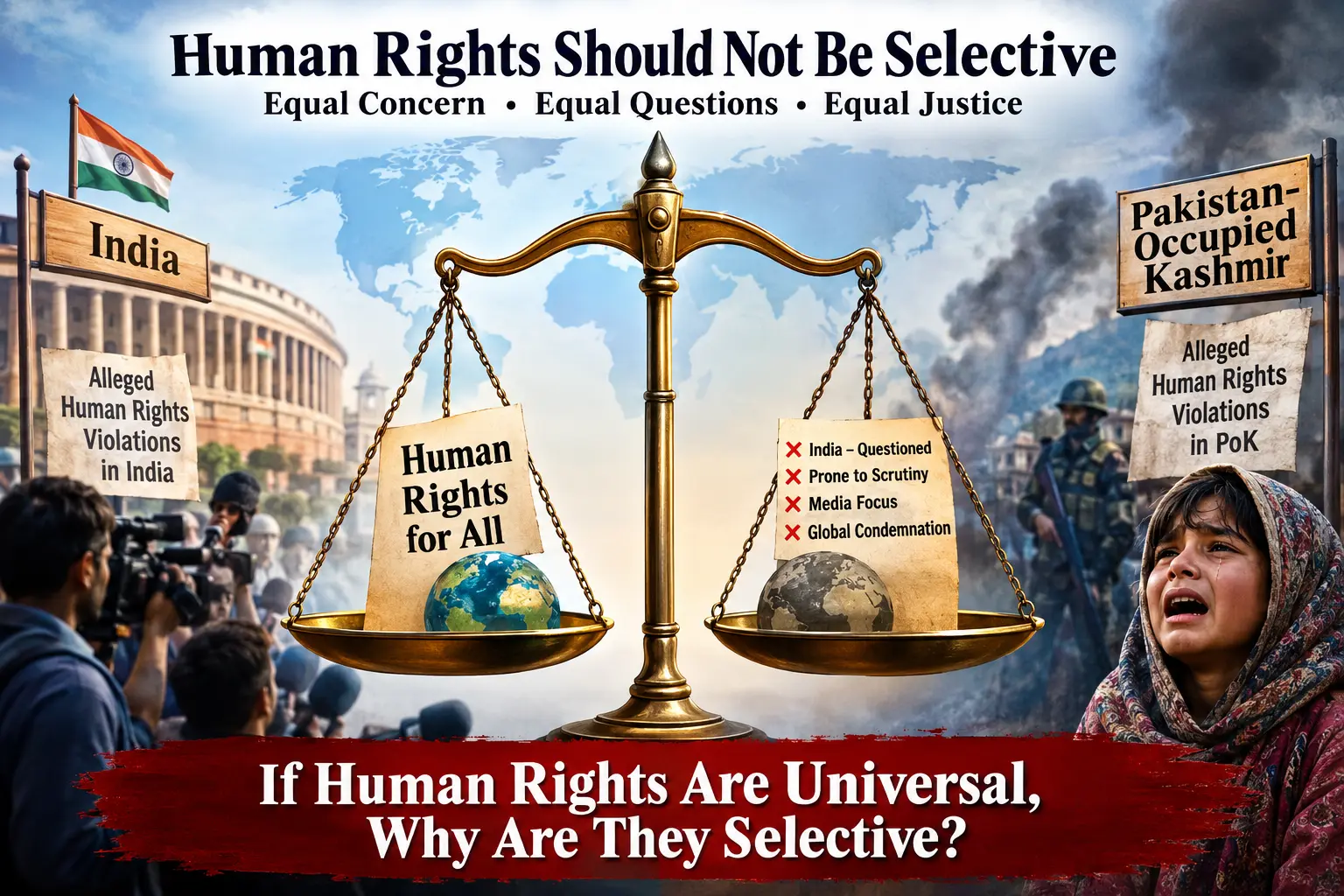
Human rights are not conditional upon any geographical, political or ideological boundaries, they are universal norms that every human in this universe is entitled to and it is the primary responsibility of all human rights organisations across the globe to ensure that no man is deprived of these basic fundamental rights on any grounds whatsoever. But, are all human rights universal, or have they become selective?
In this regard, it appears that there is a growing disquiet around the world over recent allegations concerning the revolting events in Pakistan-occupied Kashmir. Pakistan-occupied Kashmir is witnessing a crackdown on protesters during the crucial election period.
Violent confrontations are being reported, with many protesters killed. Human rights organisations have condemned the crackdown, calling for independent investigations into the allegations of rights abuses. But if these allegations turn out to be true, shouldn’t they get as much coverage in the international media and as much condemnation from international human rights organisations as similar allegations against any other country would get?
India has always emphasised that Pakistan-occupied Kashmir as its territory, and the Government of India has repeatedly expressed its stance on this issue in the past, both verbally and through diplomatic channels. So if Pakistan-occupied Kashmir is a part of India, don’t its people deserve to be entitled to the same basic fundamental rights as Indian citizens?
And this brings me to the crux of the issue.
Whenever there is an alleged human rights violation in India, the international media picks it up, human rights organisations have their press conferences, debates erupt on whether or not such actions by the Indian administration are against international norms, and the onus is placed on India to justify its actions. India may or may not have done the questionable act, it is a democracy, it is entitled to be questioned on the issue, which is its right and responsibility.
But, what I find absurd is the fact that there is no equal and opposite reaction to similar allegations made against Pakistan, but by human rights organisations that exist in India. Or rather, why does Pakistan occupied Kashmir not get the same response from human rights organisations abroad as India gets when similar allegations are made against its administration?
I am not suggesting that India should not be questioned. On the contrary, I believe that every political organisation in the world, particularly every democracy, should be put under the light microscope whenever there are allegations of rights violations against any of its citizens. But, if the international community wants India to comply to these norms, India must also be made to comply to the same norms.
For human rights to hold any meaning, for international organisations to have any credibility, human rights cannot be selective, they cannot be based on any political equations, it cannot become convenient for international communities to defend their own while questioning others on matters of international law and humanitarian stands. If human rights are being questioned in India, then if the same allegations are being made against Pakistan, shouldn’t Pakistan be questioned too?
The problem, unfortunately, is not confined to just human rights being selectively defended or violated. It is a matter of credibility, a matter of how far the international community can go before public opinion in these countries starts to become hostile. For the credibility of human rights organisations to remain intact, as well as the credibility of media houses abroad, it needs to be questioned by the public as to why Pakistan occupied Kashmir is not getting the same treatment as any other region in India is getting when it comes to allegedly being subjected to rights violations. Because if the Government of India has repeatedly stated its claims of Pakistan occupied Kashmir being an integral part of the country, the human rights organisations in India must be questioned on their stance on this very issue, for they are the ones that will decide if the rights of the people of Pakistan occupied Kashmir will not be defended.
Human rights should not be a debatable matter because at the end of the day, human rights violations are a matter of life and death.
Author Kumar Himesh specializes in National Security and strategic affairs at Rashtriya Raksha University, Lucknow.
His work focuses on India’s defense policy and internal security.

