
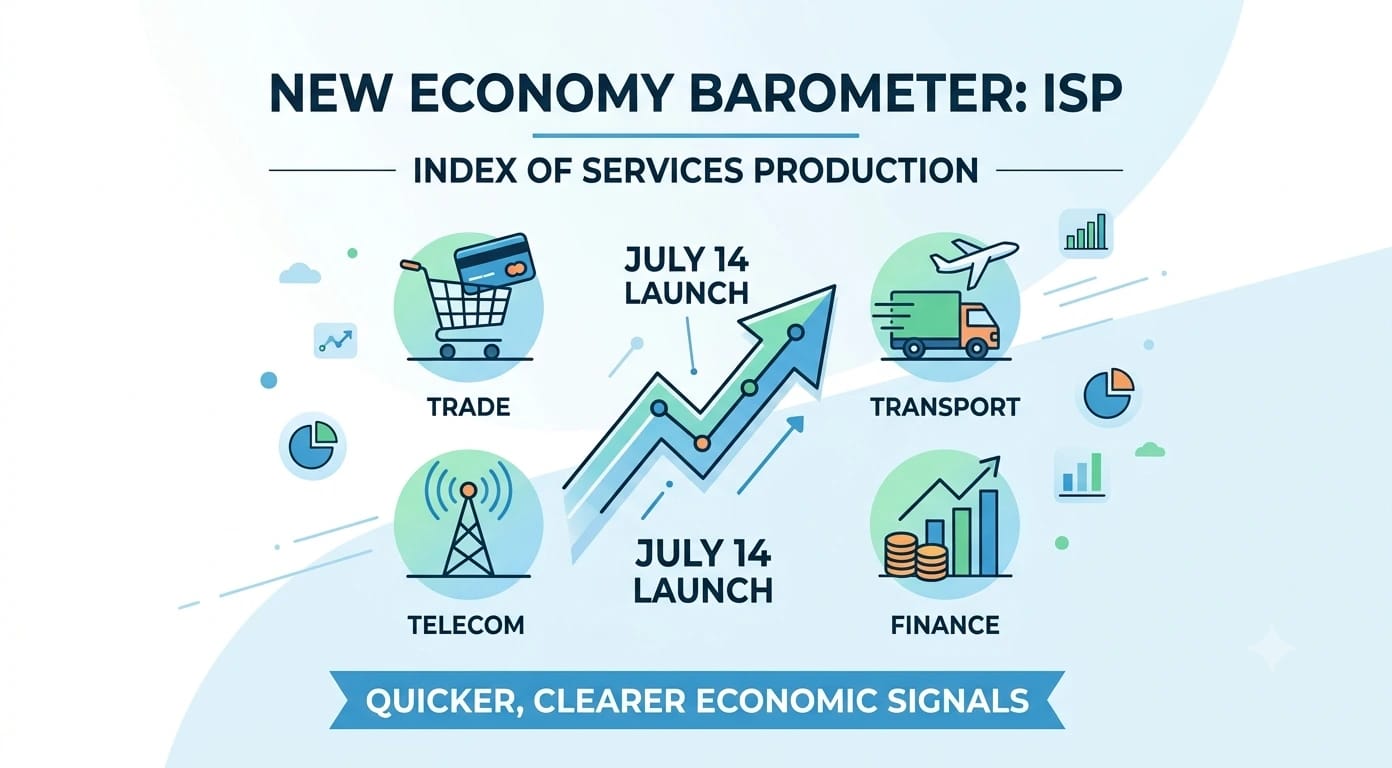
A new economic barometer is set to arrive on July 14, and it may change how people understand short-term economic movement. The new Index of Services Production, or ISP, is being introduced to track services activity more closely, since services now make up well over half of gross value added and have become the main driver of growth.
Until now, monthly economic reading has depended mostly on industrial data, especially the Index of Industrial Production. That worked well for manufacturing and factory output, but it did not show the full picture because services have grown much larger and more important in daily economic life. This is why the new index matters: it fills a gap that economists have pointed out for years.
The new index will cover many service areas that most people use every day. These include trade, transport, telecom, accommodation, entertainment, financial services, and real estate. Together, these segments make up nearly two-thirds of the services sector’s GVA, so the index should give a fairly strong signal about how this part of the economy is moving.
The idea is simple. If these services are doing well, it usually means business activity, travel, spending, and financial movement are also healthy. If the index slows down, it can be an early warning that demand is softening. That makes the indicator useful not only for officials, but also for companies, investors, and anyone trying to understand the direction of the economy.
The first version will not cover everything. Education and healthcare are not included yet because the needed data systems are still being prepared. The informal services economy and non-market activities like public administration, defence, social work, and central banking are also outside the first rollout. Even so, the index is expected to give a much better monthly view than what was available before.
A key feature of this index is that it will rely heavily on digital and administrative data rather than slow traditional surveys. The Goods and Services Tax Network will be the main source, with support from sectors such as railways, civil aviation, banking, and insurance. This approach should help make the data faster, more regular, and more reliable.
The index will likely be released on a trial basis first, so users can study it and give feedback. It is also expected to come out about 60 days after the month being measured, which makes it useful for near real-time economic monitoring. That timing is important because decision-makers often need signals before full quarterly numbers arrive.
This launch also fits into a wider upgrade of economic statistics. The government has already revised GDP and industrial production base years and is using more high-frequency indicators and nowcasting tools to monitor the economy more closely. In simple words, the system is becoming faster, smarter, and more focused on real-world changes as they happen.
When a new index tracks transport, spending, finance, and services more closely, it gives a clearer sense of whether the economy is picking up, staying steady, or slowing down. That is why this new barometer is more than a technical update; it is a new window into everyday economic activity.

