
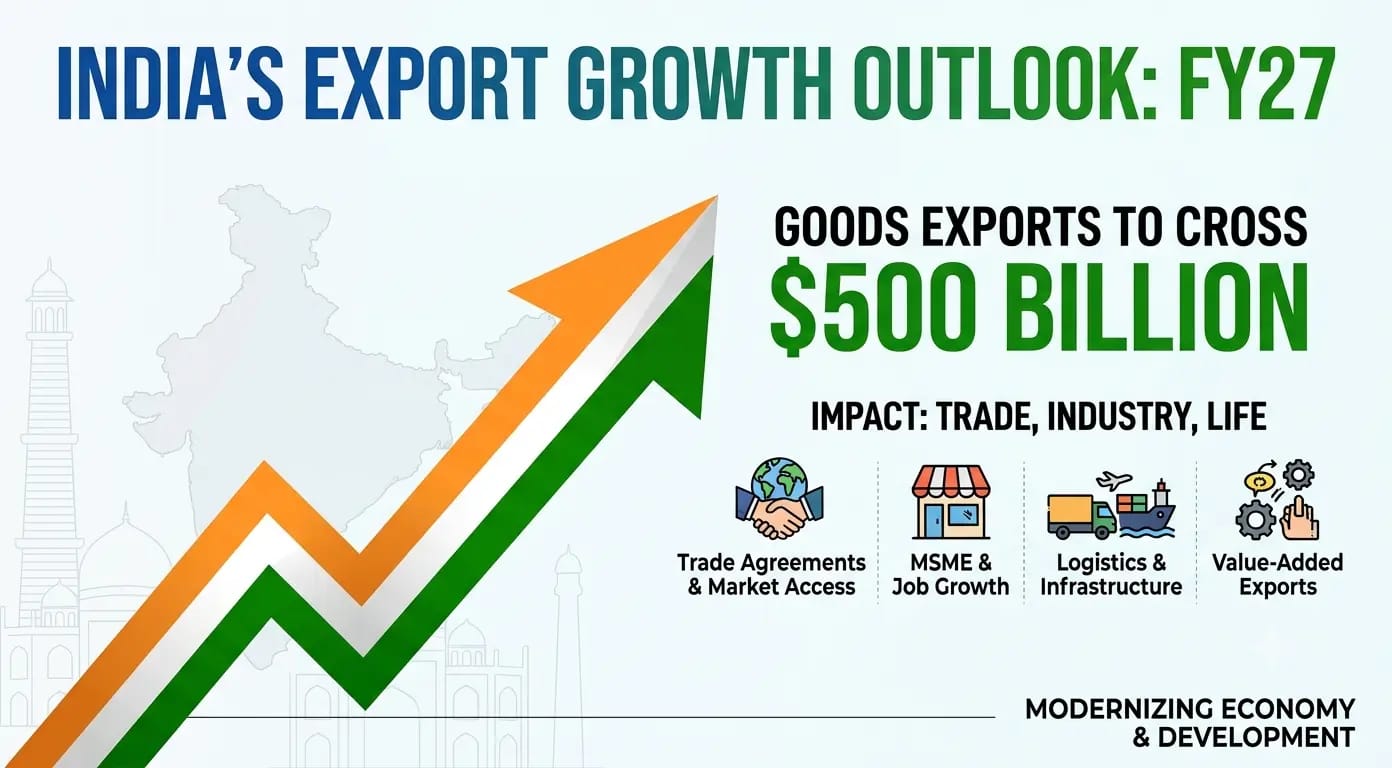
Good exports have a strong likelihood of crossing the USD 500 billion threshold in FY 2027. Exports are intrinsically linked with employment, industrial production, business incomes and the economic fortunes of a country.
Strong growth in exports will drive positive spillovers in the rest of the ecosystem from ports and shipping to banks and related services.
The concept is quite simple; as exports rise, work opportunities grow, market access expands, and a sense of confidence blooms around indigenous manufacturing capabilities. Growth driven by key factors, is expected to drive this forward, as, on the one hand, the expectation of stronger bilateral trade deals, by way of lower tariffs and more seamless access, would play a role in pushing exports.
Additionally, diversification of the export basket, that is, reducing reliance on a few items and exploring a more comprehensive array of goods, would ensure sustainable and relatively resilient export growth. A significant portion of export opportunities lies in SMEs that already produce quality products at competitive prices but often falter in meeting quality standards, managing logistics and marketing at the international level.
Training, mentorship and assistance with logistics can allow them to participate and flourish. Such participation would bring many benefits to communities in a broad spectrum, as they primarily create jobs in rural and urban areas. Efficient ports, roads, and warehousing facilities, to be able to ship goods seamlessly, are crucial to unlock this potential. Slower and costly movement of goods would stunt the growth.
Smooth flow and cheaper shipping will be required if global demand continues to surge. Another important aspect that is important for driving export growth is through diversification beyond traditional products, for which new product categories include industrial goods, value added goods etc.
Would have to be developed and market entry facilitated. Such products carry value addition and higher remuneration with more innovation involved in manufacturing them, moving the economy towards industrial development rather than solely exports of raw materials and semi processed items.
Export growth would help generate more employment, increased wages and a wider market for various economic sectors including both small scale and larger industries.
These increased exports will also help boost the quality and technological capability as exports drive competitive pressure which will also rub off on local industries making better products for consumers in the domestic market as well.
Policy is a key lever and stable, pro-business government policies can facilitate and sustain export growth. As and when the policy regime continues to remain practical and clear, a level of comfort is provided to business owners to invest more in expansion and innovation of their products to enhance exports.
Thus, achieving the export target is not just a number but it’s about strengthening the entire support ecosystem.
Achieving exports of USD 500 billion in FY 2027 will be an important indicator of overall economic progress that comes through greater global engagement, an enhanced production base and an increased capacity to export goods of all descriptions and value-addition and a robust, responsive support system and policy environment to back this up.

