
Bank provisioning has quietly become one of the most important stories in the Indian banking sector because it shows how deeply the system has changed in recent years.
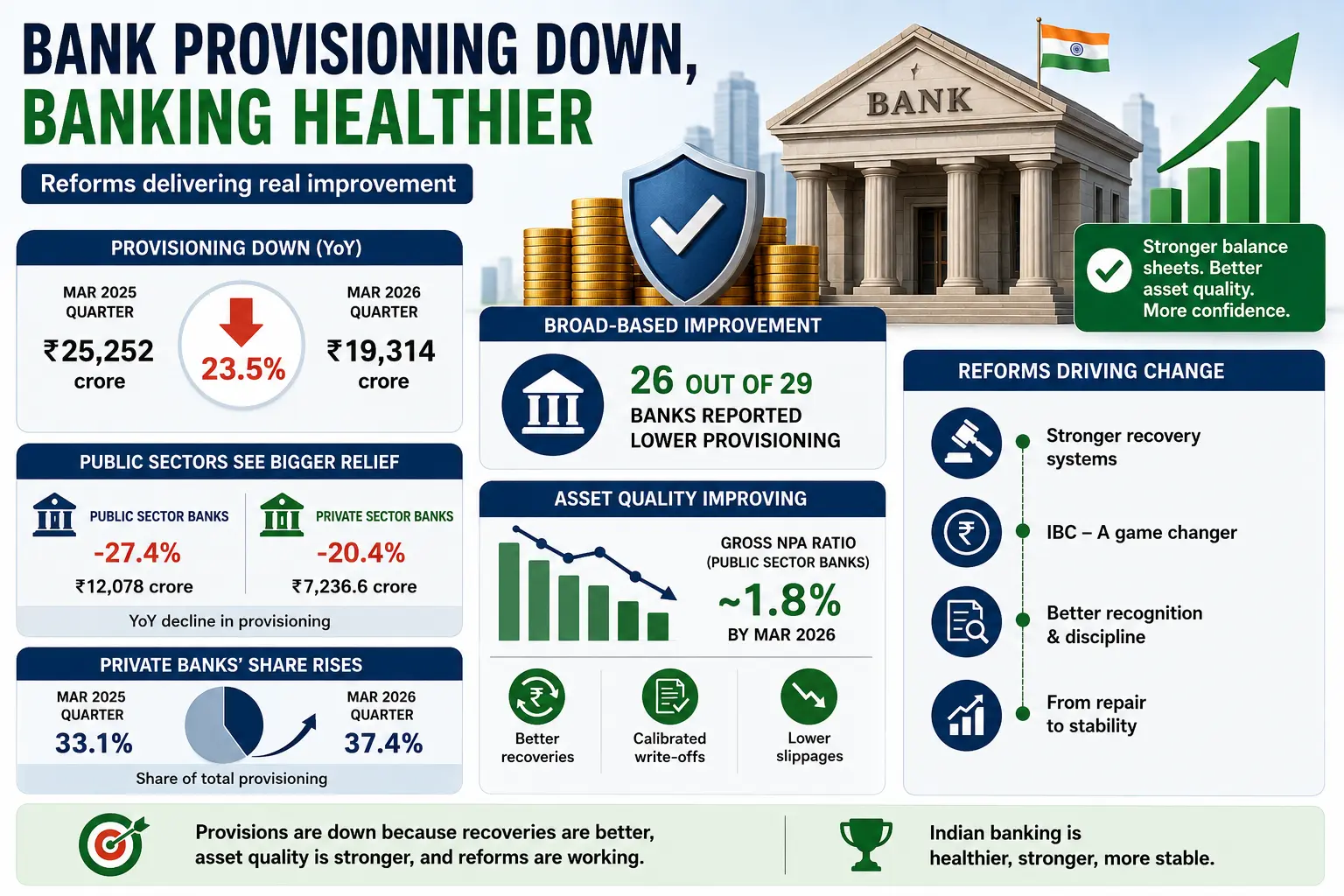
A recent report highlighted that loan loss provisioning by 29 banks fell to about ₹19,314 crore in the March 2026 quarter, which was 23.5 percent lower than a year earlier, and this decline came mainly because banks are facing less pressure from old bad loans and are recovering more money from stressed accounts.
This matters because provisioning is the money banks keep aside when there is a fear that some loans may not come back, so when provisioning falls in a healthy way, it usually signals better balance sheets, stronger confidence, and cleaner books.
This story becomes even more meaningful when seen in the bigger reform journey of the last ten to twelve years. Banking has been one of the biggest areas of reform in India, especially after the rise in bad loans forced attention toward recovery, recognition of stress, and tighter discipline in lending.
Over time, steps linked with stronger recovery systems, more serious treatment of non-performing assets, and mechanisms such as the Insolvency and Bankruptcy Code helped banks move away from the earlier period when weak loans stayed unresolved for too long.
Because of this shift, provisioning is no longer being driven by panic or delayed recognition in the same way as before; instead, it is gradually reflecting stronger recoveries and improved asset quality.
The numbers in the report make this change easy to understand. Out of the 29 banks studied, 26 reported lower provisioning, which means the improvement was broad and not limited to only a few lenders.
Public sector banks showed the biggest relief, with loan loss provisions falling by around 27.4 percent year-on-year to about ₹12,078 crore, while private sector banks also saw provisioning fall by roughly 20.4 percent to around ₹7,236.6 crore.
This difference suggests that public sector banks, which once carried a heavier burden of stressed assets, are now benefiting more clearly from the cleanup and recovery cycle.
Another important part of the story is asset quality, because lower provisioning becomes meaningful only when loan books are actually improving. The report noted that the gross non-performing asset ratio for a large set of public sector banks could come down to nearly 1.8 percent by March 2026, helped by better recoveries, calibrated write-offs, and lower slippages, which means fewer fresh loans are turning bad.
In simple terms, banks are not just setting aside less money; they are doing so because the quality of their lending is looking better and because old problem loans are being handled more effectively than before. That is why this development feels less like a temporary number and more like proof of structural improvement.
The contrast between public and private banks also adds a human and practical angle to the story. Private banks were already seen as relatively stronger on risk management, and their share in total provisioning rose to 37.4 percent from 33.1 percent a year earlier, while the share of public sector banks came down.
Even then, the public sector banking space appears to be showing a sharper visible turnaround because it has further ground to cover and therefore gains more attention when improvement appears in the numbers. In a way, this is what makes the story relatable: when the weakest part of a system begins to look stronger, the change feels more real.
So the real message is not only that provisioning is down, but that years of reform are finally showing up in a simple and visible way. A cleaner recovery framework, stronger recognition of bad loans, better control over fresh stress, and legal reforms such as IBC have slowly changed the rhythm of banking from repair mode to a more stable operating mode.
This is why bank provisioning is such a strong short-format story: it says, without too much complexity, that Indian banking is looking healthier because recoveries are better, asset quality is stronger, and reform is now visible in the numbers that matter most.

