
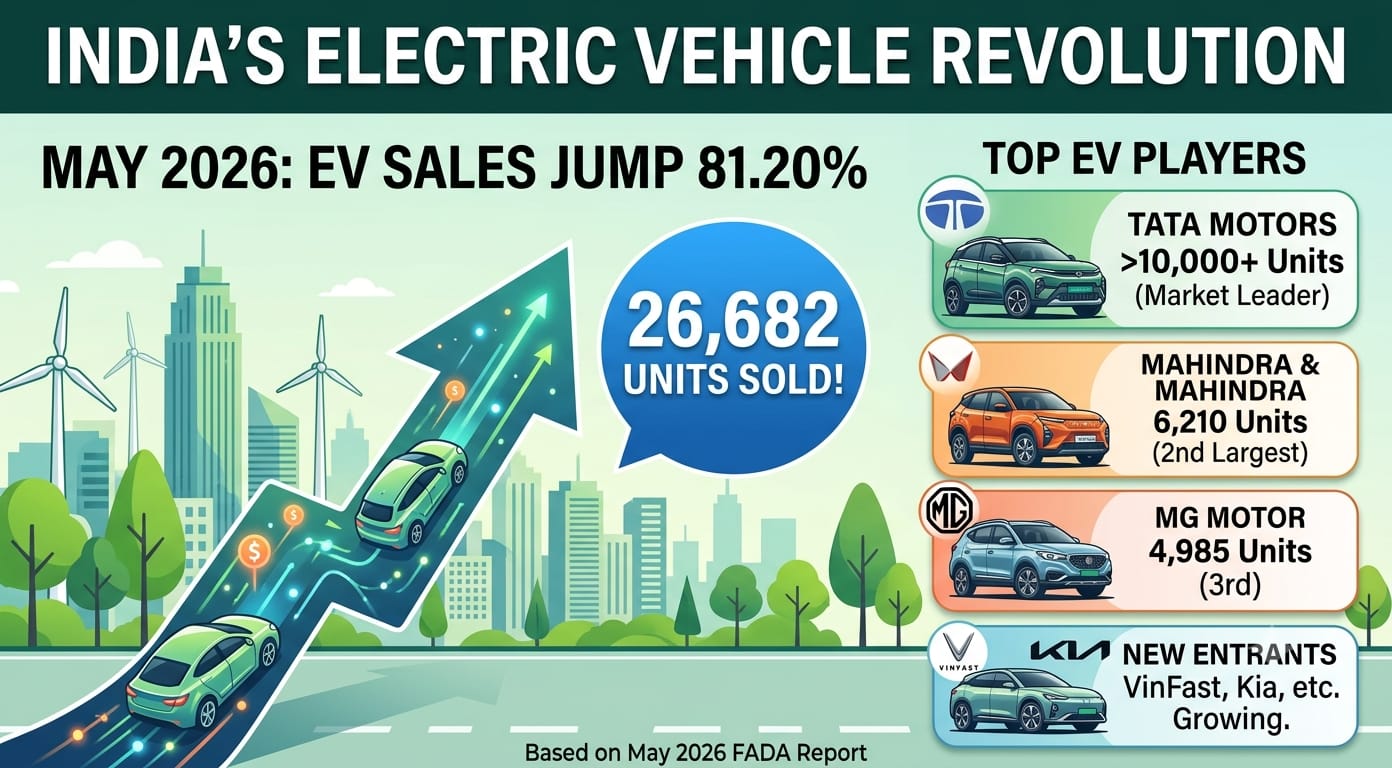
Electric passenger vehicle sales in India have reached a remarkable new milestone, with retail numbers jumping 81.20 percent to 26,682 units during May 2026 according to the Federation of Automotive Dealers Associations report.
This surge represents more than exceptional growth and signals a fundamental shift in how Indian families approach car purchases. The electric vehicle market is no longer sitting in early adoption stages but has moved firmly into mainstream acceptance, with ordinary buyers increasingly choosing electric options over traditional fuel-powered vehicles.
Tata Motors stands as the clear leader in this electric revolution, crossing the historic 10,000-unit monthly sales mark for the first time ever. The company sold 10,339 electric passenger vehicles in May alone, capturing nearly 40 percent of the entire market share.
This achievement demonstrates that Tata has successfully built trust with Indian consumers who were previously hesitant about electric vehicles. The brand’s success comes from offering multiple models across different price ranges, making electric cars accessible to various income groups rather than limiting them to luxury buyers only.
Mahindra & Mahindra recorded its highest-ever electric vehicle volumes with 6,210 units registered in May 2026, positioning itself firmly as the second-largest player. The company’s ambitious entry into the electric space with newly launched models has resonated well with buyers looking for alternative options beyond Tata.
MG Motor India followed in third place with 4,985 units, while Maruti Suzuki, the traditional market leader in conventional cars, entered the electric space with 1,591 units, showing its commitment to transitioning toward sustainable mobility.
The growth pattern reveals something important about Indian consumer behavior. Month-on-month sales increased by 4.6 percent from April’s 24,753 units, proving that the momentum is sustained and not just a one-month spike.
Year-on-year comparisons show the market has nearly doubled, rising from 14,323 units in May 2025. This consistent growth trajectory indicates that electric vehicles are becoming a practical consideration for average families, not just environmentally conscious early adopters.
EV penetration in the four-wheeler passenger car segment has increased from 5.9 percent in April to 6.6 percent in May 2026. This percentage represents the proportion of all new car sales that are electric, and while still small compared to conventional vehicles, the rapid improvement shows the transition is accelerating. In two-wheelers, electric penetration has reached 9.2 percent, demonstrating that the electric shift is happening across all vehicle categories.
Multiple factors contribute to this impressive growth. Expanding charging infrastructure across cities makes electric ownership more practical for daily use. Rising fuel prices for petrol and diesel vehicles make electric options financially attractive over the vehicle’s lifetime.
Government incentives and subsidies continue to support buyers who choose electric. The availability of more models across price ranges gives consumers genuine choices rather than being limited to expensive options. Growing awareness about environmental impact and air pollution concerns also influence buying decisions.
New entrants like VinFast have captured 4.8 percent market share with 1,238 units in their first months, while Kia achieved remarkable 751 percent year-on-year growth despite starting from a small base.
Hyundai and Citroen have faced challenges with declining sales, showing that not every brand succeeds automatically in this transition. The market is clearly rewarding companies that offer compelling products with proper support systems.
The electric vehicle revolution in India represents more than just changing what cars people buy. It signals a broader transformation toward sustainable transportation, reduced dependence on imported fuel, and cleaner cities with better air quality.
As charging stations become more common and battery technology improves, the choice between electric and conventional vehicles becomes increasingly about preference rather than compromise. The May 2026 numbers prove that India’s electric transition is moving forward with genuine momentum, setting the stage for continued growth in the coming years.

