
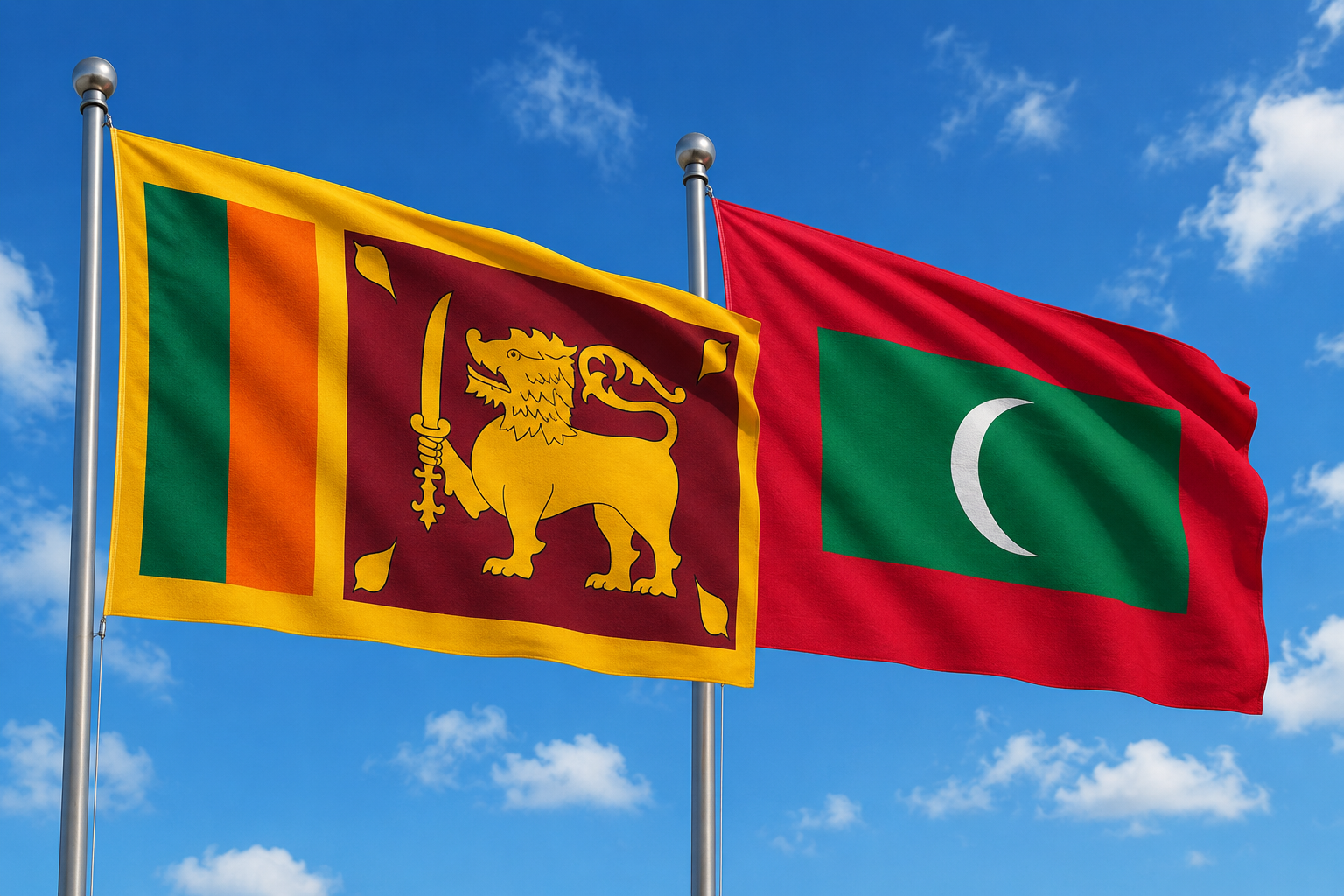
The recent flurry of agreements between Sri Lanka and the Maldives reflects a significant deepening of bilateral relations that extends beyond traditional diplomatic engagement into the domains of security, law enforcement, economic cooperation, and regional stability.
The approval on June 1, 2026, of the bilateral agreement on Mutual Legal Assistance (MLA) in Criminal Matters, alongside the signing of seven Memoranda of Understanding (MoUs) during Maldivian President Mohamed Muizzu’s visit to Colombo in May 2026, indicates a broad-based effort by the two Indian Ocean neighbours to institutionalise cooperation amid evolving regional challenges.
The MLA agreement, signed in July 2025 and now entering the implementation phase, establishes a legal framework for cooperation in criminal investigations and prosecutions. Significantly, the agreement covers terrorism-related offences, terrorist financing, asset tracing and forfeiture, and the identification, seizure and confiscation of proceeds of crime.
Such provisions are particularly relevant in an era marked by the increasing transnationalisation of security threats. The Indian Ocean Region (IOR) has emerged as a critical strategic space where illicit financial flows, organised crime networks, maritime trafficking, cyber-enabled crimes, and extremist linkages often transcend national jurisdictions. The ability of law enforcement agencies to share evidence, trace financial transactions, and cooperate in investigations is therefore becoming an indispensable component of national security.
At the same time, the seven MoUs signed in Colombo demonstrate that the bilateral relationship is not being driven solely by security concerns. Cooperation in tourism, education, youth development, sports, archiving, defence training, and economic engagement, points to a deliberate attempt to broaden the foundations of the partnership.
Discussions on trade expansion, investment promotion, fisheries cooperation, skills development, and the possible establishment of a Bank of Maldives branch in Sri Lanka suggest that both governments view economic interdependence as an important pillar of long-term stability. For Sri Lanka, which is gradually consolidating its recovery from the economic crisis of 2022, stronger commercial ties with the Maldives offer opportunities for investment and services-sector growth. For the Maldives, Sri Lanka remains an important partner in education, healthcare, training, and logistics.
The question, however, is whether these initiatives flow from rising concerns about criminal or terrorist threats. The answer is both yes and no. The MLA agreement clearly reflects growing awareness of the challenges posed by transnational crime and terrorism financing. Although neither country currently faces a large-scale active terrorist insurgency, both have experienced the consequences of extremist violence.
Sri Lanka continues to deal with the legacy of the 2019 Easter Sunday attacks, while Maldivian authorities have repeatedly expressed concerns over radicalisation, foreign terrorist fighter networks, and extremist recruitment. Moreover, both countries occupy strategically important maritime spaces that can potentially be exploited by criminal syndicates involved in narcotics trafficking, money laundering, and illegal financial activities. Enhanced legal cooperation is therefore a prudent response to emerging and future security risks.
Nevertheless, reducing the recent agreements solely to counter-terrorism concerns would be misleading. The broader package of MoUs indicates that Colombo and Malé are pursuing a comprehensive partnership shaped by economic pragmatism, people-to-people connectivity, and the shared strategic imperative of maintaining stability in the IOR. Defence cooperation and legal assistance mechanisms are important components of this agenda, but they coexist with efforts to expand trade, strengthen institutional linkages, and create avenues for human capital development.
Taken together, these developments signal a maturing Sri Lanka-Maldives partnership that is increasingly multidimensional. While concerns over transnational crime and terrorism have undoubtedly contributed to closer security cooperation, the overall trajectory suggests a broader strategic convergence aimed at enhancing resilience, prosperity, and stability across the Indian Ocean neighbourhood.
Author: Afsara Shaheen – Research Associate, Institute for Conflict Management

