
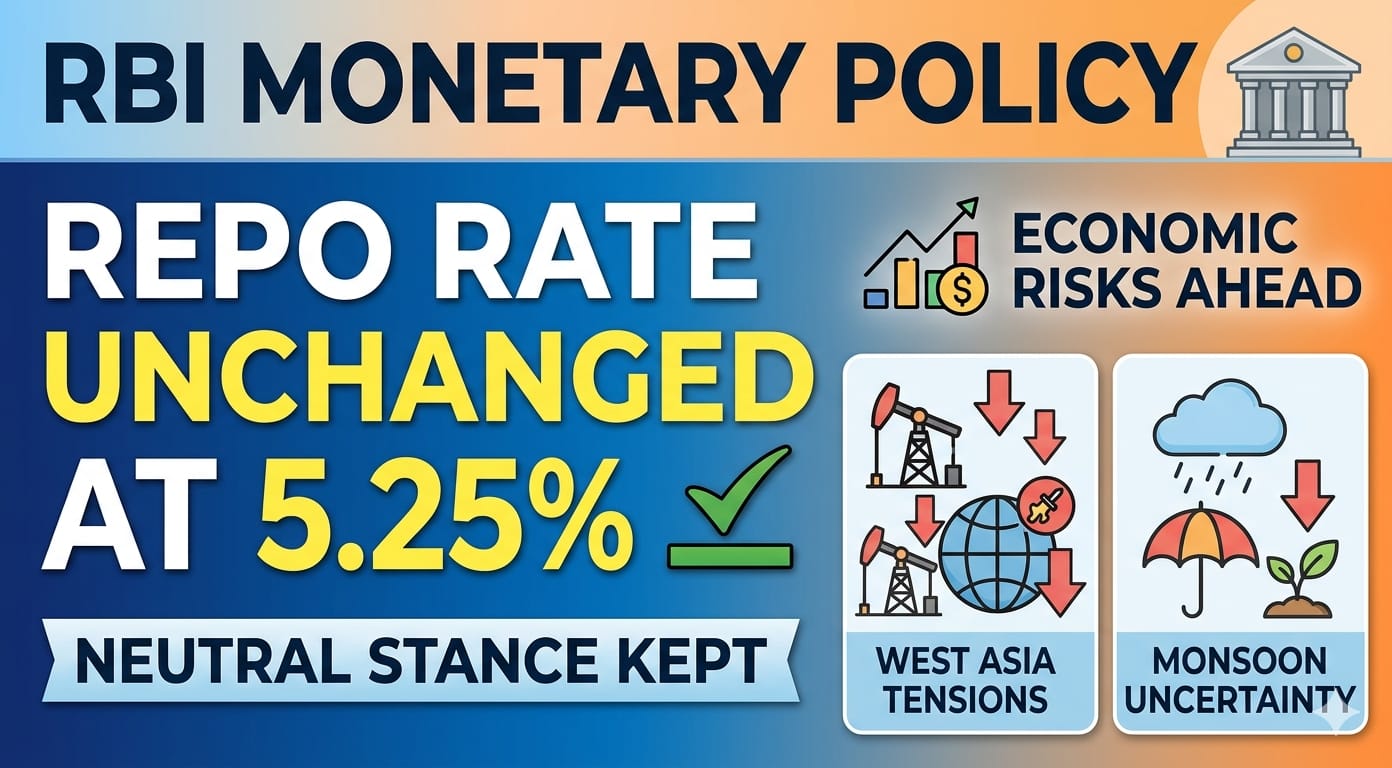
The Reserve Bank of India has decided to keep the key repo rate unchanged at 5.25 % for the third consecutive meeting, maintaining a neutral policy stance as it balances the need to support economic growth with the responsibility to control inflation.
This decision, announced on Friday June 5 2026, comes after the Monetary Policy Committee reviewed the current economic situation and found that the current rate is appropriate for India’s needs.
While the rate remains steady, the central bank made a significant adjustment to its economic outlook by cutting its gross domestic product growth forecast for the financial year 2026-27 to 6.6% from the earlier estimate of 6.9%, marking the slowest growth rate in at least four years.
The reason behind this reduced growth forecast stems from several challenging factors that have emerged since the last policy review. The ongoing conflict in West Asia has created uncertainty in global markets, while elevated energy prices have increased input costs for businesses across the country.
Supply disruptions caused by these geopolitical tensions combined with the uncertainty of whether the southwest monsoon will be normal or below normal have added to the risks facing the economy. The RBI now expects GDP growth to be 6.6 % in the first quarter of FY27, followed by 6.3% in the second quarter, 6.5% in the third quarter, and 6.8% in the fourth quarter, showing a gradual improvement throughout the year but at a slower pace than previously anticipated.
Inflation has also become a key concern for the central bank as it revised its consumer price index inflation forecast for FY27 upward to 5.1 % from the earlier estimate of 4.6%.
The quarterly inflation projections show 4.2% in the first quarter, 5.1% in the second quarter, 5.9% in the third quarter, and 5.4% in the fourth quarter, with the third quarter approaching the RBI’s upper tolerance band of 6%.
This upward revision in inflation expectations alongside the downward revision in growth expectations creates a more challenging economic environment that the policy committee must navigate carefully.
For ordinary Indians, this decision means that interest rates on loans including home loans, car loans, and personal loans will remain at their current levels without any reduction.
Banks had been hoping for a rate cut that would allow them to lower lending rates, but the RBI’s decision to hold steady means borrowers will continue paying the same interest amounts. On the positive side, savers will continue earning the same interest rates on their fixed deposits and savings accounts without any decrease.
The neutral stance signals that the RBI is watching both growth and inflation closely and will adjust rates in either direction based on how the economy performs in the coming months.
The monetary policy committee’s unanimous vote to keep the rate at 5.25% demonstrates that all six members agree this is the right approach given the current uncertainties.
Governor Sanjay Malhotra explained that despite the unfavourable and challenging external environment, the Indian economy has shown remarkable resilience, and the headroom provided by the inflation outlook has allowed the central bank to remain growth supportive while maintaining stability.
The standing deposit facility rate remains at 5 % while the marginal standing facility rate and bank rate stay at 5.5%, maintaining the existing structure of policy rates.
This Policy decision reflects the RBI’s cautious approach as it faces a rare combination of slower growth expectations and rising inflation pressures. The central bank is essentially betting that keeping rates steady will allow it to respond quickly if conditions worsen while avoiding the risk of pushing inflation higher through a rate cut.
For businesses and consumers, this means planning for a period of moderate growth with slightly higher inflation than previously expected, requiring careful financial management and realistic expectations about economic performance in the coming year.

