
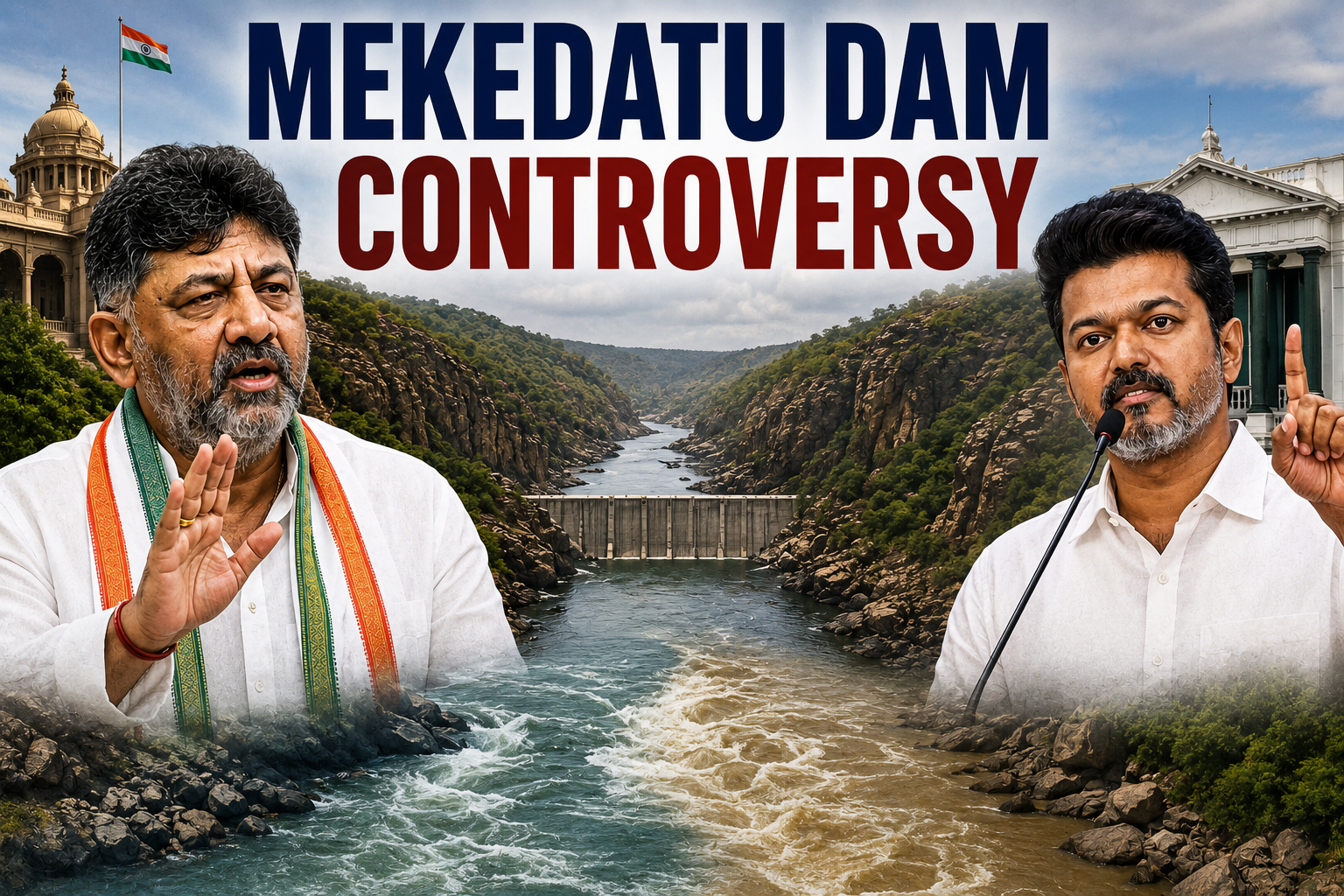
On Thursday, June 4, newly appointed Karnataka Chief Minister DK Shivakumar launched a scathing attack on the Tamil Nadu government over the Mekedatu Dam issue. Notably, the dam has been a long-standing source of friction between Tamil Nadu and Karnataka.
The dispute over Mekedatu Dam on the Cauvery River is now once again making headlines. The controversy came to prominence once again after newly elected Tamil Nadu Chief Minister C Joseph Vijay, on Tuesday, 26 May, urged Prime Minister Narendra Modi to reject Karnataka’s proposed Mekedatu reservoir project across the River Cauvery. The Prime Minister is yet to formally comment on this matter after Vijay’s visit.
CM Vijay alleged that Karnataka going ahead with the project violates the final award of the Cauvery Water Disputes Tribunal (CWDT) and the Supreme Court’s 2018 judgment on the interstate river water dispute.
Now, Karnataka Chief Minister D. K. Shivakumar has said in response, “Irrespective of the party, Tamil Nadu will do their politics. They already went to the SC and asked for a review to be heard, and the court has taken their decision and rejected the appeal. We will do our job; let them do their job.”
Cauvery river’s water has been a long standing reason for tensions between the two southern states. How the water is distributed among the two southern states has seen many political and legal fights.
Located in Karnataka’s Ramanagara district at the confluence of the Cauvery and Arkavathi rivers, Mekedatu project is seen by Karnataka as a balancing reservoir designed primarily to supply drinking water to Bengaluru and generate hydroelectric power. The state argues that the Mekedatu project is essential for meeting the future water needs of one of India’s most populated (and growing) metropolitan regions and that it will not affect Tamil Nadu’s allocated share of Cauvery waters.
For the new Karnataka CM DK Shivakumar, the project is more than just an infrastructure initiative. Having represented the Kanakapura region for decades, he has long been one of Mekedatu’s strongest advocates. Over the years, Shivakumar has repeatedly stressed that the reservoir is crucial for Bengaluru’s water security. DK Shivakumar has also indicated that Karnataka intends to continue pursuing approvals and move the project closer to implementation.
Tamil Nadu, however, has very different opinion about the project. Chief Minister Joseph Vijay says that the project violates the Cauvery Water Disputes Tribunal award as well as the Supreme Court’s judgments governing water sharing between the two southern states. He has also called for the rejection of Karnataka’s Detailed Project Report (DPR), warning that the reservoir could threaten the interests of millions of farmers dependent on Cauvery waters in Tamil Nadu’s delta districts.
The roots of Tamil Nadu’s opposition lie in concerns over water security. The state fears that a large upstream reservoir would give Karnataka greater control over river flows, potentially affecting the timely release of water downstream. Tamil Nadu maintains that the Cauvery basin is already a water-deficit basin and that the creation of any new major storage structure could disrupt the delicate balance established through decades of legal and political negotiations.
Recent developments have now intensified tensions between the states. Tamil Nadu has approached the National Green Tribunal seeking to halt activities related to the project, including any proposed groundwork or ceremonial inauguration. Political parties, farmers’ organisations and civil society groups in the state have staged protests, arguing that Mekedatu could jeopardise agricultural livelihoods across the Cauvery delta.
The dispute has acquired additional significance because it now involves two relatively new chief ministers. With the CMs of both states new in the office, they would want to make an early mark by ensuring they get most benefit for their respective state over this project. While Shivakumar has been closely associated with the project for years, Vijay is confronting the sensitive Cauvery issue for the first time as Tamil Nadu’s chief minister. Their handling of the dispute could shape not only the future of the Mekedatu project but also broader Karnataka-Tamil Nadu relations.
For now, despite Karnataka’s legal gains, the project still requires multiple clearances from central authorities and environmental regulators. As both states harden their positions, the Mekedatu Dam remains a symbol of the larger and often emotional struggle over the sharing of Cauvery waters—a dispute that continues to influence politics, agriculture and inter-state relations across southern India.

