
The air cargo sector has shown remarkable strength by recording a 10% increase in April 2026, even while facing ongoing disruptions from the crisis in West Asia. The total freight handled at Indian airports climbed from 315,000 tonnes in April 2025 to 348,000 tonnes in April 2026, according to data from the Airports Authority of India.
Chennai has emerged as the fastest-growing air cargo hub in India during that time.
This growth comes as a positive surprise since the West Asia conflict had previously caused a 6 percent drop in cargo volumes during March 2026 when flights to key transshipment hubs were interrupted.
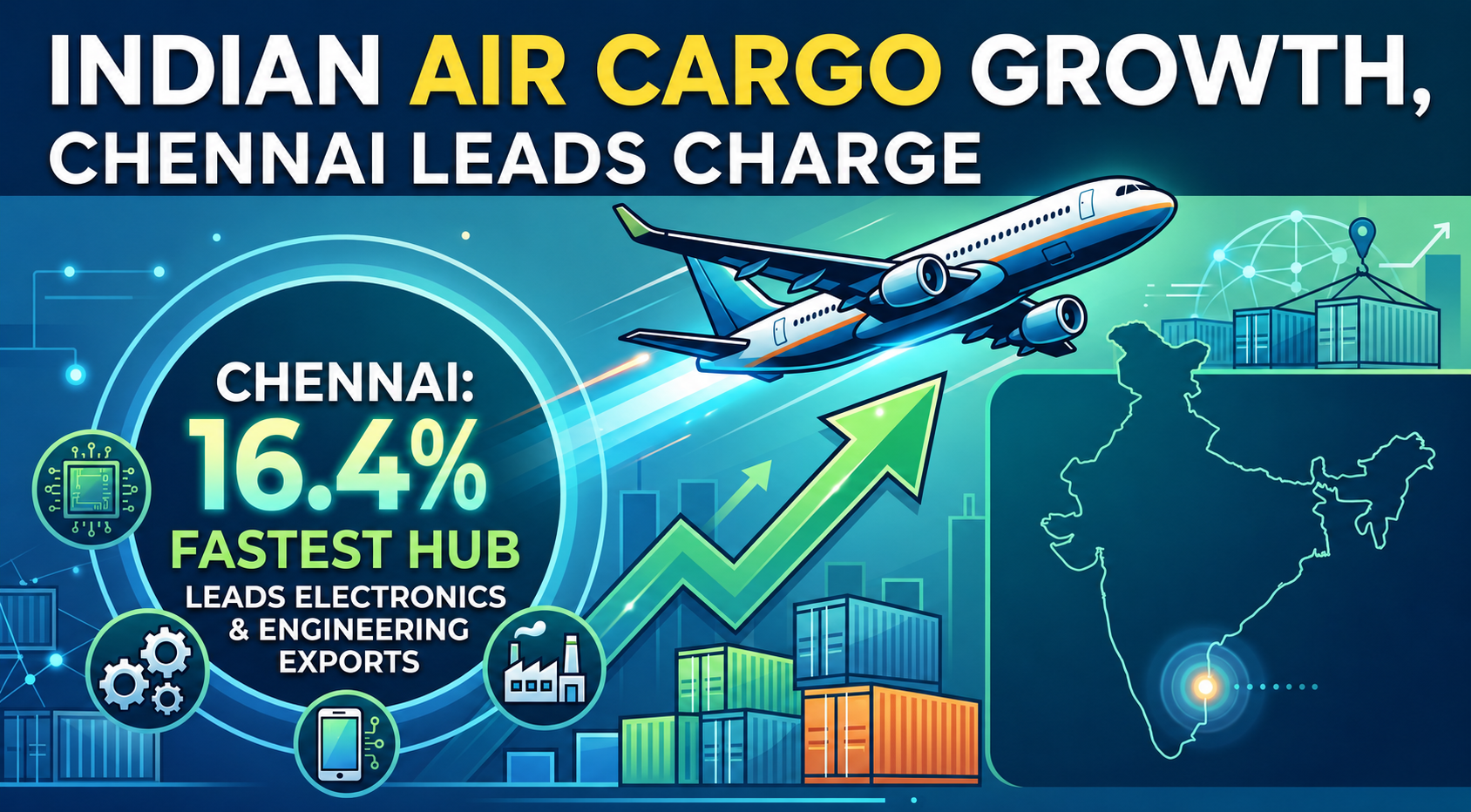
Chennai airport has stood out as the star performer among India’s major airports, posting the highest growth rate of 16.4 percent between January and April 2026. The airport handled 38,295 tonnes of cargo in April, up from 32,965 tonnes in January, making it the fastest-growing hub in the country.
This impressive performance is particularly notable because Chennai operates from a relatively small terminal facility compared to larger airports like Delhi and Mumbai.
The surge in Chennai’s cargo handling is largely driven by exports of mobile phones, electronics, and engineering products, with the airport serving as India’s main gateway for electronics exports.
Other major airports also recorded steady growth during the same period, though at more modest rates. Bengaluru saw an 8.5 percent increase, Hyderabad posted 8.4 percent growth, Mumbai recorded 8.3 percent, and Delhi grew by 6.9 percent.
Despite growing at a slower pace than Chennai, Delhi continues to maintain its position as India’s largest air cargo center by total volume. The fact that all top five airports reported positive growth demonstrates the overall resilience of India’s air freight network despite external challenges.
The recovery in April follows a difficult period in March when the West Asia crisis caused significant disruption. The conflict led to airport closures and airline service suspensions in the Gulf region, which is a crucial transshipment hub for Indian cargo.
Approximately 30 freighters carrying large volumes of Apple products flew out of Chennai to the United States between January and early April 2026, with March alone seeing 14 freighters move 1,000 tonnes of shipments to the US and Hong Kong. This electronics export boom helped offset the losses from the Middle East disruption.
Strong export demand and growing e-commerce activity are the main drivers behind India’s air cargo resilience. Industry experts describe the West Asia-related headwinds as temporary bumps rather than long-term problems. Jitendra Srivastava, CEO of Mumbai-based Triton Logistics and Maritime, noted that the broader outlook remains highly positive.
Amar More, CEO of Kale Logistics Solutions, pointed to several factors supporting continued growth including robust e-commerce demand, expanding manufacturing exports, pharmaceuticals, perishables, the China-plus-one strategy, and ongoing infrastructure investments.
The air cargo sector is also benefiting from India’s position in global supply chains as companies adopt a China-plus-one approach, looking to diversify manufacturing beyond China. Ahmedabad airport showed particularly strong performance with 17.6 percent cargo growth for fiscal year 2025 to 2026.
The Middle East conflict has removed significant air cargo capacity from the market and pushed freight rates higher, but the overall trajectory remains upward.
Looking at the broader picture, air cargo operations at Indian airports experienced a 6.2 percent increase in fiscal year 2026, reaching 39.63 lakh tonnes compared to 37 lakh tonnes the previous year.
This growth showcases the sector’s ability to adapt to global challenges while maintaining momentum. Airport cargo complexes across the country are enabling faster and smoother movement of goods, strengthening India’s trade connectivity. Between April 2025 and January 2026, airports across all five regions recorded significant cargo growth, reflecting rising trade momentum and improving operational efficiency.
The story of India’s air cargo growth in April 2026 is one of resilience and adaptation. Despite geopolitical challenges in West Asia that disrupted established shipping routes, Indian airports managed to not just recover but grow.
Chennai’s emergence as the fastest-growing hub highlights how regional specialization in electronics exports can drive national economic growth. As manufacturing expands and e-commerce continues its upward trajectory, the air cargo sector is well-positioned for sustained growth in the coming months and years.

