
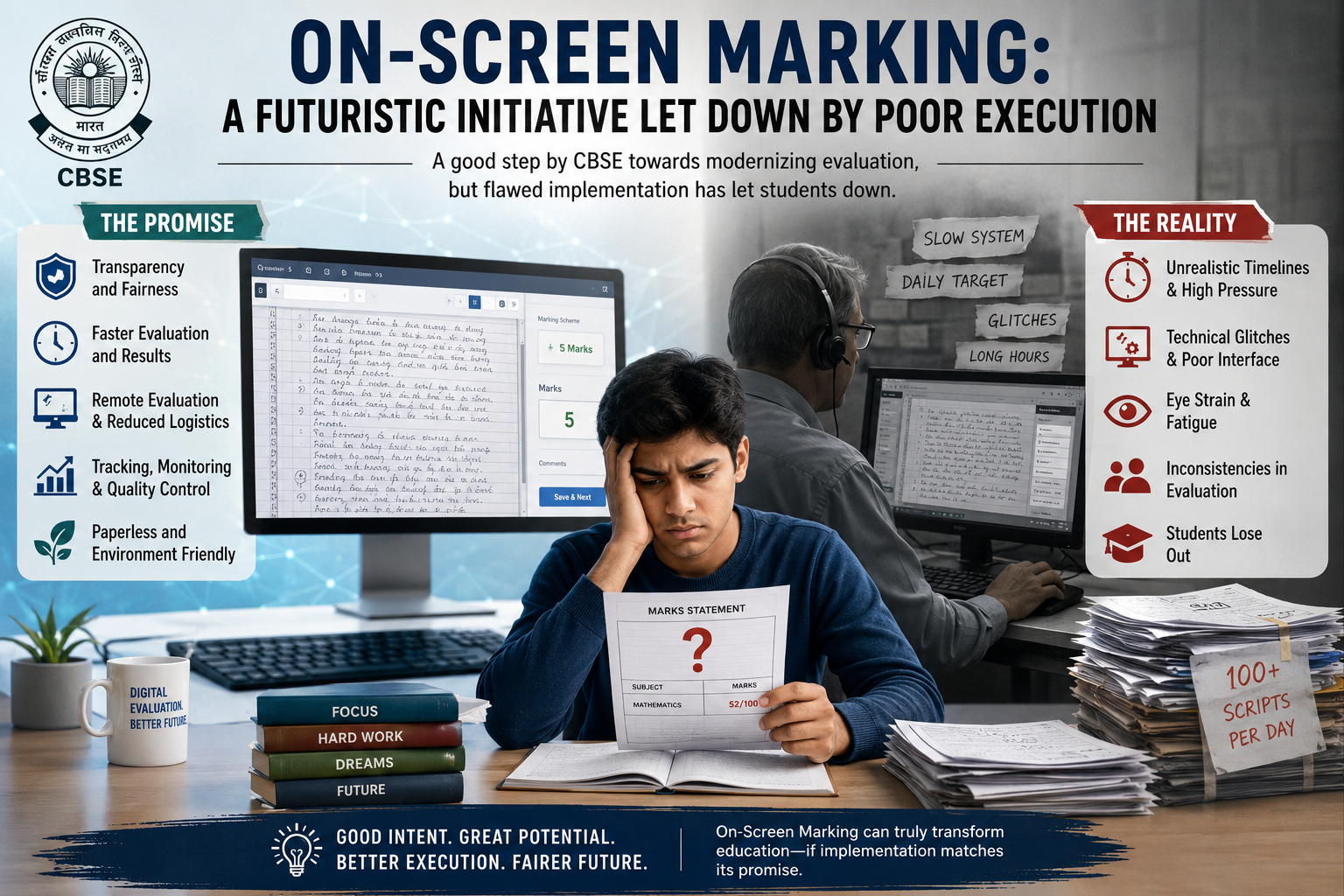
When the Central Board of Secondary Education (CBSE) introduced On-Screen Marking (OSM), it was hailed as a major step toward modernizing India’s examination and evaluation system. The idea was simple and yet ambitious. It aimed to digitize answer sheets, allow examiners to evaluate them online, improve transparency, reduce logistical challenges, and ensure faster declaration of results.
In theory, OSM represented the future of educational assessment. However, when it came to putting it into practice, it ran into many operational hurdles, and many students and teachers were left dissatisfied. These birthing problems during OSM’s implementation has meant that many people are disregarding the benefits of an otherwise promising initiative.
In its aftermath, CBSE Chairman and Secretary were transferred, and the centre set up a one-member inquiry committee to investigate the entire matter.
The concept of On-Screen Marking is not inherently flawed, in fact, it is the future and the education ministry was not just keeping up with the times, but staying ahead of it by introducing OSM. It offers several advantages over traditional manual evaluation. Once answer sheets are scanned and uploaded, examiners can access them remotely without the need to physically transport bundles of papers across the country. So much of the logistics expense and problems are solved just at this very stage.
Digital evaluation also allows supervisors to monitor marking patterns, identify inconsistencies, and ensure that examiners follow prescribed marking schemes. Features such as random allocation of answer scripts and automated tracking also reduce the chances of human bias and malpractice.
For a country as large as India, where millions of students appear for board examinations every year, such technological interventions are not only desirable but inevitable. We can not have millions and millions of answer sheets being physically sent to every corner of the vast country, and the number of answer sheets is only going to grow looking at our population. Digitization has the potential to make the evaluation process more efficient, secure, and transparent.
However, in its initial stages, On-Screen Marking has shown the problems that can come along with it, and highlighted the areas which have to be resolved. One of the biggest concerns raised by teachers involved in the process is the pressure to complete evaluations within strict timelines. Unlike traditional evaluation centres where examiners could physically review answer sheets in a more flexible environment, digital platforms often impose rigid daily targets. This can encourage speed over accuracy.
Many evaluators have reported technical glitches, slow software interfaces, and difficulties in navigating lengthy answer scripts on computer screens. Reading dozens of scanned pages continuously can cause eye strain and fatigue, potentially affecting the quality of evaluation. When an examiner is required to assess hundreds of answers digitally under time pressure, the risk of oversight naturally increases.
Students have also expressed concerns regarding unexpected score variations and evaluation inconsistencies. While no evaluation system is perfect, the perception that genuine answers are sometimes overlooked due to rushed digital marking has damaged confidence in the process. Several students who later applied for verification or re-evaluation have reported significant changes in their marks, raising questions about the reliability of initial assessments.
Another challenge lies in training. Introducing sophisticated technology into a system as vast as CBSE’s requires comprehensive preparation. Many teachers, especially those who spent decades working with traditional methods, were expected to adapt quickly to new software platforms. Without adequate training and technical support, even experienced evaluators may struggle to utilize the system effectively.
The issue, therefore, is not that On-Screen Marking is a bad idea. Quite the opposite. The initiative reflects an understanding that educational administration must evolve with technology. The problem is that technological modernization cannot succeed through software alone. It requires robust infrastructure, user-friendly platforms, realistic evaluation targets, continuous training, and mechanisms to ensure quality control.
CBSE deserves credit for attempting to bring India’s examination system into the digital age. The board recognized the need for reform and invested in a model that has proven effective in several educational systems around the world. Yet innovation must be judged not only by its intent but also by its execution.
If CBSE addresses the operational shortcomings of On-Screen Marking, the system can still achieve its original objectives. Better training for evaluators, improved software performance, reduced workload pressure, and stronger auditing mechanisms could significantly enhance the quality of assessment.
On-Screen Marking remains a futuristic and potentially transformative initiative. Unfortunately, its implementation has often fallen short of expectations, leaving many students feeling disadvantaged. The lesson is clear: technology can improve education, but only when execution matches ambition.

