
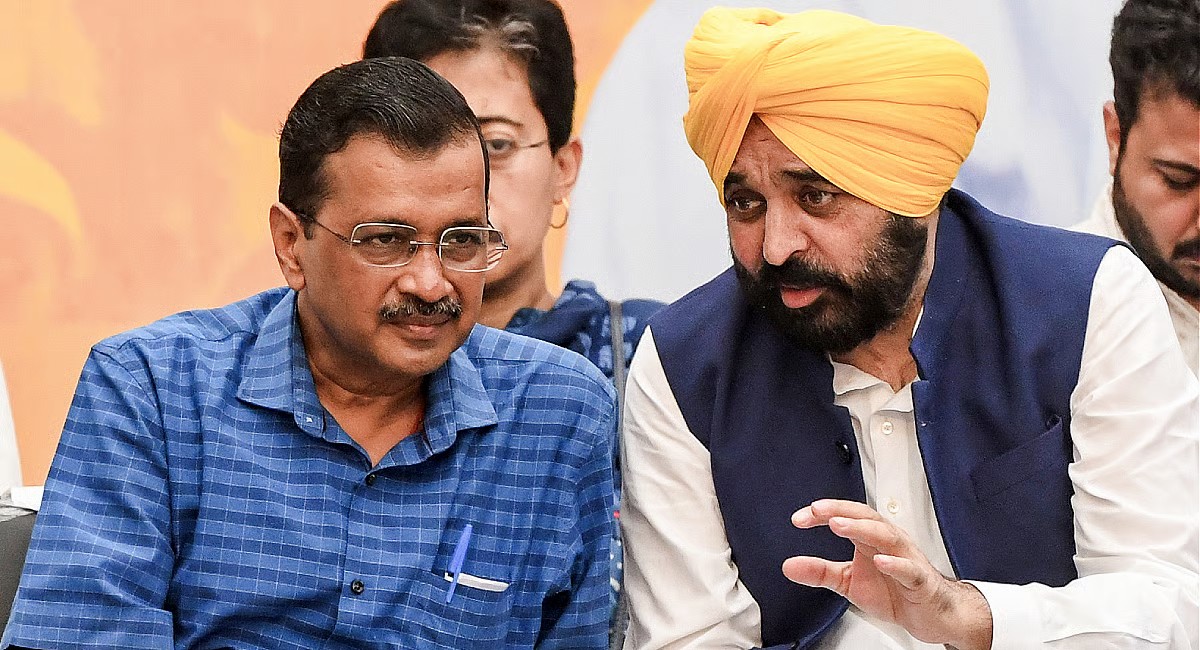
The results of Punjab’s Municipal Corporation (MC), Municipal Council and Nagar Panchayat elections, declared on May 29, 2026, delivered a decisive victory for the ruling Aam Aadmi Party (AAP), reinforcing its dominance in urban Punjab ahead of the 2027 Assembly elections.
The outcome is significant given the challenges facing the party, including the defection of seven Rajya Sabha members to the Bharatiya Janata Party (BJP), concerns over deteriorating law and order in the state, and opposition allegations that the government has politicised its anti-crime initiatives.
Conducted across 102 urban local bodies using paper ballots, the elections extended AAP’s electoral momentum and built on its strong performance in the Panchayat, Panchayat Samiti and Zila Parishad (rural local governance bodies) polls held in December 2025.
According to the Punjab State Election Commission (SEC), AAP secured 958 of the 1,977 wards contested, accounting for nearly 48 per cent of the total and emerging as the clear electoral frontrunner. The Indian National Congress (INC) finished distant second with 397 wards, followed by Independents with 251. The Shiromani Akali Dal (SAD) won 191 wards, while the BJP secured 172. The Bahujan Samaj Party (BSP) won seven wards. Polling was held on May 26, 2026, across Punjab’s urban local bodies, recording a voter turnout of 63.94 per cent, with more than 2.23 million votes cast.
Widely viewed as a political semi-final ahead of the 2027 Punjab Assembly elections, the urban civic polls have provided a significant boost to AAP. The outcome strengthens the party’s claim to continued electoral relevance and governance legitimacy in Punjab, one of only a few opposition-governed jurisdictions in northern India, alongside Himachal Pradesh and the Union Territory of Jammu and Kashmir.
The results also build on AAP’s strong performance in the December 2025 rural local body elections, where it secured a commanding share of seats, winning 218 of 346 Zila Parishad zones and 1,529 of 2,834 Panchayat Samiti zones. Taken together, the party’s successive victories in both rural and urban local elections indicate that, despite criticism over governance, law and order, and security concerns, AAP retains a broad and resilient electoral base across the state.
Reacting to the results, Punjab Chief Minister Bhagwant Mann described the outcome as “historic” and said it signalled that AAP had entered the “finals” of the political contest ahead of the 2027 Assembly elections. Taking a swipe at the BJP, he remarked that the party’s poor showing – finishing fifth – demonstrated the absence of any serious challenge to AAP.
Opposition leaders, however, downplayed the significance of the outcome. Leader of Opposition Partap Singh Bajwa argued that the results were largely expected, noting that urban local body elections in Punjab have traditionally favoured the ruling party. Meanwhile, Punjab Congress president Amrinder Singh Raja Warring accused the government of misusing the administrative machinery to influence the polls, while asserting that AAP would “bite the dust” in the 2027 Assembly elections.
Amid persistent concerns over law and order, a central element of AAP’s campaign narrative has been its claim that it is tackling Punjab’s entrenched drug trade and organised criminal networks. The Bhagwant Mann government has projected its anti-crime initiatives as evidence of a level of political resolve absent under previous administrations.
Two flagship campaigns have been central to this strategy. The first, Yudh Nashian Virudh (War Against Drugs), launched on March 1, 2025, combines enforcement, interdiction, and rehabilitation measures. According to official figures, 65,824 alleged drug traffickers had been arrested during the first 455 days of the campaign, up to May 30, 2026. Authorities also reported significant seizures of narcotics and drug proceeds, alongside expanded de-addiction and rehabilitation efforts.
The second initiative, Gangstran Te Vaar (Attack on Gangsters), launched on January 20, 2026, under Operation Prahar, targets organised criminal networks and their support structures. By May 20, 2026, Punjab Police reported conducting 77,895 raids and arresting 30,721 gangsters across the state. Recoveries included firearms, ammunition, sharp-edged weapons, and hand grenades. Further, preventive action was taken against more than 13,000 persons and over 1,100 proclaimed offenders were arrested. The government has highlighted these operations as evidence of a sustained effort to dismantle criminal ecosystems that have expanded across Punjab over the past decade.
Despite AAP’s portrayal of these campaigns as decisive blows against organised crime, a fundamental contradiction persists in Punjab’s security environment. Even as anti-drug and anti-gangster operations continue, the state has seen an escalation of incidents of targeted killings, extortion, inter-gang rivalries, attacks on police personnel, grenade attacks on security-linked establishments, continued cross-border narcotics trafficking, and the growing influence of foreign-based gangsters. Opposition parties contend that the campaigns have been heavily publicised and aimed more at generating political dividends than at delivering lasting structural change.
Leader of Opposition Partap Singh Bajwa accused the AAP government of indirectly benefiting from gangster networks for political purposes and alleged that some extortion victims were discouraged from pursuing formal complaints and instead encouraged to “settle matters” with criminal elements. The BJP similarly argued that the anti-crime drives intensified in the run-up to both the rural and urban local body elections, suggesting an electoral motive. The demolition of around 60 properties allegedly acquired through drug proceeds has become a particularly contentious issue, with AAP presenting the action as evidence of accountability and the opposition portraying it as selective enforcement against political rivals.
The reality is more nuanced. In a state where bureaucratic and policing institutions have often been influenced by political considerations, distinguishing genuine law-enforcement efforts from politically motivated action is difficult. Punjab’s history of such entanglements lends some credibility both to the government’s claims of pursuing criminal networks and to the opposition’s allegations of selective enforcement.
Despite concerns over law and order, the electoral outcome suggests that security issues have not triggered a strong anti-incumbency wave against the AAP government. A key reason is the continued fragmentation of the opposition. The Congress retains pockets of influence and remains the principal challenger to AAP in several constituencies, but it continues to grapple with organisational weaknesses and leadership uncertainties. The BJP, despite an energetic campaign in urban Punjab and efforts to expand its footprint following the collapse of its alliance with SAD in 2020, failed to convert its visibility into significant electoral gains. Its performance fell short of expectations, undermining claims that it had emerged as a viable standalone force in the state. SAD, meanwhile, though retaining influence in a few pockets, remains far from regaining its former statewide dominance.
Panthic (Sikh religious identity) politics in Punjab has undergone significant transformation in recent years. The traditional SAD, once the principal Panthic force, has weakened due to leadership crises, the fallout of the farm laws agitation, internal divisions, and electoral setbacks. While radical and hardline Panthic groups have attracted periodic attention, their influence remained limited in the recent local body elections, with no significant electoral gains.
With issues of Sikh identity, diaspora radicalisation, and historical grievances continuing to provide a latent reservoir for political mobilisation, particularly amid evolving security challenges, AAP intensified its outreach to the Sikh community. Amid growing political competition over Panthic issues and criticism from religious groups and opposition parties – especially SAD – that it was employing religious symbolism for electoral gain, the AAP government enacted the Jaagat Jot Sri Guru Granth Sahib Satkar (Amendment) Act, 2026, introducing stringent penalties for sacrilege-related offences. Presented as a landmark initiative, the legislation was followed by Chief Minister Bhagwant Mann’s statewide Shukrana Yatra (thanksgiving tour), during which he paid obeisance at key Sikh religious institutions, including the Akal Takht, Takht Sri Kesgarh Sahib, and Takht Sri Damdama Sahib. Together, these measures reflected the government’s effort to strengthen its engagement with Sikh religious sentiments while consolidating political support among the community.
A notable feature of the municipal elections was the use of paper ballots instead of electronic voting machines (EVMs), with the SEC citing a shortage of machines. While opposition parties alleged administrative bias and electoral irregularities, the paper-ballot system blunted claims of EVM manipulation. AAP leaders highlighted this as strengthening the mandate’s credibility, though there is little empirical evidence that the voting method affected the outcome. Allegations of booth-level irregularities and political pressure nevertheless persisted, underscoring that electoral trust in Punjab depends as much on administrative conduct as on voting technology.
Overall, the results indicate that AAP continues to enjoy a strong organisational presence across Punjab’s urban centres. Political observers often regard municipal elections as an important indicator of booth-level mobilisation and grassroots strength ahead of Assembly elections. At the same time, critics interpreted AAP’s failure to cross the 1,000-wards mark, along with BJP and Congress victories in select municipal corporations, as early signs of emerging anti-incumbency sentiment.
Moreover, while urban local body elections are often viewed as a political semi-final ahead of Assembly polls, Punjab’s recent electoral history suggests that their predictive value is limited. In the 2021 municipal elections, the Congress secured a sweeping victory, winning 1,516 seats across Municipal Corporations, Municipal Councils, and Nagar Panchayats. Yet, within months, AAP swept the 2022 Assembly elections with 92 seats, while the Congress was reduced to 18. A similar pattern emerged earlier. In the 2015 municipal polls, the SAD-BJP alliance won 1,420 urban wards against the Congress’s 356, but the Congress went on to secure 77 of 117 Assembly seats in 2017, while the SAD-BJP alliance was reduced to 18.
The broader implication of the municipal elections is therefore not that AAP’s re-election is assured, but that the party has demonstrated political resilience despite operating within one of India’s most challenging security and governance environments. The results suggest that a significant section of the electorate has not yet held the government solely responsible for Punjab’s entrenched problems and may view its anti-drug and anti-gangster campaigns as credible, if still incomplete, efforts to address these longstanding issues.
Whether this perception survives until 2027 will depend less on campaign rhetoric than on measurable improvements in security, governance and economic conditions. Punjab’s political future will ultimately be shaped by the interaction between electoral calculations and the unresolved structural challenges posed by the state’s evolving drug-gangster-terror nexus.
Several factors could reshape Punjab’s political trajectory before the 2027 Assembly elections. A deterioration in law and order could erode AAP’s governance credentials and weaken its anti-drug/gangster narrative. Equally important will be whether opposition parties remain fragmented or succeed in forging a more cohesive challenge. The evolution of Panthic politics will also be a key variable. Although SAD has struggled to regain its traditional support base, Sikh religious and radical Panthic groups continue to influence voting patterns in some constituencies and could affect local electoral dynamics. Given Punjab’s complex mix of shifting Panthic alignments, security concerns, and AAP’s relatively broad support base, the 2027 Assembly election is shaping up to be one of the most consequential – and unpredictable – contests in the state’s recent political history.
While civic body elections are not always reliable predictors of Assembly outcomes, they offer important indicators of trends in organisational strength and voter sentiment. The current results point to a growing consolidation of Punjab’s politics around the principal contenders, particularly AAP and the Congress, with AAP enjoying a clear advantage in momentum and organisational reach.
As the 2027 Assembly elections approach, issues such as governance, public safety, employment, and the continuing menace of drugs and organised crime are likely to shape voter preferences. AAP enters with momentum, yet the state’s structural vulnerabilities ensure no outcome is predetermined.
Author Nijeesh N – Research Associate; Institute for Conflict Management

