
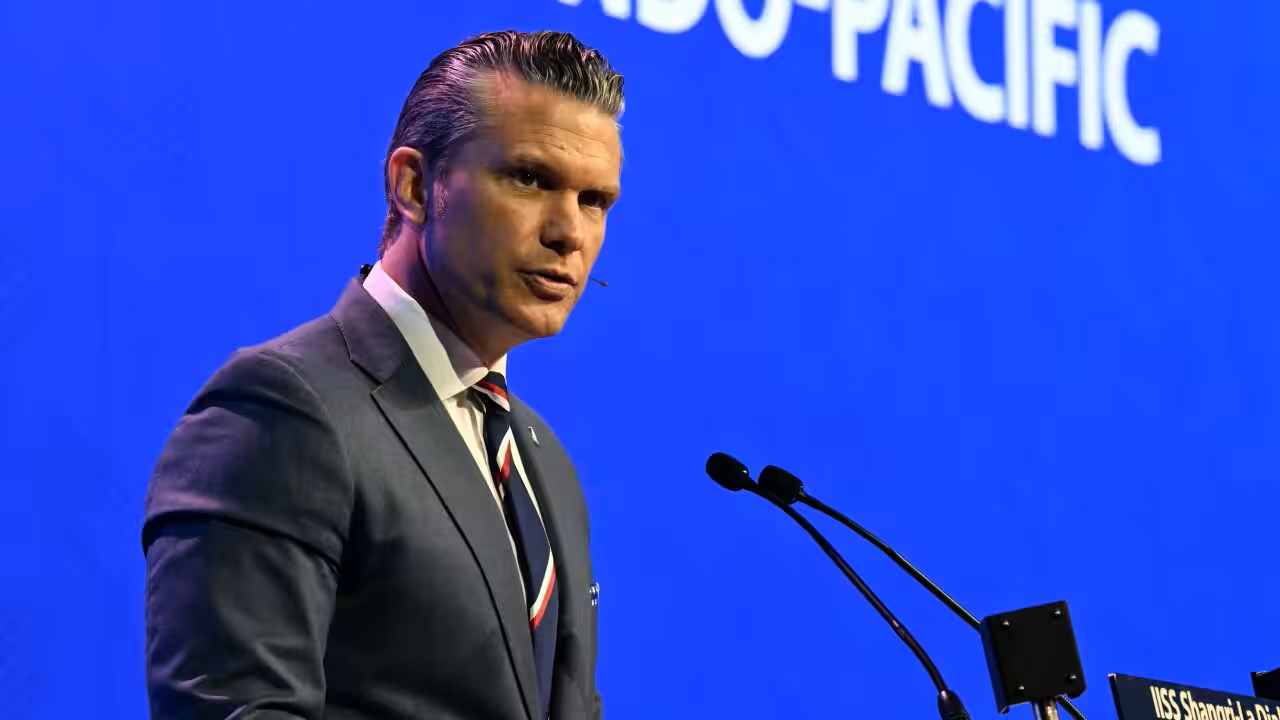
Growing concerns over China’s rapid expansion of its military capabilities have once again come into focus after U.S. Defense Secretary Pete Hegseth warned that countries in the Indo-Pacific have legitimate reasons to be alarmed by Beijing’s strategic ambitions. Stressing that no single power should dominate Asia, Hegseth argued that China cannot impose its hegemony over the region through military pressure or coercive influence.
Pete Hegseth was speaking at International Institute for Strategic Studies Shangri-La dialogue in Singapore.
Notably, Hegseth’s remarks come in the wake of reports that satellite images have shown that Beijing is building launch pads, bunkers and communications nodes near the isolated nuclear silos that hold the Chinese military’s longest-range missiles. Notably, Chinese missiles can already reach any city in the US, so construction of these launch pads is as much concerning for the US as for the other countries in the region.
Hegseth’s remarks reflect a wider shift in US security thinking over China’s military modernization program, one the largest in modern history. Beijing has invested heavily in advanced naval fleets, hypersonic missile systems, cyber capabilities, artificial intelligence-driven warfare technologies and long-range power projection assets. Its military expansion has increasingly moved beyond territorial defense toward a capability structure designed to shape regional outcomes.
At the center of US concern is the Indo-Pacific region that has become the world’s economic engine and one of its most strategically important theatres. China’s growing naval presence in contested waters, particularly in the South China Sea, has generated unease among neighboring countries that fear restrictions on freedom of navigation and erosion of established international norms.
Then of course there is Taiwan. China has always claimed that self-governing island Taiwan is a part of China and even US officially agrees to One-China policy. The threat of China invading Taiwan is ever present and with this military buildup, there are concerns that China may be looking to take over Taiwan by force.
Several countries across Asia have responded by strengthening defense partnerships and increasing strategic coordination. Security dialogues, joint military exercises and efforts to diversify supply chains reflect broader attempts to maintain regional balance. The objective, according to many policymakers, is deterrence rather than confrontation — ensuring that no actor concludes that military dominance can replace diplomacy.
China, for its part, has consistently rejected accusations of hegemonic intent and maintains that its military modernization is defensive in nature. Chinese officials often argue that Western nations are exaggerating the threat in order to justify their own military presence in Asia. Beijing also points to historical experiences and national security concerns as drivers of its strategic planning.
However, critics contend that concerns stem less from China’s rise itself and more from the speed, scale and increasingly assertive posture associated with that rise. For many observers, the issue is not whether China becomes powerful, but whether that power is exercised within internationally accepted norms.
As strategic competition intensifies, the future of the Indo-Pacific may depend on maintaining a stable balance where economic integration continues while military escalation is avoided. Hegseth’s warning reflects a broader message gaining traction across capitals: Regional leadership cannot be imposed, and long-term stability depends on rules, partnerships and restraint rather than hegemony.

