
Paris Climate Agreement was signed in 2015, among all the signatories, one country has done the most to follow the agreement, India under Narendra Modi’s leadership. Now India is making sure that even its railway network reduces carbon footprint.
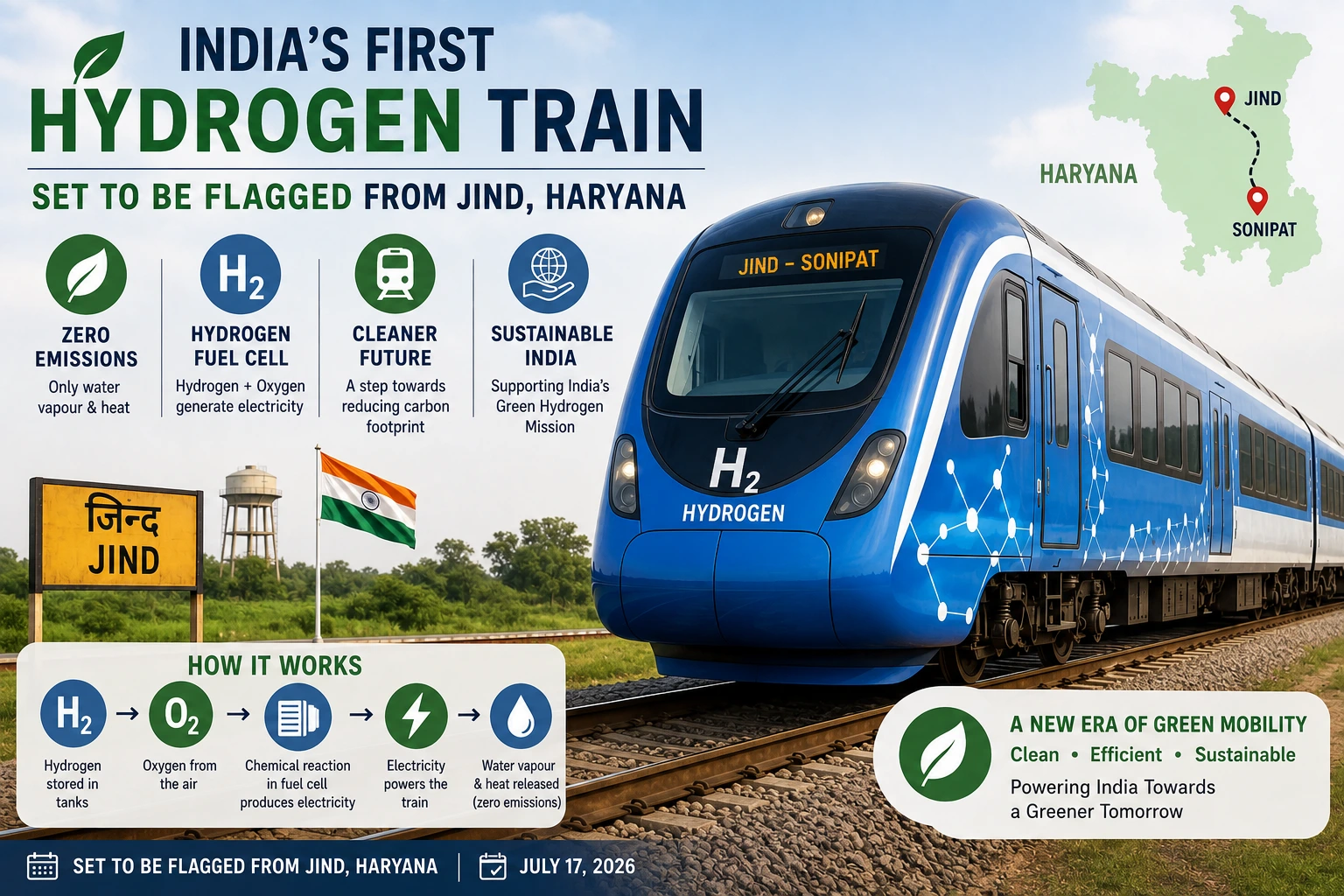
On July 17, Prime Minister Narendra Modi is set to flag off India’s first hydrogen-powered train from Jind in Haryana, a significant milestone in India’s efforts to reduce carbon emissions and modernize public transport. The train will operate on the Jind-Sonipat section, which falls under Northern Railway. This 89-kilometre route has been chosen as the pilot corridor for this ambitious green mobility project which will be expanded nationwide in due time.
What makes this Hydrogen train special is that it does not rely on fossil fuels or electrical wires, instead, it uses hydrogen fuel cell technology to generate electricity onboard. Inside the train, hydrogen stored in special tanks reacts with oxygen from the air in fuel cells. This chemical reaction produces electricity, which powers the train’s motors. The only by-products of the process are water vapour and heat, making it a virtually zero-emission mode of transport. Science is amazing, isn’t it!
The hydrogen train consists of two driving power cars and eight passenger coaches, with a combined power output of 2,400 kW. According to railway officials, it will operate at a speed of up to 75 kmph on the Jind-Sonipat route while offering modern passenger amenities. The train has undergone extensive trials over the past few months before receiving approval for commercial introduction.
The importance of this project goes beyond a single train service. Indian Railways is one of the largest railway networks in the world, with millions of people using it daily. The Railways has set ambitious targets to reduce its carbon footprint, and it seems like they will achieve it. While electrification has already helped cut diesel consumption across much of the network, there are still sections where cleaner alternatives are needed. Hydrogen-powered trains provide a solution, particularly on routes where full electrification may not be practical or economical.
Hydrogen technology is increasingly being seen as a key component of the global energy transition. Countries such as Germany, Japan, China and the United States have already experimented with hydrogen trains. With this launch, India joins a select group of nations exploring hydrogen as a fuel for rail transport. The project also aligns with the government’s broader National Green Hydrogen Mission, which aims to make India a major producer and user of green hydrogen in the coming decades.
The flagging off of the hydrogen train from Jind is therefore more than just a technological achievement. It is a demonstration of how innovation can support sustainability goals. If the pilot proves successful, hydrogen-powered trains could become an important part of India’s strategy to reduce pollution, lower dependence on fossil fuels and build a cleaner transportation future. And this is another major step that the Narendra Modi government has taken to reduce India’s carbon footprint and fight against climate change.

