
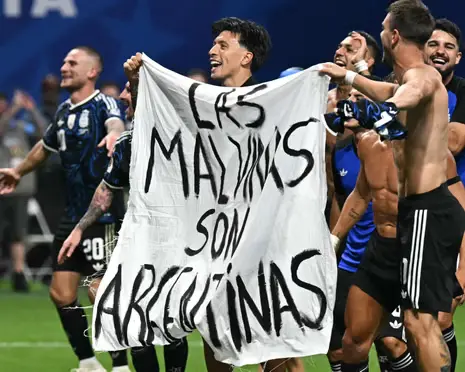
Argentina scored twice in dying minutes to knock out England from the FIFA World Cup. The dramatic 2-1 victory by Argentina did not just send their talisman Lionel Messi to his 3rd World Cup final, it also reignited one of the world’s oldest geopolitical disputes.
With victory gained, after the final whistle, several Argentinian players celebrated with a banner reading “Las Malvinas son Argentinas” (“The Malvinas are Argentine”), prompting sharp criticism from English football authorities and politicians. Notably, Las Malvinas is Argentinian name for the Falkland Islands, which they claim as theirs.
Falkland Islands are located in the South Atlantic Sea, about 480 Kilometers from Argentina. England and Argentina fought a war over it back in 1982 when England prevailed, but apparently, Argentina has not forgotten anything.
Falkland Islands is currently a British Overseas Territory that Argentina calls Las Malvinas and claims as its own. The territorial dispute has remained unresolved for nearly two centuries.
For Argentinians, the Malvinas issue transcends politics. It is deeply embedded in national identity, with governments across the political spectrum maintaining that the islands rightfully belong to Argentina. The phrase “Las Malvinas son Argentinas” is commonly seen in schools, public buildings, sporting events and even on government documents.
The timing of the banner made the celebration especially symbolic. Argentina had just eliminated England, the country that fought and won the 1982 war. Many Argentine supporters viewed the display as an emotional expression of national pride rather than a political provocation. English officials, however, argued that the football field should not be used to promote territorial claims or inflame historical disputes.
However, England’s football association has raised concerns with FIFA, contending that political messages have no place in post-match celebrations. FIFA’s regulations generally prohibit political, religious or personal statements during official competitions, although enforcement has often been inconsistent depending on the circumstances.
The controversy has also reopened memories of another iconic Argentina-England encounter. In the 1986 World Cup quarterfinal, Diego Maradona famously scored both the “Hand of God” goal and the “Goal of the Century” just four years after the Falklands War. Those goals became inseparable from the political and emotional backdrop of the conflict, making every football meeting between the two nations carry significance beyond the sport.
Whether England’s objections will result in disciplinary action remains uncertain. FIFA will have to determine whether the banner amounted to a prohibited political statement or was simply an expression of national identity. Similar incidents involving flags, slogans and political symbols have often been judged on a case-by-case basis.

