
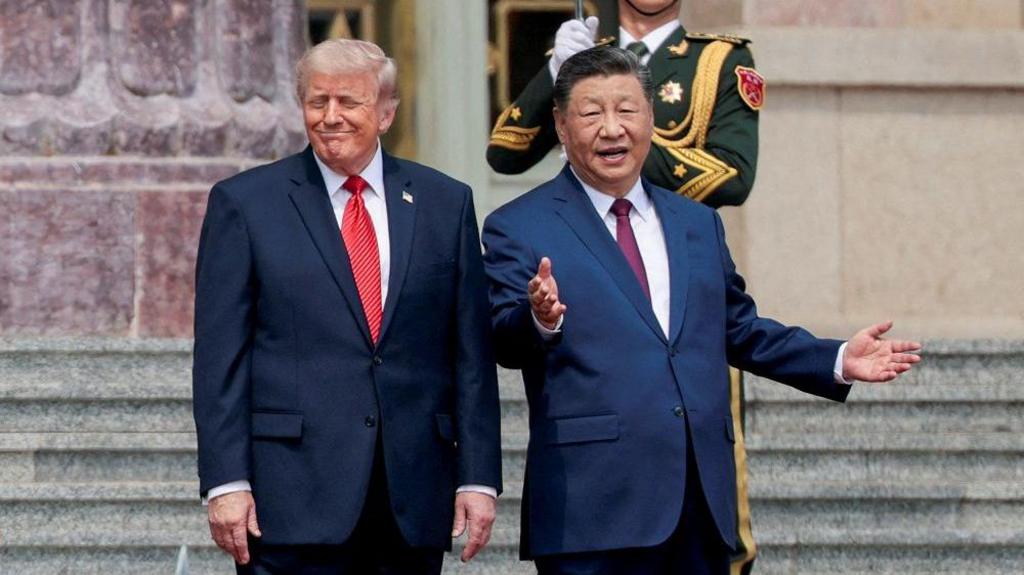
Donald Trump’s visit to Beijing, the first US Presidential visit to China after a decade, comes at a very crucial time in geopolitics. Trump’s meeting with Chinese President Xi Jinping comes at a moment when tensions in West Asia are still high. While trade, technology, tariffs and strategic rivalry dominate the official agenda, one issue hangs silently yet heavily over the visit — Taiwan.
For both Washington and Beijing, Taiwan is no longer just a regional dispute. It has become the symbolic centre of the larger contest between a rising China and an America determined to preserve its influence in Asia.
Trump’s arrival in Beijing therefore carries significance far beyond ceremonial diplomacy. The meeting between Trump and Xi is being watched closely by governments across Asia, global markets, military strategists and Taiwan itself.
Taiwan: The unspoken centrepiece
China considers Taiwan an inseparable part of its territory and has repeatedly declared that reunification with the self-governing island is inevitable. Beijing has not ruled out the use of force if Taiwan formally moves toward independence or if foreign powers interfere in Taiwanese affairs.
The United States officially follows the “One China” policy, but simultaneously remains Taiwan’s most important security partner. Washington supplies weapons to Taipei, maintains strategic ambiguity over military intervention and increasingly views Taiwan as critical to containing Chinese dominance in the Pacific.
Even when American and Chinese leaders discuss trade or climate cooperation, Taiwan remains the invisible issue influencing every conversation.
Trump’s meeting with Xi therefore becomes politically sensitive. Any statement perceived as too soft on Taiwan could trigger criticism in Washington. At the same time, any aggressive rhetoric could further inflame Beijing and deepen military tensions in the Taiwan Strait.
Xi Jinping’s message to USA over Taiwan
Xi Jinping warned President Trump that Taiwan, if handled poorly, could lead to a clash with the United States.
Beijing wants Washington to reduce military cooperation with Taipei and stop what China sees as encouragement for “separatist forces” within Taiwan. Chinese officials are also deeply concerned about increasing American military coordination with Japan, the Philippines and other regional allies.
Jinping’s message is aimed not just at Trump but at the wider American political establishment.
Trump’s balancing act
Donald Trump has historically approached foreign policy through transactional calculations rather than ideological frameworks. During his presidency, he alternated between praising Xi Jinping personally and taking a hardline approach against China on trade and technology.
While Trump is in Beijing, Taiwan has even thanked Trump for his support after the warning by Xi Jinping. However, Donald Trump may not be able to maintain the ambiguity around Taiwan much longer if Xi Jinping continues to press the issue.
Trump may seek economic understandings with China to stabilise markets and showcase his negotiating abilities, but he also cannot appear weak on a geopolitical issue that has become central to American strategic thinking.
Global implications
Any escalation over Taiwan would have enormous global consequences. Taiwan produces a dominant share of the world’s advanced semiconductors, making the island central to global technology supply chains. A military conflict in the Taiwan Strait could disrupt world trade, crash markets and destabilise the Indo-Pacific region.
Countries like India, Japan, Australia and South Korea are closely monitoring developments because their economic and security interests are directly linked to regional stability.
For India in particular, US-China relations increasingly influence strategic calculations in Asia. A more confrontational Washington-Beijing relationship could deepen geopolitical blocs, while a temporary thaw may reshape regional alignments once again.

