
Had you ever imagined that the fabric once associated mainly with elderly people, politicians, and freedom fighters, would one day shine on the ramps of a Fashion Week? A fabric that was once dismissed as “old-fashioned” has now become a preferred choice for Gen Z. That fabric is Khadi, and at the center of this remarkable transformation stands the Khadi and Village Industries Commission (KVIC).
Recently, KVIC presented a figure that surprised the entire country. In FY2025-26, the organization recorded a historic sales turnover of ₹1.87 lakh crore, and it has now set an ambitious target of ₹2.51 lakh crore for FY2026-27. Following this extraordinary growth, some questions have to be answered for the larger public: What exactly is KVIC, how did this transformation begin, which products drove this success, and where is the journey headed next?
What is KVIC
The Khadi and Village Industries Commission (KVIC) is a statutory body functioning under the Ministry of MSME, Government of India. Established in 1956 and headquartered in Mumbai, its original objective was simple yet powerful — to make rural India self-reliant.
However, KVIC’s scope extends far beyond khadi fabric. It covers seven major industry groups that include incense sticks, beekeeping, handmade paper, pottery, bamboo and cane products, handloom sarees, toys, food products such as laddoos, leather goods, and many other rural industries. In simple terms, almost every handcrafted product made in India’s villages falls under the KVIC ecosystem.
The situation before the transformation
Back in FY2013-14, KVIC’s total sales stood at only ₹31,154 crore, while production was valued at ₹26,109 crore. Around 1.30 crore people were associated with the sector for employment.
At that time, khadi was something people purchased out of necessity rather than aspiration. For young consumers, it was considered “uncool.” It lacked strong branding, digital visibility, and modern appeal. The market was highly competitive, but khadi had neither a contemporary identity nor a large-scale national presence.
Then the transformation began.
PM Modi and the rebranding of Khadi
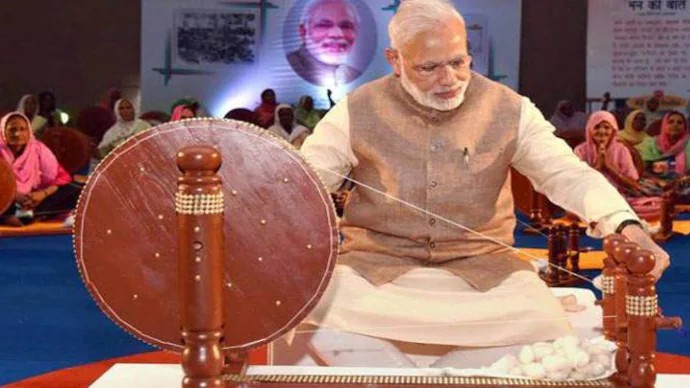
Prime Minister Narendra Modi did not treat khadi merely as a fabric; he presented it as a movement. Through his radio program Mann Ki Baat, he repeatedly encouraged citizens, especially the youth, to purchase and wear khadi. His message revolved around the idea of “Khadi for Nation, Khadi for Fashion, Khadi for Transformation.”
PM Modi himself became the biggest brand ambassador of khadi by consistently wearing it during public appearances. KVIC later launched exclusive designer collections such as the “Modi Jacket” and “Modi Kurta.”
The impact of this branding effort was immediate and dramatic.
Khadi textile production rose from ₹811 crore to ₹3,974 crore, marking an increase of nearly 390%. Sales of khadi textiles surged from ₹1,081 crore to ₹7,869 crore, representing a growth of over 628%.
Record growth over the years
The growth trajectory accelerated rapidly:
- FY2023-24: ₹1.40 lakh crore sales
- FY2024-25: ₹1.70 lakh crore sales
- FY2025-26: ₹1.87 lakh crore sales
A 501% increase in overall sales within just 12 years is no ordinary achievement.
Beyond fabric: Empowering rural industries
The impact of KVIC extends well beyond textiles. Under the Gramodyog Vikas Yojana, KVIC has distributed more than 3,23,006 machines, toolkits, and equipment pieces across rural India.
These include:
- 51,230 electric pottery wheels
- 2,674 automatic and pedal-operated incense stick making machines
- 2,46,099 bee boxes and bee colonies
- 7,669 footwear toolkits
- 836 paper plate machines
- 5,138 wooden toy-making machines
In FY2025-26 alone, 37,769 machines were distributed.
This ecosystem has also emerged as a major source of women’s empowerment. Out of the 79,682 people trained under KVIC programs during FY2025-26, around 47,382 participants — nearly 59% — were women. Khadi today is not merely a fabric; it has become a vehicle for financial independence and social empowerment for rural women.
Preserving India’s traditional skills
One of the most important aspects of khadi and village industries is their role in preserving India’s traditional craftsmanship.
These industries are not just sources of income; they are custodians of centuries-old skills passed down through generations. The art of weaving, pottery, handcrafted toy-making, and other rural crafts cannot simply be learned from books. Without local employment opportunities, many of these traditional skills would gradually disappear.
Initiatives like KVIC therefore serve a dual purpose: they create livelihoods while simultaneously preserving India’s cultural heritage for future generations. This makes local employment not only economically important but also culturally invaluable.
GI tags and global recognition
Several KVIC products have now received Geographical Indication (GI) tags. One example is Ponduru Khadi from Andhra Pradesh, famous for its ultra-fine hand-spun yarn, which received a GI tag in November 2025.
A GI tag signifies that a product’s identity is deeply connected to a specific geographical region and cannot be authentically replicated elsewhere.
PMEGP: Driving rural employment
Another major strength of KVIC is the Prime Minister’s Employment Generation Programme (PMEGP).
Under this scheme:
- 10,84,679 units have been established across India
- ₹80,705 crore worth of loans have been supported
- ₹29,623 crore has been provided as margin money subsidy
- Nearly 97.95 lakh people have gained employment
In FY2025-26 alone:
- 66,494 new units were established
- 7,31,434 new jobs were created
This expansion has directly improved artisan incomes. Spinners who earlier earned ₹4 per hank now earn approximately ₹15 per hank, representing a 275% increase in wages over 12 years.
Khadi goes global
KVIC is no longer focused solely on India; it now aims to establish khadi as a global symbol of sustainability and craftsmanship.
In March 2025, KVIC participated in Moscow Fashion Week, where designer Samant Chauhan showcased an all-white collection inspired by Fyodor Dostoevsky’s White Nights. The collection used cotton, wool, and Eri silk sourced from Uttar Pradesh, Rajasthan, Gujarat, Tamil Nadu, and Assam.
This was not just a fashion event — it was a statement that khadi represents sustainable luxury and handcrafted excellence on the global stage.
KVIC has also organized fashion shows in the UAE as part of its “Local to Global” campaign.
The road ahead: Digital and youth-centric
On May 26, 2026, KVIC Chairman Manoj Kumar announced that the organization’s target for FY2026-27 is ₹2.51 lakh crore in sales.
To achieve this, KVIC is preparing to launch a revamped, mobile-first e-commerce platform specifically designed for Gen Z consumers. The platform will feature high-resolution product displays, interactive “Shop the Look” experiences, and simplified checkout systems.
In many ways, the journey that began with Gandhi’s charkha has now reached the smartphone screen.
KVIC is also working on khadi denim products to connect with young consumers who prefer jeans and western-style fashion.
Conclusion
The story of KVIC is the story of India’s rural transformation. From Gandhi’s spinning wheel to international fashion runways, khadi has evolved into a symbol of sustainability, cultural pride, and economic empowerment.
Today, more than 2.04 crore people depend on this ecosystem for their livelihood. A 501% rise in sales, growing global recognition, and a strong digital push demonstrate what can happen when policy, branding, and political will work together.
KVIC’s journey proves that even from the soil of India’s villages, history can be created.

