
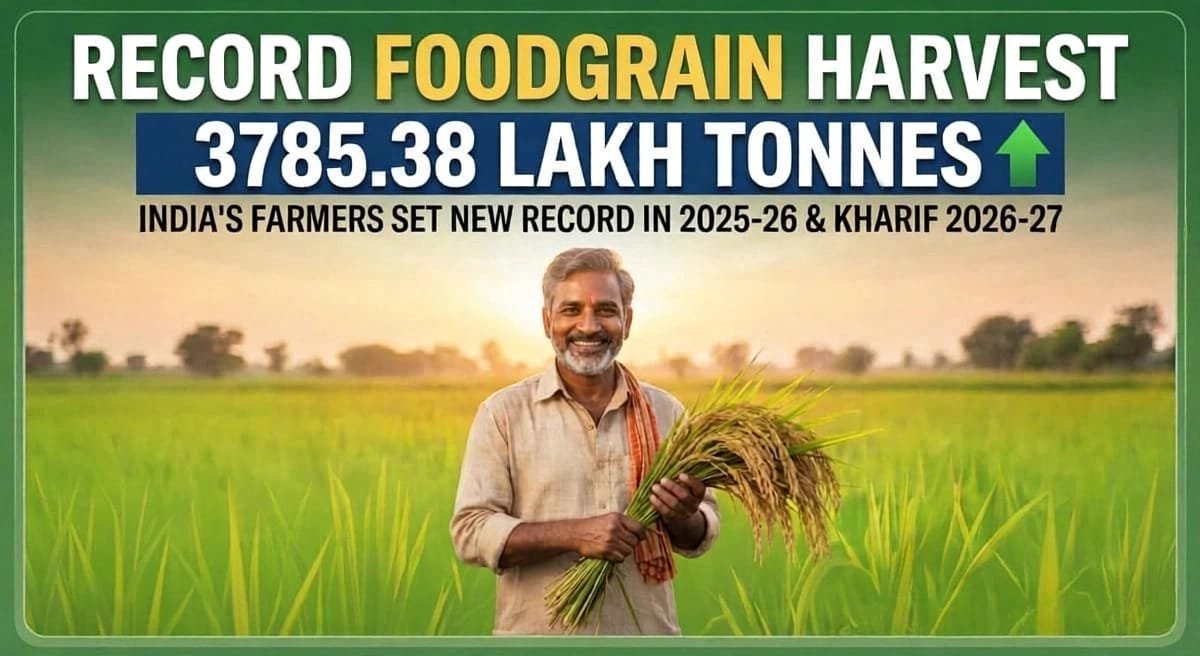
India’s farmers have set a fresh record. On 26 November 2026, Agriculture Minister Shivraj Singh Chouhan released final crop estimates for 2025-26 and first advance estimates for the 2026-27 kharif season. Total foodgrain production reached 3785.38 lakh tonnes, which is 208.06 lakh tonnes more than 3577.32 lakh tonnes in 2024-25. In simple words, more grain was grown than ever before, and every household that eats rice, roti or dal is linked to this success.
Rice and wheat led the rise. Rice touched a record 1551.54 lakh tonnes, up 49.70 lakh tonnes, while wheat reached 1220.64 lakh tonnes, up 41.19 lakh tonnes. Maize jumped from 434.09 to 550.25 lakh tonnes. Pulses rose to 272.40 lakh tonnes, with moong setting a record at 43.96 lakh tonnes. Oilseeds reached a historic 432.55 lakh tonnes, helped by record groundnut at 131.71 lakh tonnes and record rapeseed and mustard at 137.66 lakh tonnes. Sugarcane stood at 5037.29 lakh tonnes.
India also stands tall globally. It ranks first in rice, pulses, jute, millets and spices, and second in wheat, cotton, groundnut, fruits and vegetables. It is second in sugarcane after Brazil. Stocks of rice and wheat are adequate, and rice exports grew 5 per cent. Basmati reaches tables in the United States, Canada and Middle Eastern countries.
The weather made this year tough. El Niño returned, the June monsoon came late, and rainfall ran 35 to 40 per cent below normal. Low soil moisture and drought-like conditions hit Maharashtra, Karnataka, Telangana and Andhra Pradesh, affecting paddy, maize, tur, soybean and cotton sowing. Even so, kharif foodgrain production is estimated at 1671.43 lakh tonnes, which is 97.67 lakh tonnes above the five-year average. Government schemes and climate-resilient seed varieties from scientists supported this result.
Kharif details show where strength lies. Rice is estimated at 1219.05 lakh tonnes. Nutri-cereals and coarse cereals are projected at 381.05 lakh tonnes, including 260.64 lakh tonnes of maize and 89.43 lakh tonnes of bajra. Kharif pulses are pegged at 71.32 lakh tonnes, and kharif oilseeds at 239.47 lakh tonnes, with groundnut at 111.68 and soybean at 102.44 lakh tonnes. Sugarcane is projected at 4543.39 lakh tonnes, cotton at 248.66 lakh bales and jute and mesta at 97.06 lakh bales.
Attention now shifts beyond rice and wheat. Since stocks of these two are comfortable, focus is moving to crop diversification and self-reliance in pulses and edible oils, where domestic demand keeps climbing and imports remain a concern. National Pulses Mission and National Oilseeds Mission are running in mission mode, and the minister said results are already visible in final figures.
One caution matters. Kharif numbers are only first advance estimates. They will be revised after crop-cutting experiments record actual yields at harvest. Figures came from states and Union Territories, remote sensing, the weekly Crop Weather Watch Group, the Digital Crop Survey and the Digital General Crop Estimation Survey. Industry consultations were held, and data went through three-tier validation.[
Overall, the story is one of resilience to record harvests in a good year, and steady output in a difficult one. Whether pulses and oilseeds can cut import dependence will be the next big test for Indian agriculture.

